GMC 2026’s thematic sessions drew university leaders and international experts from the UNESCO Institute for Information Technologies in Education (IITE), the University of Ottawa (Canada), the University of Johannesburg (South Africa), Chulalongkorn University (Thailand), Queen Mary University of London (U.K.), Beijing University of Posts and Telecommunications (China), the London School of Economics and Political Science (U.K.) and Harvard University (U.S.).
    |
 |
|
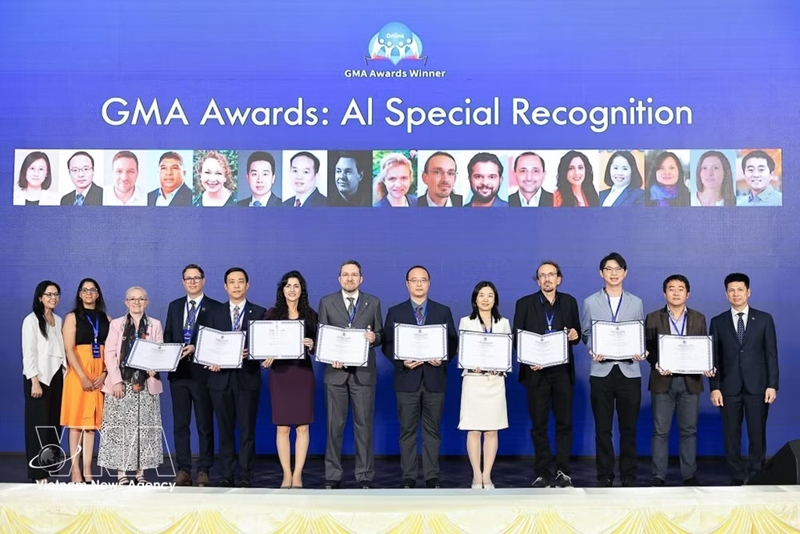
GMA Awards are presented honor outstanding AI courses at the Global MOOC & Online Education Conference 2026. |
Talks focused on reinventing the university model, governance and leadership in the AI era; building learner capacity, lifting education quality and creating learning ecosystems that keep pace with fast-moving technology.
Prof. Li Luming, President of China’s Tsinghua University and Chair of the Board of the Global MOOC and Online Education Alliance (GMA), pressed the concept of “redistribution of intelligence” as AI redraws the division of cognitive labor between humans and machines.
In his view, as AI explains knowledge, solves complex problems and supports research, human value increasingly lies in asking questions, thinking critically, verifying information and making responsible judgments. That pushes universities to move from knowledge transmission to learners’ independent thinking, problem solving and creativity.
A roundtable moderated by Assoc. Prof., Dr. Nghiem Xuan Huy, Director of the VNU-Ha Noi Institute of Quality Management and Assessment, focused on drawing the line between tasks AI can take on and the core values higher education must protect.
Panelists said AI can support knowledge delivery, information processing and personalized learning, but cannot replace teachers in building independent thinking, critical capacity, emotional intelligence and humanistic values. Universities therefore need to overhaul teaching, testing and assessment and redefine lecturers’ role in an AI-integrated environment.
Assoc. Prof., Dr. Tran Thanh Nam, Rector of VNU-Hanoi’s University of Education, said education must keep the core values of learning, especially intellectual effort, social connection and learner autonomy. Technology should help learners explore actively and build cognitive capacity rather than replace thinking. Digital education should be judged by learners’ substantive progress, not technology usage metrics alone.
A GMC 2026 highlight was an exhibition on smart education achievements, showcasing 39 models, products and initiatives from educational establishments and international organizations across five thematic groups.
The exhibition featured Tsinghua University, Fudan University and Shanghai Jiao Tong University (China), Nanyang Technological University (Singapore), Hong Kong University of Science and Technology (China), Chulalongkorn University (Thailand), Macquarie University (Australia) and the University of Johannesburg (South Africa), plus units under the VNU-Ha Noi.
The “Intelligence building foundations” group presented 10 models, products and initiatives for specialized AI, knowledge bases and education support platforms in engineering, energy, medicine, agriculture and social sciences.
The “Intelligence driving coexistence” group featured five initiatives on AI agents, situational learning and human-AI collaboration models aimed at personalized learning, problem-solving and thinking-capacity development.
The “Intelligence reshaping learning environments” group introduced five models for smart education platforms, digital learning ecosystems and future learning spaces.
The “Intelligence Promoting Integration and Innovation” group added eight initiatives applying AI in practical training, professional development, university-industry cooperation and testing and assessment reform.
Notably, the “Intelligence connecting the world” group showcased 11 courses and education initiatives under the GMA network, spanning computer science, AI, medicine, social sciences, foreign languages and professional development.
Within that group, the “English B1 on the LMS system” course from VNU-Ha Noi’s University of Languages and International Studies was presented as a flagship product and honored at the GMA Awards 2026.
This year’s awards drew 47 nominations from 30 educational establishments in 22 countries, judged by 30 experts from 17 countries. The VNU-Ha Noi course award recognizes work on digital learning materials, technology application and online training innovation.
Nam said VNU-Ha Noi will keep working with international partners to develop online courses in Vietnamese and English, pilot cross-border blended classrooms and push AI research in teaching, assessment and faculty development.
Source: VNA