The meeting was held ahead of the opening of the Global MOOC and Online Education Conference 2026 (GMC 2026), which is co-organized by the two universities in Ha Noi.
Appreciating the cooperation foundation established by the two institutions over the years, Chau expressed his hope that they will further leverage their strengths and expand specialized cooperation programs to deliver practical benefits to education and science – technology development in both countries.
    |
 |
|
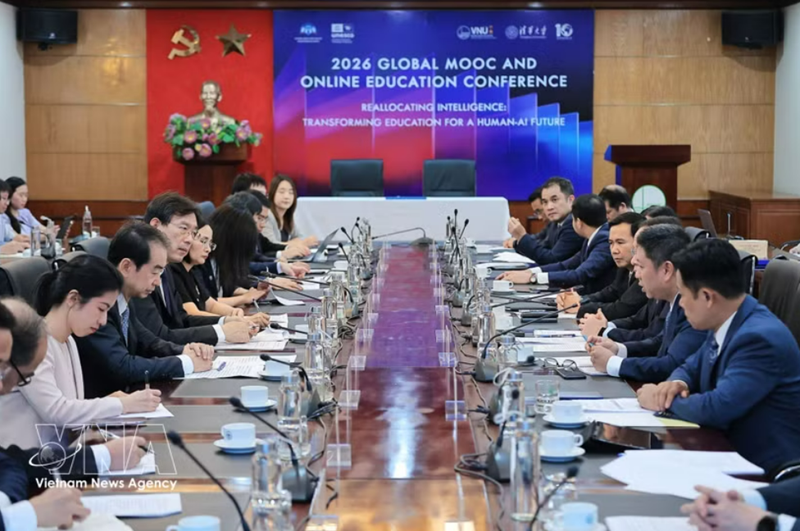
The meeting between Deputy Prime Minister Le Tien Chau with representatives of Viet Nam National University, Ha Noi (VNU) and China’s Tsinghua University in Ha Noi on November 3, 2026 |
The Deputy PM commended Tsinghua University’s experience in developing a research-oriented university, advancing science and technology and fostering innovation. He also praised the two universities’ efforts to strengthen their longstanding ties through academic exchanges, training, scientific research and cooperation in emerging technologies.
He said their co-hosting of GMC 2026 in Hanoi is timely as artificial intelligence (AI) reshapes higher education, providing a forum for scientists, experts and international education organizations to explore innovative solutions.
Stressing that education and training form a top national priority for Viet Nam, he underscored the importance of international cooperation in improving the quality of human resources, research capacity and innovation. He noted stronger links with leading research universities will create more learning and research opportunities and enhance the capacity of Vietnamese higher education institutions.
Suggesting cooperation directions, he asked Tsinghua University to expand opportunities for young officials and outstanding students of Viet Nam to study and conduct research in China. He also encouraged the two universities to develop specialized training and research programs, establish joint research groups and laboratories, carry out joint projects and publications, and step up exchanges of lecturers, scientists and students through both in-person and online formats.
Chau also called for greater cooperation in technology transfer and research result commercialization, encouraging Tsinghua to share its experience in developing innovation ecosystems and applying research findings to address practical needs.
|
|
 |
|
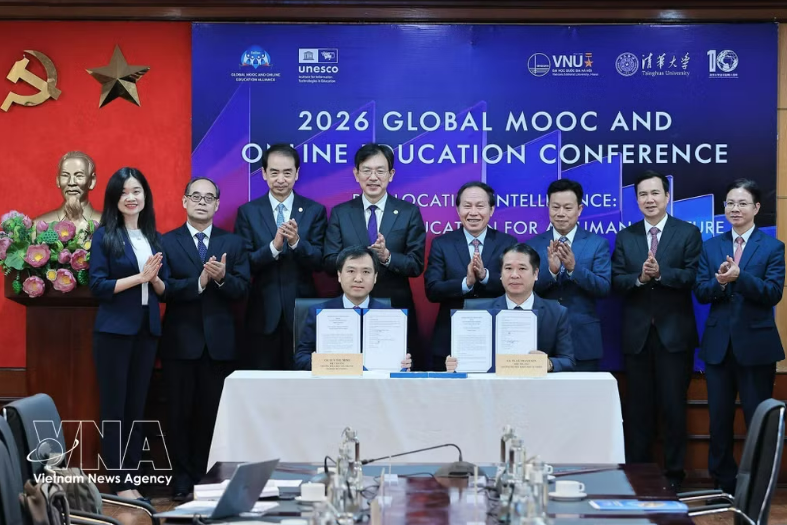
VNU University of Science and Tsinghua's School of Environment sign a memorandum of understanding on cooperation in training, scientific research and sustainable development. |
President of Tsinghua University Li Luming, for his part, affirmed the importance both countries attach to higher education and talent development, noting that university cooperation is essential to sharing experience, connecting resources and adapting to new requirements amid AI-driven changes in teaching, learning and research.
He said Tsinghua will expand study and research opportunities for Vietnamese students and scientists, including increasing enrolment quotas and scholarships. In 2026, the Chinese university admitted 27 Vietnamese undergraduates and more than 60 postgraduate students and doctoral candidates.
The two sides have considerable potential for further cooperation, Li said, affirming Tsinghua University’s readiness to step up exchanges of lecturers and students, host scientists for research and work, and share experience in organizing research, developing technology and commercializing scientific achievements.
On the occasion, VNU University of Science and Tsinghua's School of Environment signed a memorandum of understanding on cooperation in training, scientific research and sustainable development.
The MoU provides for exchanges of around five students and one to two lecturers annually, as well as one to two visiting scholars from each side.
Priority areas include environmental science and engineering, environmental health, green technology and sustainable development. The two sides will also develop joint research proposals and seek funding from domestic, regional and international science and technology programs.
Source: VNA