Major NGUYEN DUY KHANH, Deputy Political Commissar of Vang Ma Chai Border Station, Lai Chau Provincial Border Guard Command
The responses from the Prime Minister and leaders of ministries and sectors have helped me and many other young people gain a clearer understanding of the orientations, mechanisms, and policies aimed at promoting the role of youth in national construction and defense, particularly in mastering science and technology, innovation, and digital transformation.
As a border officer serving in the border area of Lai Chau province, my greatest concern is how to create conditions for young officers to fully develop their capabilities and apply their knowledge and technology to addressing practical challenges, while ensuring that people in border areas are not left behind in the digital transformation process.
For the border guard force, patriotism is also demonstrated through practical efforts to help local residents improve their living standards, access knowledge, and develop their homeland. I hope the Government will continue to provide support and favorable conditions for military youth, particularly young border guards, to promote their pioneering and creative spirit and master science, technology, and digital transformation.
In border areas, I hope the State will continue to invest in digital infrastructure and equipment, while stepping up digital skills training for ethnic minority communities. These efforts will help residents gradually access and master technology, develop their economies, and improve their living standards, thereby strengthening the posture of people’s heart and joining the border guard force in firmly safeguarding national territorial sovereignty and border security.
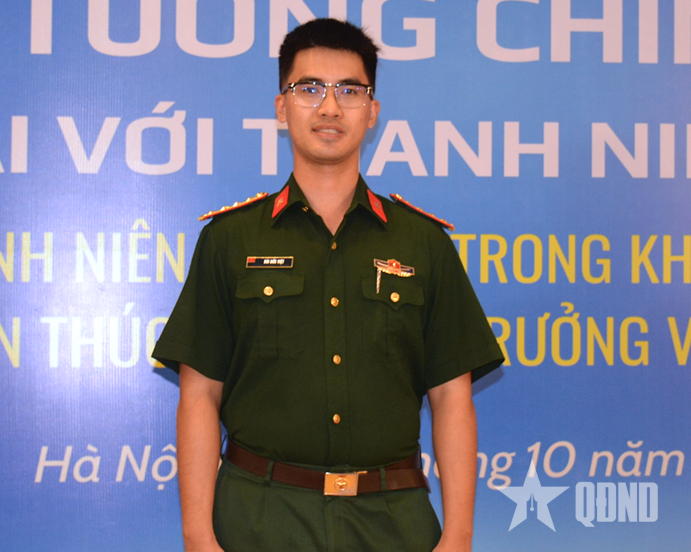
Senior Captain BUI DUC VIET, PhD, Researcher at the Institute of Information and Communications Technology, Military Technical Academy
    |
 |
|
Senior Captain Bui Duc Viet |
What moved me most was the Prime Minister's direct assignment to the Ho Chi Minh Communist Youth Union Central Committee and the Ministry of Science and Technology to establish mechanisms enabling capable young scientists and engineers to take on challenges, propose, and lead the development of strategic technologies and products. The Prime Minister also called for the issuance of a list of strategic technologies to be commissioned from young scientists, along with policies to develop young talents in emerging fields such as AI, aerospace, and nuclear energy. To me, these were not only words of encouragement, but also a clear expression of trust and responsibility entrusted to the next generation of young scientists.
As a young military researcher, I hope the Government will continue to remove institutional bottlenecks in scientific research in the coming time, including through flexible pilot mechanisms and risk-based management that accepts delays and even failures in research, allowing scientists to focus on their core mission of innovation. I also hope the Government will invest in shared computing infrastructure and develop secure, open data resources, enabling young research teams, including those in the military, to master core technologies without relying on external sources.
Captain HOANG KHAC HIEU, Head of Development Division 2, Government Solutions Center, Viettel Solutions, Viettel Group
For military youth, science, technology, and innovation today represent both an opportunity and a major responsibility. In my view, young military personnel should pro-actively acquire new knowledge, particularly in AI, big data, information security, automation, and digital technologies. More importantly, they must be able to combine technological expertise with an in-depth understanding of military and national defense missions to develop genuinely useful, highly applicable solutions that meet practical requirements.
Through my work at Viettel, I have come to realize that Viet Nam has many talented young engineers with strong aspirations. The key is to channel their capabilities into addressing the country's major challenges and create opportunities for them to directly participate in researching and developing valuable technological products. I hope that more "Make in Viet Nam" products and solutions, researched, designed, and developed by Vietnamese youth themselves, will be used in the military, helping enhance technological self-reliance and reduce dependence on foreign technologies.
TO KHANH DUNG, Data Analytics cadet, Computer Science Department, Company 157, Military Technical Academy
The discussions and responses from the Prime Minister and leaders of ministries and sectors during the dialogue have helped young people better understand the State's orientations, policies, and guidelines for the younger generation, particularly in education, human resource development, digital transformation, and innovation. I hope the orientations and solutions discussed at the event will continue to be translated into practical policies, creating more opportunities for young people to access knowledge, promote initiatives, and develop their capabilities. For military youth, this will help create favorable conditions for them to improve their scientific and technological expertise, meeting the requirements of building a revolutionary, regular, elite, and modern military and fulfilling the mission of Fatherland protection in the new situation.
In my opinion, defending and building the Fatherland are the responsibility of military youth in today's technological era. Especially, amidst the rapid pace of digital transformation, military youth should take the lead in learning, scientific research, innovation, and mastering science and technology.
From the perspective of a data analytics cadet, I have recognized that data is increasingly becoming an important resource. When properly collected, processed, and analyzed, data can help identify trends, improve forecasting, support management, and enable more effective decision-making. Therefore, equipping the younger generation with knowledge of data analytics, AI, information security, and relevant digital technologies is essential. By mastering knowledge and technology and promoting their creative spirit, military youth will not only contribute to building a revolutionary, regular, elite, and modern military, but also help develop a high-quality workforce for the country.
Translated by Quynh Oanh