The program integrates three national target programs into a unified framework designed to modernize rural areas, narrow development gaps, and ensure that ethnic and mountainous communities benefit from inclusive growth. It also marks one of the most ambitious social-development commitments of the coming decade, with State budget resources of about 423 trillion VND (16.05 billion USD) allocated for 2026-2030 alone.
    |
 |
|
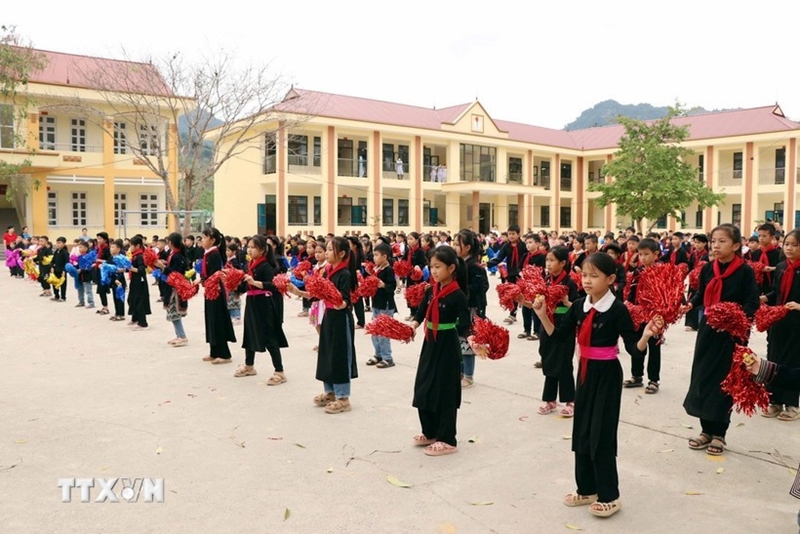
Students at Linh Phu Primary and Secondary Boarding School for Ethnic Minorities |
According to the resolution, the program aims to build prosperous, sustainable and climate-resilient new-style rural areas closely linked with urbanization. It seeks to promote comprehensive development in ethnic-minority and mountainous regions; ensure multidimensional, inclusive and sustainable poverty reduction; advance gender equality and social welfare; and foster a green, circular and ecological rural economy aligned with agricultural restructuring.
The overarching goal is to improve incomes, living standards and overall well-being while narrowing regional disparities, particularly between ethnic areas and the national average. The program also emphasizes preserving cultural identities, strengthening national unity, and ensuring national defense, security and social order, especially in strategic, border and island areas.
Ambitious targets for 2030 and 2035
By 2030, Vietnam aims to raise average rural incomes to 2.5 - 3 times higher than the 2020 level, while incomes of ethnic people are targeted to reach at least half of the national average. The multidimensional poverty rate is expected to decline by 1% - 1.5% annually nationwide, and fall below 10% in ethnic and mountainous areas. The country strives to eliminate extremely difficult communes and villages in these regions, and to have about 65% of communes nationwide meet new-style rural standards, including 10% meeting modern rural standards. Five provinces or centrally-run cities are expected to be recognized as having completed new-style rural development tasks.
By 2035, per capita income in rural areas is targeted to increase at least 1.6 times from 2030, with incomes in ethnic areas continuing to reach at least half the national average. The national multidimensional poverty rate will continue to decline by 1 - 1.5 percentage points annually under the 2031-2035 poverty standards. The country aims to reduce by at least half the number of difficult communes and villages in ethnic and mountainous regions, and for five provinces in these regions to have no remaining difficult communes. Around 85% of communes are expected to meet new-style rural standards, 30% of them recognized as modern new-style rural communes, and at least 10 provinces meeting new-style rural development tasks, including five achieving modern new-style rural status.
Significant financial commitment
The program will be implemented nationwide from 2026 to 2035, with priority given to extremely difficult villages and communes, ethnic and mountainous regions, former revolutionary bases, border areas and islands. Beneficiaries include local communities, cooperatives, enterprises and especially poor, near-poor and recently-escaped-poverty households.
For 2026-2030, the State budget will provide about 423 trillion VND, including 100 trillion VND from the central budget (70 trillion VND for development investment and 30 trillion VND for recurrent spending), 300 trillion VND from local budgets, and 23 trillion VND from policy credit sources.
The Government will continue to allocate additional central budget resources, including social policy credit funds, depending on real-world conditions to ensure that the program’s targets and tasks are fully funded. Based on outcomes achieved in the 2026-2030 phase, the Government will submit to the N.A. the required funding for the 2031-2035 period.
Source: VNA