At a meeting on September 29, the Deputy PM asked the Ministry of Science and Technology and relevant agencies to review all key laboratories that have been operating for 10-15 years, identifying those requiring further investment, upgrading, shared use or other solutions.
    |
 |
|
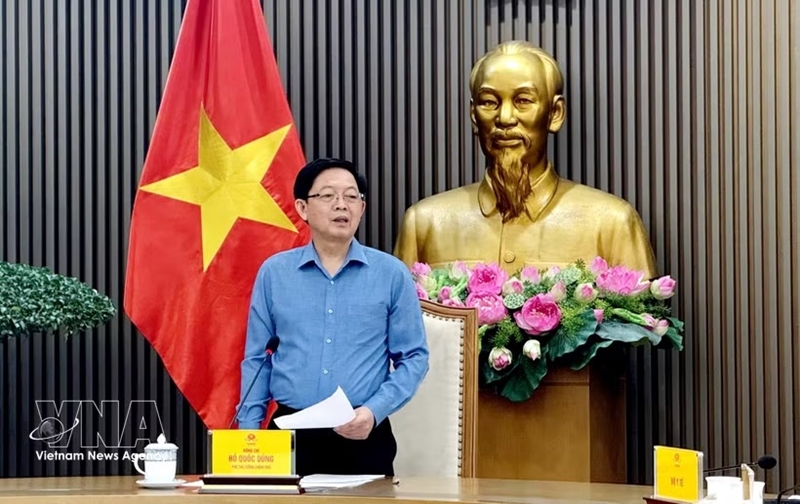
Deputy Prime Minister Ho Quoc Dung speaks at the meeting. |
Taking note of the opinions raised at the meeting, Dung asked the Ministry of Science and Technology and relevant ministries and agencies to review and remove bottlenecks in the science and technology market, and explore ways to directly connect research institutes and universities with businesses to identify needs and supply capacity and jointly address challenges in translating research results into production and business.
He asked for a fundamental shift from fragmented, separate investment to the development of shared research infrastructure, forming a complete chain from research and prototype development to testing, measurement, certification, pilot production and commercialization.
Specific plans and roadmaps must be developed to achieve the targets set for 2030 under Decision No.1483/QD-TTg, with priority projects selected for focused implementation and emerging obstacles promptly addressed, he stressed.
Research institutes, universities, scientists and businesses should be given easier and more transparent access to shared research infrastructure, while autonomy should be linked with responsibility and output efficiency, he said.
The Ministry of Science and Technology was tasked with coordinating with ministries, sectors and localities to build a database and capacity map of laboratories and research and testing centers nationwide by November 2026, and assess the capacity of each facility.
The ministry, together with the Ministry of Finance, must also review problems related to investment, procurement, maintenance and operation, ensuring financial mechanisms cover the entire equipment lifecycle, from initial investment to operation, maintenance, repair and upgrading.
The Deputy PM also asked for appropriate governance and operation models for different types of laboratories and research and testing centers, with clear responsibilities for asset management, human resources, operation and shared use.
He stressed that basic research must be distinguished from applied research and activities aimed at commercialisation, and that financial and evaluation mechanisms for basic research should not mechanically require annual output products.
According to a report presented by Deputy Minister of Science and Technology Le Xuan Dinh at the meeting, a survey of 113 key facilities at 23 major institutions found nearly 1,200 specialised staff, more than 5,500 scientific publications over the past five years and 622 service and technology transfer contracts.
However, the system faces fragmented infrastructure and ageing equipment. Among 16 national key laboratories invested in during 2000-2013 with total funding of more than 966 billion VND (37.19 million USD), 78% of equipment is over 10 years old.
Decision No.1483/QD-TTg, dated August 4, 2026, sets a target of upgrading, newly investing in and putting into operation at least eight national key laboratories and four research and testing centres by 2030, focusing on strategic technologies.
A delegate from the Ministry of National Defense proposed closer inter-agency coordination to expedite the implementation of identified schemes and projects, while developing sector-specific databases and connecting them to the shared system coordinated by the Ministry of Science and Technology to prevent overlapping investment and resource waste.
Source: VNA