Harnessing young talents and community resources
After studying and gaining experience in different environments, some young people choose to return to their hometowns to build careers and contribute to local development.
    |
 |
|
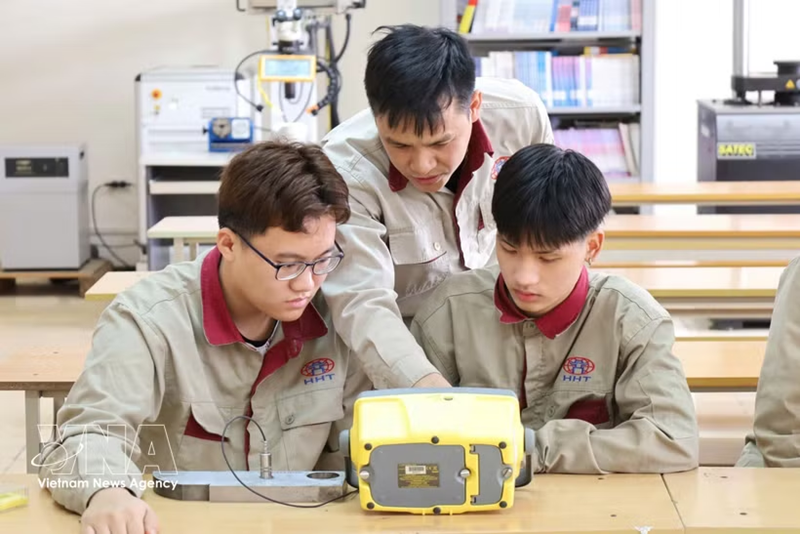
Students from the Faculty of Mechanical Engineering Technology at Ha Noi College of High Technology engage in a practice session. |
At Chang Son paper fan-making village, Nguyen Thanh Long returned to his family business after earning a degree in economics and gaining experience in private business. Working with his family, he has introduced mechanization into production and used social media to expand the market. From a workshop that had almost no orders, the business now produces around 1,000–1,500 fans a day. New designs tailored to changing consumer tastes have also opened up fresh markets for traditional handicrafts.
Le Cong Thanh, founder of Information Retrieval (InfoRe) Technology Joint Stock Company and "Binh Dan Hoc AI" (AI literacy) Community, has brought new technology knowledge to his hometown of Ha Mo village, O Dien commune, through the “Dong ho hoc AI” (Families learning AI) program. Developed in response to residents’ interest in artificial intelligence (AI), the initiative helps people of different ages learn to use AI tools and apply them in daily life and work. Participants also share knowledge, with some already using AI to develop online sales channels and improve business processes.
Le Anh Tuan from the Ha Noi Center for Employment Services and Youth Support, founding chairman of "Huong nghiep" (Career guidance) 360 ecosystem, said young people now have increasingly diverse choices in building careers and contributing to society. Their contribution should not be measured solely by whether they return to their hometowns, but also by how effectively they apply their knowledge and experience to create value for communities.
He stressed the importance of helping young people develop a “readiness to work” from an early age, understand their abilities and labor market requirements, and identify suitable employment opportunities.
Linking training with Ha Noi’s practical development needs
The need to harness young talents is becoming more pressing as AI, automation and digital transformation rapidly reshape the labor market. According to the Ministry of Home Affairs, the youth unemployment rate among people aged 15–24 stood at 9.07% nationwide in the third quarter of 2026, while around 1.6 million young people were not in employment, education or training. One key reason is the mismatch between training programs and actual labor market demand.
At a recent dialogue with young people on their role in entrepreneurship and innovation, Prime Minister Le Minh Hung called on localities to identify development challenges and invite young intellectuals and businesses to help address them.
Bui Quang Huy, First Secretary of the Ho Chi Minh Communist Youth Union Central Committee, also proposed shifting from theory-based competitions to practical assignments linked to the application of solutions.
For Ha Noi, this approach will enable young people to contribute directly to urban management, public services and business innovation. Ha Noi University of Science and Technology introduced a cooperation model linking education, research, and industry, featuring an interdisciplinary innovation space developed in partnership with GELEXIMCO Group. Based on the Design Factory model, the center brings students, lecturers, experts and businesses together to develop products, from identifying problems and designing prototypes to testing and commercialization.
Ha Noi aims to create around 171,000 new jobs in 2026, with 75.8% of its workforce receiving training and 55.5% holding degrees or certificates. The city is also working to improve labor market connectivity, develop high-quality human resources and attract talented people, particularly in digital and green economic sectors.
Experts called for closer involvement with employers in designing training programs, organizing internships and assessing professional skills. Career guidance should be more closely linked to actual job opportunities and community needs, with the Youth Unions and local authorities serving as bridges between young people and organizations seeking solutions.
Attracting talents is not simply about bringing skilled workers to Ha Noi. It is about creating effective connections between people with knowledge and the organizations and communities that need it. With training aligned with employment demand and more opportunities to apply knowledge in practice, young people can make a tangible contribution to the capital’s sustainable development.
Source: VNA