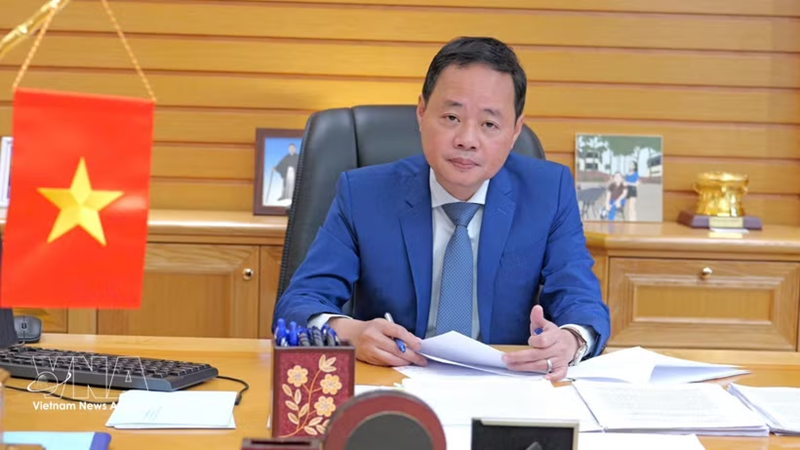
Speaking to the Vietnam News Agency (VNA) ahead of General Secretary of the Communist Party of Viet Nam Central Committee and President To Lam’s state visit to Russia at the invitation of President Vladimir Putin, Thai highlighted the long-standing scientific ties between the two countries and pointed out priorities for future cooperation.
    |
 |
|
Prof., Dr. Tran Hong Thai, President of the Viet Nam Academy of Science and Technology (VAST) |
The former Soviet Union and Russia at present have made huge contribution to building Viet Nam’s scientific workforce and research capacity in fundamental sci-tech fields, he noted.
He also highlighted the longstanding ties between the Viet Nam Academy of Science, the predecessor of VAST, and the Academy of Sciences of the Soviet Union, which was established in the 1970s. After 1991, the relationship continued with the Russian Academy of Sciences and has been further strengthened through a series of cooperation agreements.
In the early stages, Russia provided substantial support to the Vietnamese academy in training scientific personnel, laboratory development and research in fields in mathematics, mechanics, materials science, chemistry, Earth sciences, biology, resource ecology, biotechnology and marine science.
According to the expert, a notable example is marine research cooperation, under which the two sides conducted nine joint research voyages aboard the Akademik Oparin in Vietnamese waters from 2005-2025. In 2025, they agreed on a new marine research cooperation roadmap for 2026-2035. This clearly demonstrates the effectiveness and comprehensive nature of substantive Viet Nam-Russia scientific cooperation.
Viet Nam’s participation in the Joint Institute for Nuclear Research (JINR) in Dubna, Russia, since 1956 has also helped train generations of scientists. Nearly 50 Vietnamese researchers currently work there in areas including nuclear physics, neutron research, radiation-resistant materials, nuclear medicine and accelerator technology, providing valuable human resources for Viet Nam’s nuclear energy development for peaceful purposes.
He highlighted Russia’s contribution to Vietnamese science, from laying the foundations for basic research and building a core scientific workforce, to giving Vietnamese scientists access to Russia’s advanced science and strategic technologies. More recently, the relationship has evolved from one centered on support towards an equal partnership, with the two sides jointly conducting research, pooling resources, generating knowledge and developing new technologies.
The most enduring value of Viet Nam-Russia cooperation lies in the scientific capacity accumulated and passed down through generations, enabling Viet Nam to gradually build its own research and technological capabilities on the foundation of international cooperation, he stressed.
Regarding areas where Russia could become a particularly important partner in helping Viet Nam strengthen its scientific and technological self-reliance, Thai said scientific and technological self-reliance should not mean doing everything independently, but rather mastering technology principles, design, system integration, operation, maintenance, improvement, and the training of future experts.
Against this backdrop, he identified nuclear physics and peaceful nuclear energy; new energy and advanced energy systems including hydrogen and energy storage, quantum and foundational digital technologies, space technology and small satellites, remote sensing, UAVs, autonomous systems, and advanced materials as promising areas for deeper cooperation.
He stressed that cooperation should shift from personnel exchanges, workshops and individual research projects to joint technology development, through shared laboratories and research groups in Viet Nam, long-term co-funded programs focused on specific technological challenges, “train-the-trainer” models and early participation by businesses to build a full chain from research and prototyping to testing, production and commercialization.
Looking ahead, VAST will adopt a “cooperation by problem” approach, matching Russian expertise with Viet Nam’s major development needs, including energy security, peaceful nuclear technology, marine and environmental monitoring, disaster and climate-change response, new materials, quantum technology, space and biotechnology.
The Year of Russia – Viet Nam Science and Education Cooperation 2026 provides a favorable framework for expanding cooperation into larger, strategically oriented programs, he said.
VAST will prioritize several long-term flagship projects with measurable outcomes, such as mastered technologies, pilot systems, national databases, joint laboratories and teams of Vietnamese experts capable of continuing technological development after projects conclude, the expert said.
Thai emphasized that future programs must place greater weight on human-resource development and technology ownership. Their success should be measured not by the number of memoranda or workshops, but by the technologies mastered, level of localization, intellectual property generated, practical applications and, most importantly, the capacity of Vietnamese scientists to further develop the technologies independently.
With decades of cooperation, mutual trust and complementary strengths, Viet Nam and Russia have favorable conditions to build a more substantive, selective and strategically focused new phase of science and technology cooperation, he said.
Source: VNA