She affirmed that Vietnam has put in place a comprehensive and coherent policy framework to encourage and create the most favorable conditions for women to fully exercise equal rights in political, economic, cultural and social spheres.
    |
 |
|
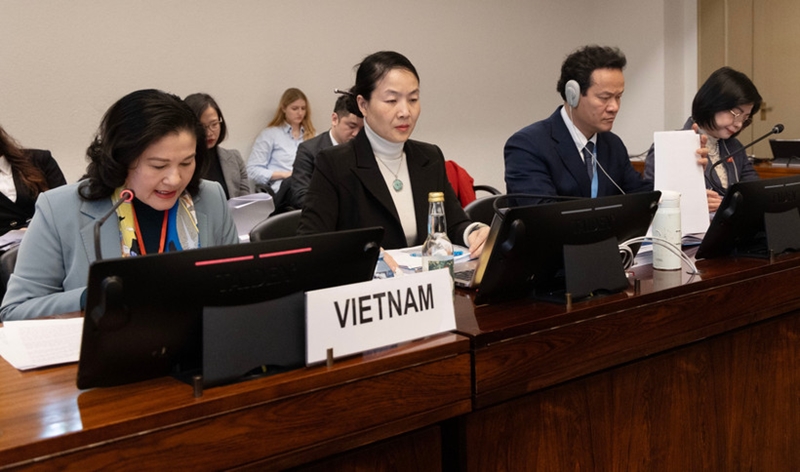
Deputy Minister of Home Affairs Nguyen Thi Ha (first from left) at the dialogue session on the country’s ninth national report on the implementation of the Convention on the Elimination of All Forms of Discrimination against Women. |
A notable highlight of Vietnam’s latest report is the concrete implementation of constitutional principles through progressive legislation. These include the 2019 Labor Code, which contains advanced provisions promoting substantive gender equality; the 2024 Law on Social Insurance, expanding social security coverage for women; and the 2024 Land Law, marking significant progress in gender-sensitive asset management. In particular, the 2022 Law on the Prevention and Control of Domestic Violence represents a fundamental shift in approach by placing victims at the center, with a focus on groups most affected, especially women and girls. In addition, the 2017 Law on Legal Aid has broadened access to free legal support for disadvantaged women, ranging from those in poor households and ethnic minorities in extremely difficult areas to victims of domestic violence and human trafficking.
Gender mainstreaming is not confined to social policies but has extended into economic and governance domains. The 2025 State Budget Law affirms the requirement to ensure gender considerations in the allocation of national resources; the 2017 Law on Support for Small- and Medium-sized Enterprises guarantees equal business opportunities while prioritizing resources for women-led enterprises or those employing large numbers of female workers; and the 2025 Population Law marks an important shift towards a human rights-based approach that promotes women’s autonomy and decision-making.
Alongside the consolidation of the legal framework, the Vietnamese Government has issued and implemented in a coordinated manner strategies and action programs on gender equality aimed at empowering women. These policies not only set clear objectives but also strengthen inter-sectoral coordination mechanisms, optimize resources and clarify implementation responsibilities, thereby creating a solid foundation for women to access and benefit fairly from social achievements.
These sustained domestic efforts have yielded tangible results, helping Vietnam to consolidate its standing on the international stage. According to the Global Gender Gap Report 2025, Vietnam rose to 74th place out of 148 countries, an increase of nine positions compared to 2022. This recognition is particularly significant as the country is currently serving as a member of the Executive Board of U.N. Women for the 2025-2027 term.
In her closing remarks, Ha stressed that the documents of the 14th National Congress of the Communist Party of Vietnam serve as a lodestar defining the strategic vision for a new development phase, in which the goal of building a prosperous nation is closely linked with a foundation of social equity and progress. The congress reaffirmed the priority of developing female human resources and increasing women’s participation in leadership bodies at all levels, viewing this as an important political commitment by the Party and State to remove remaining barriers in society.
On behalf of the Vietnamese Government, the head of the Vietnamese delegation expressed serious consideration of the Committee on the Elimination of Discrimination against Women’s concerns and recommendations on emerging challenges such as gender stereotypes, sex ratio imbalance at birth, and the rights of disadvantaged women in the digital era.
Demonstrating a constructive and substantive commitment, the Vietnamese delegation announced a three-step roadmap following the dialogue: reporting comprehensively to the Government to integrate outcomes into the action program for implementing the Resolution of the 14th National Party Congress; urgently developing a national action plan with commensurate financial resources; and continuing to refine a gender-responsive legal system.
Vietnam remains steadfast in its goal of building a prosperous, strong, democratic, equitable and civilized society, where all women have the opportunity to fully realize their creative potential and contribute to the country’s sustainable development, she stressed.
Source: VNA