The meeting saw the presence of Prime Minister Le Minh Hung; Permanent member of the Party Central Committee's Secretariat Tran Cam Tu, who is also head of the steering committee; other Politburo members; members of the Party Central Committee and its Secretariat; along with officials of ministries, sectors and central agencies.
Citing the Politburo’s Resolution 80 on developing Vietnamese culture, General Secretary and President To Lam said culture must no longer be treated as just another development sector but must become society’s spiritual foundation. He pushed for a shift from a focus on traditional spaces to cultivating culture in both physical and digital spaces, and from simply prioritizing preservation to striking a close balance between preservation with innovation.
    |
 |
|
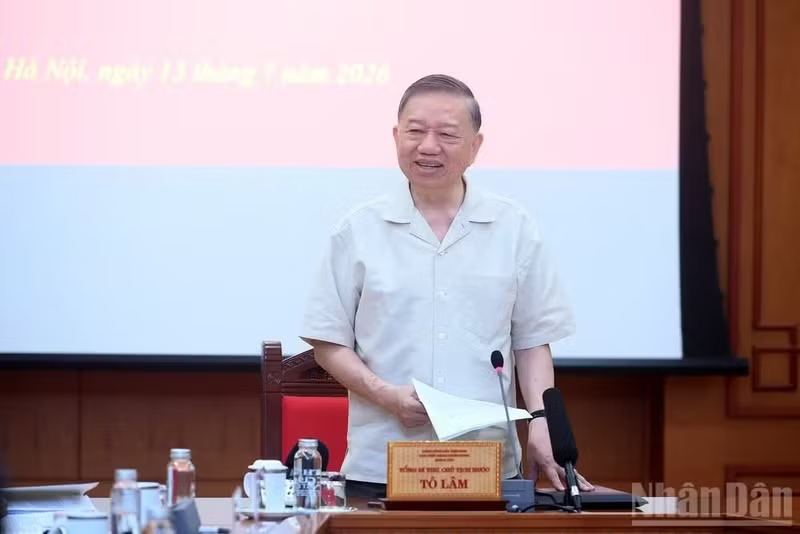
Party General Secretary and State President To Lam speaks at the second session of the Central Steering Committee for Vietnamese culture development in Ha Noi on July 13. (Photo: nhandan.vn) |
To lay the groundwork for cultural development in the coming years, he directed the committee to press ahead with institutional reforms from the second half onward, aiming to unleash society’s creative potential and pool resources for cultural development more efficiently.
The leader also ordered a review and update of all cultural development strategies, master plans and agendas to meet the demands of a new era, singling out the Vietnam Cultural Development Strategy to 2035, with a vision to 2045, as a priority, to ensure cultural development goes hand in hand with socio-economic progress. He requested greater engagement of the public, including communities, businesses, and social organizations, as well as stronger mobilization of state and non-state resources, to develop an advanced Vietnamese culture deeply imbued with national identity and having strong competitiveness and spillover effects in the new era.
Strengthening cultural sovereignty in the digital space is now essential to sharpen the appeal, reach and protection of Vietnam’s cultural values, he said.
He tasked the Government Party Committee with building and launching a national digital cultural space scheme and refining policies that back digital platforms, communication channels and content ecosystems rooted in Vietnamese identity. It was also told to set up partnerships among the State, businesses, social organizations and creative communities to produce and distribute quality and attractive cultural products that can compete in the digital environment.
Targeted commissioning and investment mechanisms should be put in place for artistic and cultural works of high artistic merit, broad public appeal, educational value and the potential to compete for international recognition, he said.
The Party Central Committee’s Commission for Information, Education and Mass Mobilization was ordered to work with relevant agencies to raise public awareness of Vietnamese cultural values, and modernize communications, especially on digital platforms, so that the country’s national, cultural and family values and standards of conduct resonate more directly with the public, particularly the youth.
The Central Steering Committee must conduct regular reviews in which success is measured not only by the volume of cultural content digitized but by whether the public actually recognizes and embraces it, with the goal of building a healthy digital cultural environment by 2030, he said.
The leader called for turning cultural heritage and cultural capital into knowledge, intellectual property, creative products and resources for education, science – technology, cultural industries and innovation. Resolution 80 sets a target of digitizing all nationally recognized and specially designated national cultural heritage elements.
Heritage data must be standardized, traceable and searchable, with interoperability that allows sharing and reuse. Rather than sitting in closed databases, such data should power governance, education, research, tourism, cultural industries and artificial intelligence development, beginning with the creation of core data sets, he said.
According to him, each key locality should focus on only a limited set of priority sectors and no more than three flagship projects, each with clearly defined products, enterprises, financing, target markets, intellectual property outputs and expected contribution to gross regional economic growth, employment, exports or tourism.
General Secretary and President To Lam concluded by urging relevant agencies to sustain a strong sense of responsibility and rapidly translate Resolution 80 into concrete action, aiming to make culture a genuine spiritual foundation, a source of internal strength and a key driver of Vietnam’s development in the new era.
Source: VNA