Presenting the Government’s proposals on the two projects, Minister of Construction Tran Hong Minh said the proposed Ring Road 5 project aims to develop a modern expressway belt linking Hanoi with surrounding provinces, urban centers, industrial parks and logistics hubs. The project is expected to meet growing transport demand, expand development space, stimulate socio-economic growth, strengthen defense and security, and ease traffic congestion and environmental pressure.
    |
 |
|
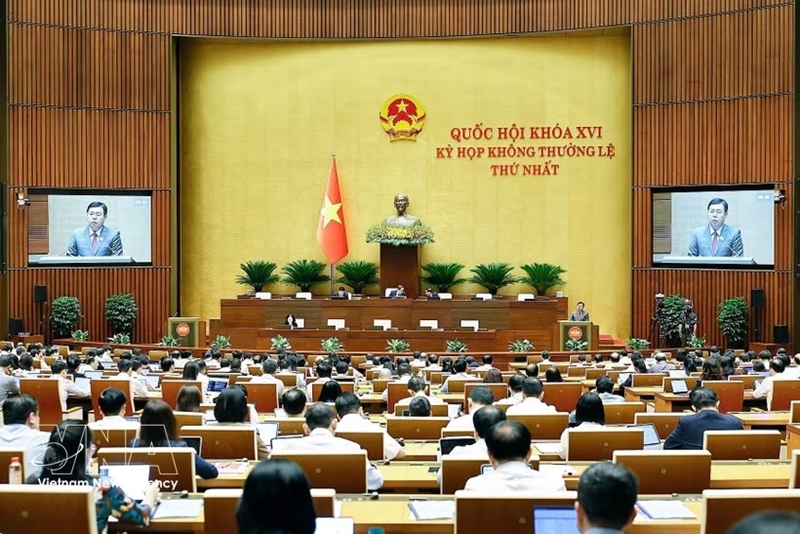
An overview of the discussion on August 6 |
The planned route will stretch 349 kilometers across seven localities. The main expressway will have six lanes, designed for speeds of 100–120 km per hour, while parallel roads will have at least two lanes with design speeds of 60–80 km per hour.
The Government has proposed funding the project initially through public investment, with toll collection after completion following the model used for the eastern North–South Expressway. During the feasibility study stage, authorities will continue assessing the possibility of implementing the project under a public-private partnership (PPP) model.
The preliminary investment cost is estimated at 288.268 trillion VND (about 11 billion USD). Of this, 215.192 trillion VND will come from the central budget for the main expressway, while 73.076 trillion VND from local budgets will fund the parallel roads.
Preparatory work is scheduled to begin in 2026, with construction starting in 2027 and the main sections expected to be substantially completed by 2030. Remaining sections will continue to mobilize funding during the 2026–2030 period, with the goal of completing the entire route before 2035.
According to the minister, assessments show that the route will also provide a strategic transport corridor in emergency situations, supporting the integration of economic development with national defense and security.
The Government proposed 10 special policy mechanisms for the project, including eight measures already approved by the National Assembly for other nationally significant projects, along with two additional mechanisms covering compensation and support for enterprises affected by land acquisition and the authority to change the investment model.
Regarding the Lao Cai - Hanoi - Hai Phong railway, the Government proposed adding an 8.4-kilometre Yen Vien - Gia Lam section and relocating the northern passenger hub from Yen Vien to Gia Lam to align with Hanoi’s master plan and the revised national railway development plan.
The proposal also redesignates the Nam Hai Phong - Lach Huyen section from a main line to a branch line to better reflect the revised railway network planning and transport operations. Two new branch lines linking the existing railway network to stations on the Lao Cai - Hanoi - Hai Phong route would also be added.
In addition, the section between Bac Hong and Nam Hai Phong stations will be upgraded from a single-track phased investment to a fully double-track system.
The Government also proposed changing the traction system for branch lines serving seaports. Instead of electric traction, the branches would initially use diesel locomotives already included in the approved investment plan, with a transition to clean-energy locomotives expected by 2045.
Presenting the verification report, Chairman of the National Assembly’s Committee for Economic and Financial Affairs Phan Van Mai said the Ring Road 5 project meets the criteria for a nationally significant project, with documentation broadly satisfying legal requirements and offering strong potential to enhance regional connectivity.
The committee called for further clarification of the project’s links with other major transport schemes under implementation and a comprehensive assessment of the regional transport network’s overall efficiency.
Given that the project comprises 22 component sub-projects, the committee also requested clearer assignment of responsibilities, particularly regarding coordination mechanisms, implementation milestones and measures to address delays.
While the preliminary investment cost stands at 288.268 trillion VND, only 59.7 trillion VND, equivalent to 27.7% of the required central budget funding, is expected to be allocated during the 2026–2030 period. Funding sources for the remaining central budget requirement and all local budget contributions remain unclear.
The committee therefore urged the Government to provide more detailed information on funding sources, financing structures, allocation schedules and the financial capacity of both central and local budgets, along with assessments on the project’s impact on the medium-term public investment plan, and a more comprehensive analysis of investment efficiency.
For the Lao Cai - Hanoi - Hai Phong railway adjustments, the committee agreed they are necessary and within the National Assembly’s authority, but requested further review of planning consistency, environmental impacts, implementation schedules, land acquisition, resettlement, construction material supply and mechanisms to capture land value while preventing speculation.
Source: VNA