Speaking at the standing committee’s sixth session, the N.A. President said in 2027 the Government should shift from pursuing a high volume of legislation to ensuring high-quality laws that provide stability and create favorable conditions for development.
He noted that a large number of laws have been adopted in recent years, helping remove institutional bottlenecks. The key task now, however, is to ensure effective implementation and translate laws into practice.
N.A. President Tran Thanh Man pointed out that the legislative program has undergone frequent adjustments, while some legislative dossiers have been submitted late or without sufficiently thorough preparation. Impact assessments in some cases have also lacked depth, resulting in bills being postponed, withdrawn or submitted for expedited procedures.
He stressed that before a bill is included in the program, its key issues, policies, scope, required resources and feasibility must be basically clear. He called for greater discipline in maintaining the stability and consistency of the legal system. While laws must respond promptly to practical requirements, this should not mean frequent amendments.
    |
 |
|
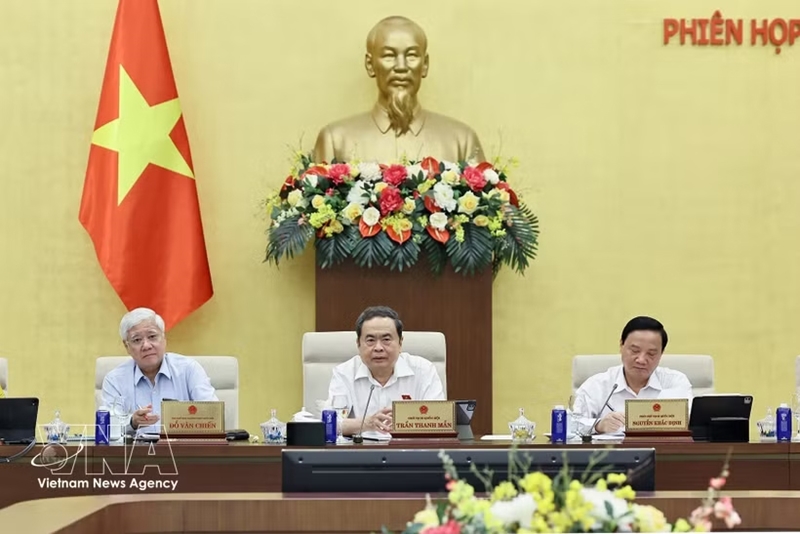
N.A. President Tran Thanh Man (center) speaks at the N.A. Standing Committee's sixth session on September 21. |
The top legislator requested that the 2027 legislative program be designed from the perspective of the legal system as a whole rather than the individual needs of particular agencies.
For emerging fields such as data, artificial intelligence, cybersecurity, digital technology, and unmanned aerial vehicles, he called for a comprehensive review of the relevant legal framework and clear delineation of regulatory boundaries before deciding whether separate legislation is necessary.
He also urged the adoption of a new legislative approach under which laws should cover matters falling under the N.A.’s authority and establish stable, fundamental principles, and frequently changing issues should be delegated to competent authorities to ensure flexibility.
However, he stressed that such a division between legislation and regulation must not simply shift difficult issues to lower levels. Law drafting techniques should also be strengthened to prevent group and local interests from influencing law-making.
N.A. President Tran Thanh Man also called for stricter discipline from the outset, with the Government and relevant agencies preparing legislative dossiers well in advance and supervision agencies becoming involved from the policy-making stage. Supplementing the legislative program during the year should remain an exception rather than become a regular practice, he added.
At the session, Deputy Prime Minister Le Tien Chau said the Government is reviewing documents of the 14th National Party Congress, resolutions, directives and conclusions of the Party Central Committee and its Politburo and Secretariat, as well as the results of a comprehensive review of the legal system to fully identify additional legislative tasks needed.
The Government will propose only genuinely necessary bills with clear political, legal and practical foundations and sufficient preparation, while minimizing requests to add, withdraw or postpone bills, he stated.
Concluding the discussion, N.A. Vice President Nguyen Khac Dinh said the standing committee agreed in principle to consider adopting a resolution on the 2027 legislative program, with 23 of the 28 projects proposed by relevant agencies included.
Also at the session, the State Audit Office of Viet Nam reported that it carried out 132 audit tasks through 180 audit teams in 2026. For 2027, it plans to conduct 139 audit tasks, focusing on public finance and assets, major national projects, public investment, enterprises and financial institutions, as well as areas vulnerable to wastefulness and negative practices.
Source: VNA