This was not only an extraordinary journalistic achievement but also a unique example of the close connection between revolutionary journalism and military operations, with the newspaper directly contributing to the campaign’s victory.
Journalism model on fierce battlefield
More than 71 years later, the 33 issues are recognized for their major historical, spiritual and professional value. They reflect lessons in political and ideological work, journalism, social orientation, power of truth, and national unity, making them worthy of consideration as a national treasure.
    |
 |
|
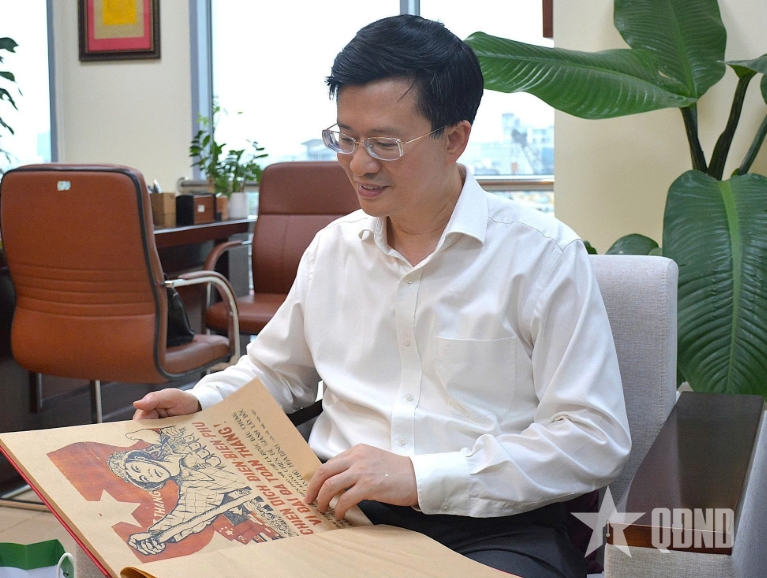
The author looks at the 33 issues of the People’s Army Newspaper published at the Dien Bien Phu Front. (Photo courtesy of the author) |
The Dien Bien Phu Campaign required unprecedented mobilization of manpower and logistics during the resistance war against the French colonialists. In that context, the PAN’s 33 issues served not only as a source of information but also as a tool for shaping awareness, reflecting reality and strengthening confidence.
Published from December 28, 1953 to May 16, 1954 in Muong Phang, only a short distance from the headquarters bunker of the Commander-in-Chief and the campaign’s Political Chief, the newspaper operated with only five staff members. They simultaneously worked as reporters, editors, printers and soldiers while enduring heavy bombardment and severe shortages.
The newspaper provided rapid battlefield updates directly from the trenches. After the Him Lam victory on March 13, 1954, the PAN immediately published front-page reports the next day, featuring battle results, messages from President Ho Chi Minh and praise from the Commander-in-Chief.
Despite limited space and urgent printing conditions, every issue was densely packed with information. Coverage extended beyond military victories, including those of Pathet Lao soldiers, to comprise support from the Soviet Union and China, developments in the rear, declining morale among enemy troops, and warnings against complacency after battlefield successes.
The newspaper did more than just report events. It explained the meaning of each battle and offensive step, affirmed the justice of the resistance war, and reinforced confidence in Party leadership and ultimate victory. Each issue became a “pillar of awareness,” unifying perspectives and thought, thereby unifying action.
The 33 issues also played an important role in building wartime social consensus. Stories of bravery, sacrifice and determination inspired soldiers, while letters and directives from national and military leaders, as well as support from international friends and news from the rear strengthened morale at the front.
A defining feature of these issues was that the journalists themselves were combatants. They reported directly from the battlefield under dangerous and primitive conditions, giving their reporting exceptional authenticity and moral authority.
Despite shortages of paper, ink and electricity, every issue represented extraordinary dedication.
Journalism at Dien Bien Phu became an active force on the ideological front, helping combat doubt and maintain confidence.
Special value and significance of 33 issues
The 33 issues hold value in three dimensions: historical, cultural and communicative. They are original records of a decisive campaign, symbols of patriotism and national solidarity, and evidence of journalism’s ability to inform, guide and unite society even under extreme conditions.
Recognizing the 33 issues as a national treasure would honor not only historical artifacts but also the enduring role of revolutionary journalism in Vietnam’s history.
The lessons from these issues remain relevant today. Journalism must be based on truth, closely connected to reality, persuasive rather than imposing, centered on people, and capable of serving as a trusted source of information in the digital age.
The PAN’s 33 issues published at the Dien Bien Phu Front remain a special legacy combining history, culture and communication. They contributed not only to military victory but also to strengthening national unity, social connectivity, and public trust, values that continue to guide Vietnam in the new era of development.
By Assoc. Prof., Dr. Do Chi Nghia, full-time member of the National Assembly’s Committee for Culture and Social Affairs
Translated by Mai Huong