During Vietnam’s two resistance wars, the peaceful village became the scene of fierce battles in which many soldiers and local guerrillas fought and sacrificed their lives. Decades later, many of their remains are still believed to lie beneath the village’s fields and farmland.
This series of articles seeks to revive the memories of veterans, local residents, and anyone with knowledge of fallen soldiers, encouraging them to share information with authorities to support the ongoing search for and recovery of missing martyrs’ remains.
Memories that have never faded
Le Thi Bich Nong, an 85-year-old Meritorious Artisan and former soldier of Regiment 270, still remembers the day her younger brother, a soldier of Battalion 47, Regiment 270, was killed in Mai Xa village (old Gio Linh district, Quang Tri province) on August 23, 1968. Stationed along the Ben Hai river that day, she recalled hearing the battle cries of Vietnamese troops echoing from the other side of the river. Then the shouting and gunfire from our side gradually fell silent. The following day, she learned that her brother and many of his comrades had been killed.
    |
 |
|
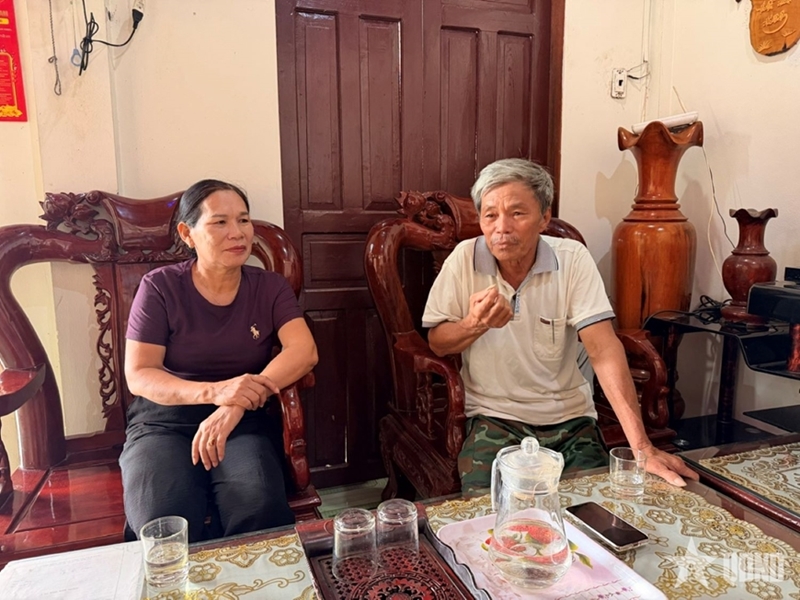
Bui Van Hoa and his wife, the son of martyr Bui Van Dong, at their house in Mai Xa hamlet, Cua Viet commune, Quang Tri province |
Their bodies were initially buried in Vinh Giang commune (former Vinh Linh district) but repeated U.S. air raids struck the burial site, forcing repeated reburials. Only fragments of the remains could be recovered. Today, her brother is commemorated with a symbolic grave at a martyrs’ cemetery, while many of his comrades from Regiment 270 remain missing.
Historical records in “O chau can luc” (Essential Records of O Chau) identify Mai Xa (Gio Mai commune, former Gio Linh district; now Cua Viet district, Quang Tri province) as one of the region’s 65 ancient villages. Located at the confluence of the Hieu, Thach Han, and Canh Hom rivers, the village preserves not only the character of a traditional Vietnamese rural community, but also the layers of Quang Tri's historical and cultural legacy. Local elders believe that the land where three rivers meet is blessed with exceptional geography that produces outstanding people. After Lord Nguyen Phuc Tan ordered the dredging of the Canh Hom River toward Cua Tung, Mai Xa became a thriving trading center in southern Vietnam. Blessed with fertile land and favorable geography, the village seemed to be destined for peace and prosperity, yet history repeatedly turned it into a battlefield.
In 1948, French troops launched a sweep into the village from the Nhi Ha outpost (Gio Thanh commune, former Gio Linh district), capturing and beheading two revolutionary fighters before displaying their heads outside the communal house to intimidate local residents. Despite the danger, villagers secretly recovered part of the bodies for burial. The incident gave rise to the local saying, "The courage of Mai Xa, the rock of Hao Son," which is still remembered today.
Now nearly 80 years old, my mother vividly remembers the horrors of sleeping in underground shelters as rockets screamed overhead, devastating bombing raids, summary executions, and repeated attacks by U.S. naval and marine forces advancing inland from Cua Viet Port along the Thach Han River. Many villagers died while working in the fields, still clutching their farming tools.
Besides my mother, my grandmother had four sons, two of whom devoted their lives to the revolutionary cause. My mother clearly remembers an afternoon shortly before the Lunar New Year of 1966, when my uncle Bui Thanh Thuy unexpectedly returned home with several comrades after months in the resistance base.
Before my grandmother stood her son, painfully thin, pale, and exhausted from months of hunger and sleeplessness. At the sight of him, she burst into tears. All the longing, anxiety, and love she had carried for months poured out at once. She gathered everything the family had to prepare a meal for her son and his comrades: a few sweet potatoes, several slices of fermented cassava, and water spinach dipped in plain salt. It was a heartbreaking meal in its simplicity, yet it contained all the love a mother could offer, never knowing it would be their final reunion.
Tragically, someone informed on them. Just as the meal was served, gunfire erupted only about 200 meters from the family's fragile thatched house. My uncle and his comrades immediately grabbed their weapons and rushed out from the back, attempting to fight their way through. After several bursts of gunfire disappeared into the darkening winter sky, silence returned. Fearing the worst, my mother and grandmother took an oil lamp to the riverbank and followed a trail of blood until they found my uncle slumped beneath a bamboo grove, with two comrades lying beside him. After the war, my uncle was posthumously recognized as a martyr, but the remains of his two comrades have never been found.
My mother gave birth to her eldest daughter in 1968, the fiercest year of the war. The village was devastated by relentless bombardment, forcing her to flee while pregnant, braving a hail of bullets. The journey across the Thach Han River, the most terrifying ordeal of her life, seems etched into the wrinkles around her eyes.
During the Tet Mau Than Offensive and Uprising in 1968 in Quang Tri, the U.S. and its puppet regime deployed approximately 45,000 troops along the Khe Sanh–Road 9 defensive line, of which 28,000 were American troops. Gio Linh district, including Mai Xa village, became one of the campaign's fiercest battlefields. Battalion 47 of Regiment 270 fought tenaciously alongside local militia and guerrilla forces, suffering heavy casualties.
Where is my father?
More than 60 years after his father's death, Bui Van Hoa continues searching for the remains of martyr Bui Van Dong, a platoon leader of K400 who was killed on January 22, 1964. In the family's house in Mai Xa, the State’s Certificate of Merit honoring the fallen soldier hangs prominently beside the portrait of Hoa's mother, Le Thi Nay, who was awarded the title of Heroic Vietnamese Mother.
Hoa began searching for his father's remains at the age of 21. According to witnesses, Bui Van Dong was wounded while commanding a battle against an enemy sweep in the former Gio Hai commune before dying a day later after being evacuated. He and two comrades were buried at the site with coffins provided by local villagers.
When Hoa finally traced the burial location in 1983, he learned that a district recovery team had exhumed and relocated the remains only days earlier. Since then, all information about the relocation has been lost.
A second search led him to Doc Mieu Martyrs' Cemetery, but among countless unidentified graves, he could not determine which one belonged to his father. In desperation, the family later turned to spiritual guidance, only to discover that the grave they had believed belonged to his father had subsequently been identified as another martyr from Ha Nam Ninh province. The search gradually reached a dead end as time passed and eyewitnesses became fewer.
(to be continued)
By Tran Khac Tra
Translated by Tran Hoai