According to the provincial Steering Committee 515, Lam Dong has 12 martyrs' cemeteries with 13,228 graves. Of these, 11 cemeteries require DNA sampling from 4,776 unidentified graves. Authorities have also identified 3,422 fallen soldiers whose burial information remains unknown, while 2,215 relatives are eligible for DNA sample collection to support future matching. The scale of the work requires close coordination among local authorities, the military, public security, healthcare agencies, and other relevant forces.
    |
 |
|
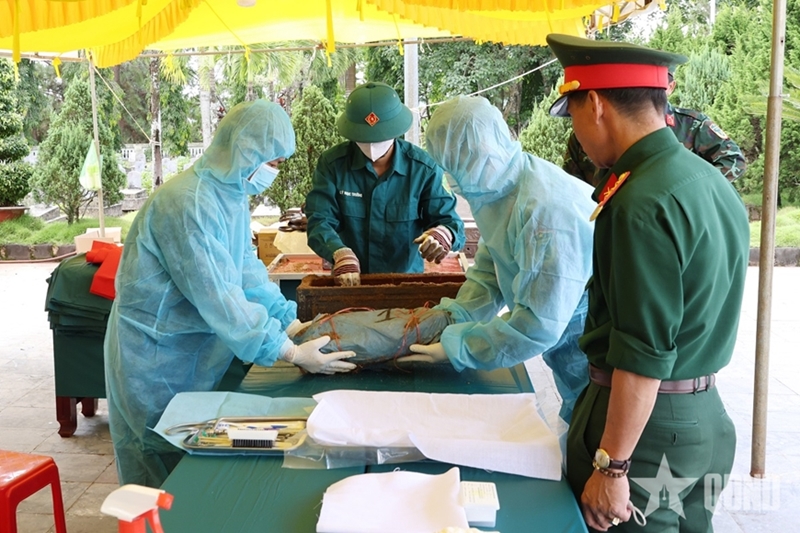
Forces collecting biological samples at Dak Nong War Cemetery in Lam Dong province |
The work presents significant challenges. Most cemeteries have been renovated with reinforced graves, making exhumation both labor-intensive and time-consuming while requiring extreme care to preserve the remains and the graves' structure. In many cases, skeletal remains have severely deteriorated, making it difficult to distinguish bones, teeth, or other materials. Some graves no longer contain viable biological samples, complicating DNA analysis and identification.
Every stage of the process, from exhumation, photography, and digital documentation to sample labeling, preservation, and transfer, is carried out under strict procedures. Senior Colonel Nguyen Thanh Quang, Deputy Political Commissar of the Lam Dong provincial Military Command and Deputy Head of provincial Steering Committee 515, said identifying fallen soldiers is a particularly sacred mission that allows no room for error. All graves are carefully surveyed, while personnel involved in sample collection are selected and professionally trained before deployment.
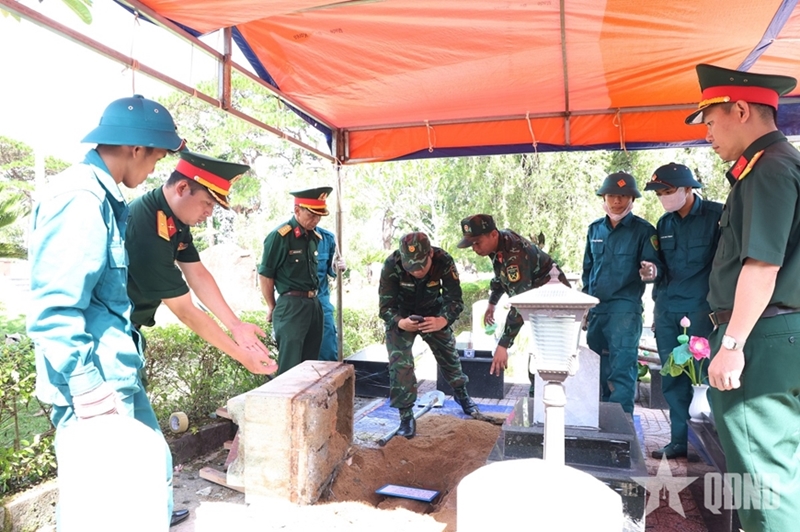
Before expanding operations across the province, Lam Dong conducted training on sample collection, data digitization, record management, and sample transfer, followed by a pilot project at Duc Linh War Cemetery. Collection teams follow the principles of "One set of remains at one time" and "Only one set of remains may be opened at any given time" to eliminate any risk of DNA cross-contamination or sample mix-ups. Each grave receives a unique 10-digit identification code linked to its location, photographs, records, and biological samples. The database will be integrated with the national DNA database to facilitate future identification.
|
|
 |
|
The biological sample collection and digitization process for fallen soldiers’ remains in Lam Dong is being carried out swiftly and rigorously by participating forces. |
The province also requires all activities to respect the solemnity of martyrs' cemeteries. Before exhumation and sampling begin, flower- and incense-offering ceremonies are held to honor those who sacrificed their lives for national liberation and the defense of the country, while traditional spiritual rites are observed.
Following sample collection, the remains are reburied in their original locations, and every grave is restored to its original condition. According to Col. Quang, DNA sampling has been completed at nine of the province's 11 martyrs' cemeteries. Sampling at Lam Dong War Cemetery in Cam Ly-Da Lat ward, covering 651 graves, is scheduled to begin on July 13, while work at Binh Thuan War Cemetery in Hong Son commune, involving 3,431 graves, is expected to start on August 10.
At the same time, the Lam Dong provincial Police Department has launched a campaign to collect DNA samples from relatives of fallen soldiers. Mobile teams visit elderly, infirm, or mobility-impaired family members at home or arrange transportation to ensure that every eligible individual can participate.
Local authorities are also reviewing records, verifying information, comparing lists of fallen soldiers, and gathering information from relatives, veterans, and historical witnesses to strengthen the DNA identification database. Many local units are working with veterans and residents to obtain additional information on unidentified fallen soldiers.
Lam Dong plans to complete DNA sampling at all martyrs' cemeteries before November 15, 2026, ahead of the national schedule. Colonel Tran Thanh Son, Deputy Director of the Political Department of the Lam Dong provincial Military Command and a member of the provincial Steering Committee 515, said every biological sample represents a family's hope of finally identifying a missing loved one after decades of waiting. Through careful preparation and application of science, technology, and digital transformation, the province is contributing to the national effort to identify fallen soldiers and honor their sacrifice.
Translated by Tran Hoai