After completing its mission in Mondulkiri province, the unit immediately resumed operations in Vietnam as part of the 500-day Campaign to accelerate the search, recovery, and identification of fallen soldiers' remains.
    |
 |
|
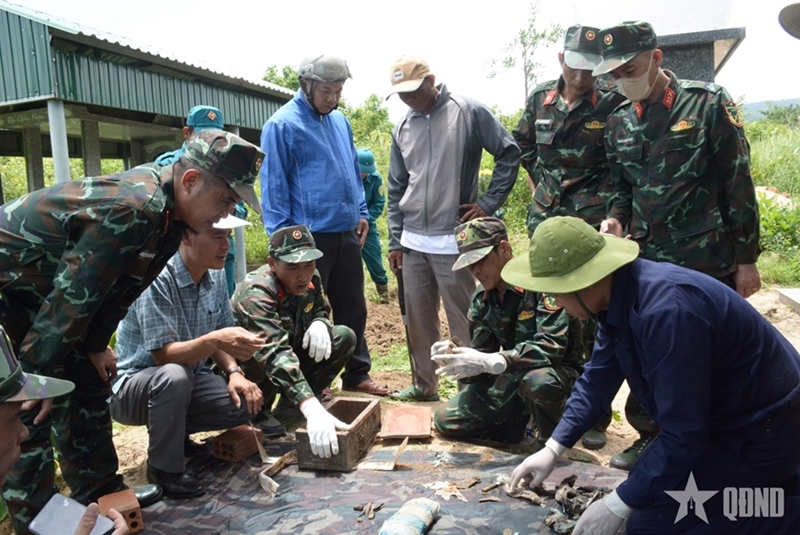
Team K51 carefully and scientifically recovers remains and collects DNA samples for identification. |
Once one of Cambodia's fiercest wartime battlefields, Mondulkiri has undergone rapid development, while the passage of time has claimed many historical witnesses and altered former burial sites. Racing against time, Team K51 deployed 20 search teams along the Vietnam - Cambodia border and three main task forces to conduct recovery operations in Kaev Seima, Ou Reang, Pechr Chenda, Kaoh Nheaek, and Sen Monorom districts.
Supported by local authorities and residents, who actively reported suspected burial sites discovered during farming or forest work, the team verified 506 information leads, surveyed 118 locations, and recovered the remains of 27 fallen soldiers during the six-month dry season. The final recovery was made only days before the team's withdrawal from Cambodia.
|
|
 |
|
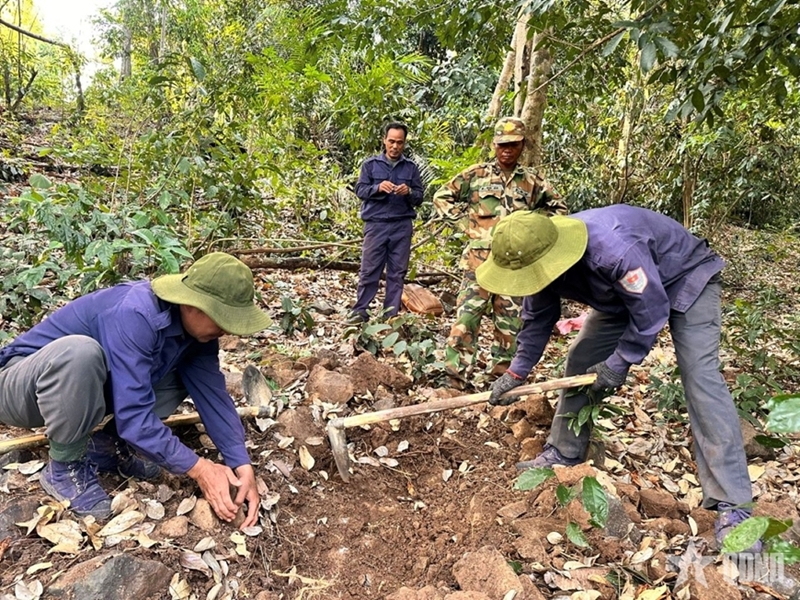
Team K51 conducts search and recovery operations in Mondulkiri province, Cambodia. |
One of the most memorable recoveries took place at Dak Dam stream in Pechr Chenda district. After 12 days of unsuccessful excavation, Non-commissioned Major Vi Xuan Thanh, member of the team, lit incense and offered a prayer before resuming work. About 30 minutes later, the team uncovered bone fragments, shell casings, and military uniform buttons beneath an ancient tree, confirming the location of a fallen soldier's grave.
According to head of the team Colonel Nguyen Van Tu, recovery sites were often located deep in remote forests, requiring the team to live in temporary camps for extended periods. Despite extreme heat, limited water supplies, and constant threats from mosquitoes, leeches, oriental fruit flies, and fire ants, the soldiers remained committed to finding and bringing home as many fallen comrades as possible.
When the recovered remains were repatriated through Bu Prang Border Gate in Lam Dong province, the team’s Political Commissar Senior Colonel Do Van Thieu quietly asked the convoy driver to slow down and uncover the truck carrying the remains so that "they could once again see their homeland after so many years away."
|
|
 |
|
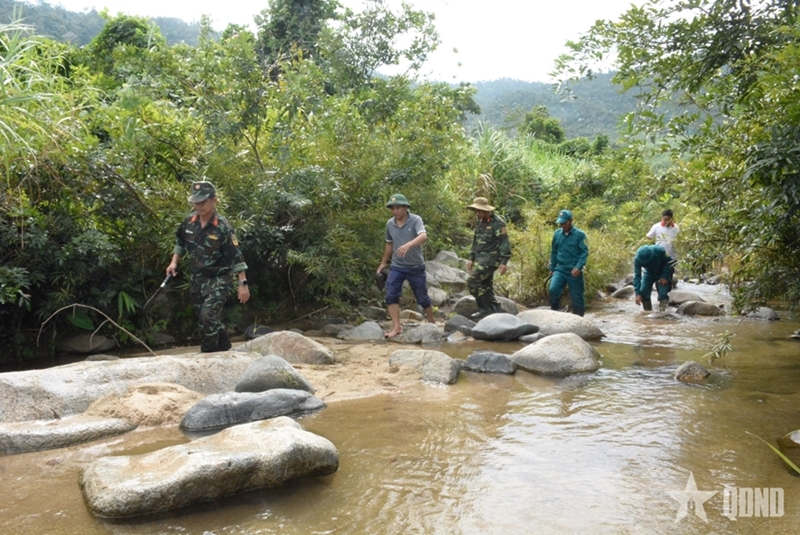
Officers and soldiers of Team K51 cross forests and streams in search of fallen soldiers' remains. |
Unlike previous years, Team K51 did not take leave after returning from Cambodia. Instead, the unit immediately joined the nationwide 500-day Campaign, working with local authorities across Dak Lak province to collect and verify information on possible burial sites.
On July 1, after receiving a report from a resident in Krong Bong commune who had discovered fragments of a military poncho and personal belongings while working in the fields, Team K51 coordinated with local authorities to recover the remains of one fallen soldier along with a body bag, a communications antenna, and rubber sandals.
With the assistance of 96-year-old So Hon, a Cham H'roi elder from Tay Son commune, the team also recovered the remains of two additional fallen soldiers. According to his account, during 1968–1969, severely wounded Vietnamese soldiers were treated at Truc Bach Field Hospital on Hon Ong Mountain, while those who died were buried near Ca Lui stream. Although many graves were relocated after the war, others disappeared because of bombing, floods, and changes in the landscape.
|
|
 |
|
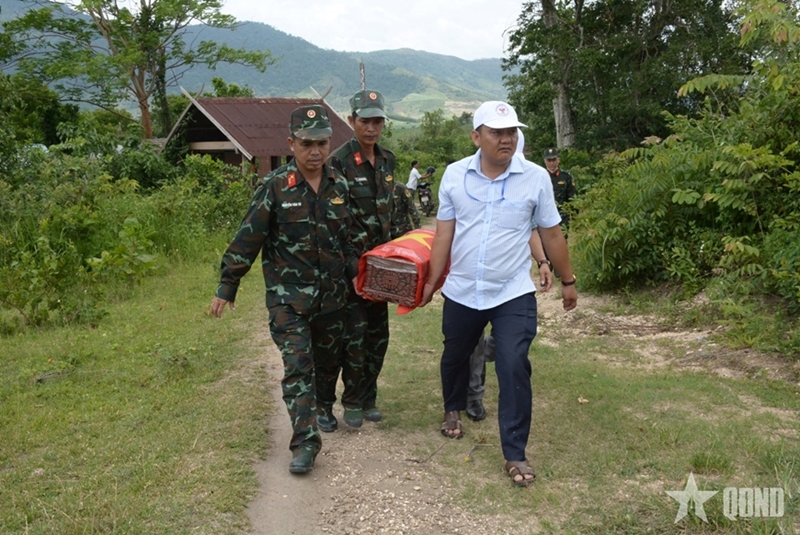
Team K51 coordinates with authorities in Cu Prao commune to recover the remains of a fallen soldier. |
The team also confirmed the identity of remains first discovered on Cu Prao Mountain in late 2020. At that time, insufficient evidence prevented authorities from identifying the remains, which were temporarily buried at a local cemetery. After reviewing archival records, surveying the original site, and exhuming the remains on July 10, 2026, Team K51 confirmed they belonged to a fallen Vietnamese soldier.
Using systematic and scientific methods, Team K51 has recently recovered six additional sets of remains in Dak Lak province and is continuing search operations in Ia Rve, Ia Lop, Ea Bung, Buon Don, Tuy An Bac, Tuy An Tay, Phu Hoa 1, Phu Hoa 2, Dak Lieng, and other localities. Documentation and DNA sampling are being carried out carefully in accordance with official regulations to help identify the fallen.
Guided by Vietnam's enduring tradition of honoring those who sacrificed themselves for the nation, Team K51 continues its race against time to recover, identify, and bring home those who gave their lives for international duty, national independence, and the well-being of the Vietnamese people. Every recovered set of remains means another fallen hero has finally returned home.
Translated by Tran Hoai