The top leader stressed that rapid growth must go hand in hand with sustainability, better governance and improved quality of life.
Acknowledging the city's efforts in pursuing multiple major tasks simultaneously, he commended the capital's proactive and determined approach, as well as its strong aspiration for development, particularly in institutional reform, infrastructure development, administrative reform and spatial reorganization for development.
    |
 |
|
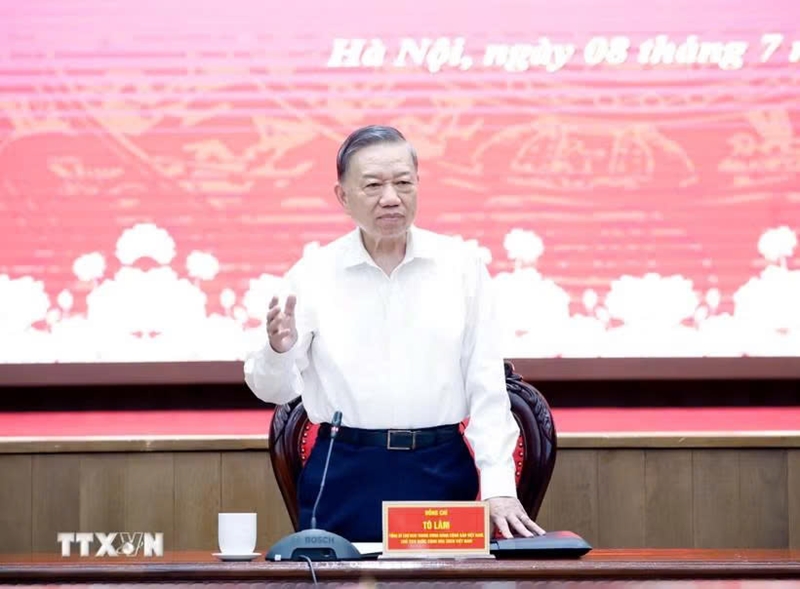
Party General Secretary and State President To Lam speaks at the working session. |
However, he pointed to several shortcomings, including slower-than-expected growth, underutilized development resources, limited spillover effects from public investment, insufficient private-sector dynamism and slow progress in resolving urban bottlenecks.
He described the second half of 2026 as decisive for achieving the year's targets and called on Hanoi to develop sector-specific growth scenarios instead of relying on broad-based management. Authorities should closely monitor implementation, define measurable outcomes and assign clear responsibilities to each agency and official.
Party Secretary and State President Lam also urged the city to conduct a comprehensive review of all development resources, including land, public assets, investment capital, resettlement funds, technical and social infrastructure, high-quality human resources, data, science and technology, to identify idle or inefficiently used assets and unlock new growth drivers.
He stressed that rapid growth should not come at the expense of environment, quality of life, social welfare or effective governance.
He stressed the need to unlock stalled resources, describing them as Hanoi's biggest source of growth potential. The city must avoid waste and delays in using public land, offices and infrastructure while demand remains high for schools, hospitals, housing, cultural facilities and urban infrastructure.
The top leader also urged authorities to speed up site clearance and investment disbursement for key projects, particularly ring roads, bridges across the Red River, urban railways, flood control infrastructure, wastewater and solid waste treatment facilities, housing projects, and regional transport links, while ensuring adequate resettlement, livelihoods and public services for affected residents.
Looking beyond infrastructure, he called for stronger support for businesses, services and tourism sectors, and domestic consumption, while making breakthroughs in science, technology, innovation, digital transformation and high-quality human resources development. He encouraged Hanoi to pioneer a knowledge-, data- and innovation-based economy, including piloting financial support for high-tech enterprises.
The city should also prioritize tackling pressing public concerns, particularly traffic congestion, flooding, air pollution, waste treatment, food safety, urban order, schools and hospitals, so residents can see tangible improvements in daily life, he stressed.
|
|
 |
|
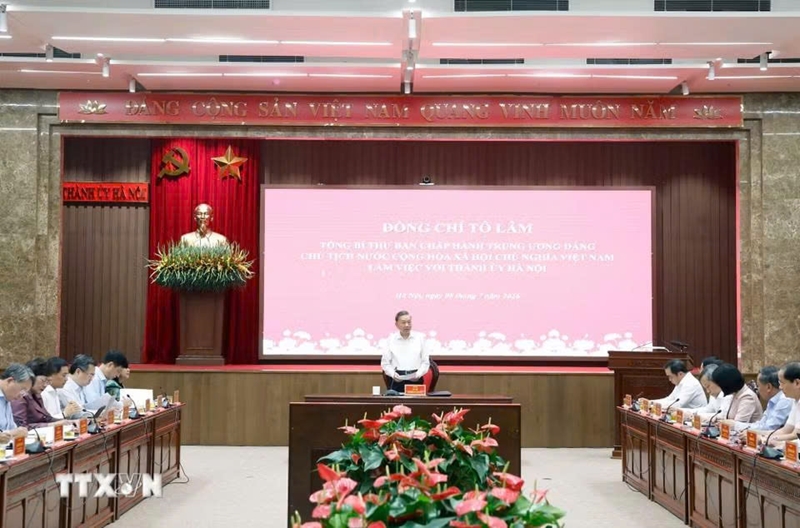
An overview of the meeting |
The top leader also urged Hanoi to strengthen regional connectivity and prepare early for 2027 and the 2026-2030 period, with investment plans, land resources, planning and administrative procedures put in place well in advance.
Hanoi must grow faster, but with higher-quality development, he stressed, adding that the capital should promote modernization, while preserving its cultural identity and ensuring that all residents benefit from development. He also called on the city to pioneer new development models, governance approaches and growth drivers that can be replicated nationwide.
According to a brief report on the city’s socio-economic development in the first half of the year delivered at the session, Hanoi’s GRDP grew 8.22% in the January - June period, surpassing the national average growth rate. Public investment was a bright spot, with disbursement reaching more than 63 trillion VND (2.39 billion USD), up over 112% year on year. Urban development, social welfare, and national defense and security continued to be maintained.
The city has resolved 39 of 51 traffic congestion hotspots. Hanoi ranked first nationwide in graduation rates and second in terms of average scores at the 2026 national high school graduation examination.
The capital city has set a target of achieving 11% GRDP growth in 2026, identifying it as a key political task.
Source: VNA