Regarding notable achievements after five years, Major General Nguyen Viet Dung noted that the Project enabled legal dissemination, education, and public mobilization to proceed in a coordinated, targeted manner, with closer military-civilian coordination across sectors and localities.
    |
 |
|
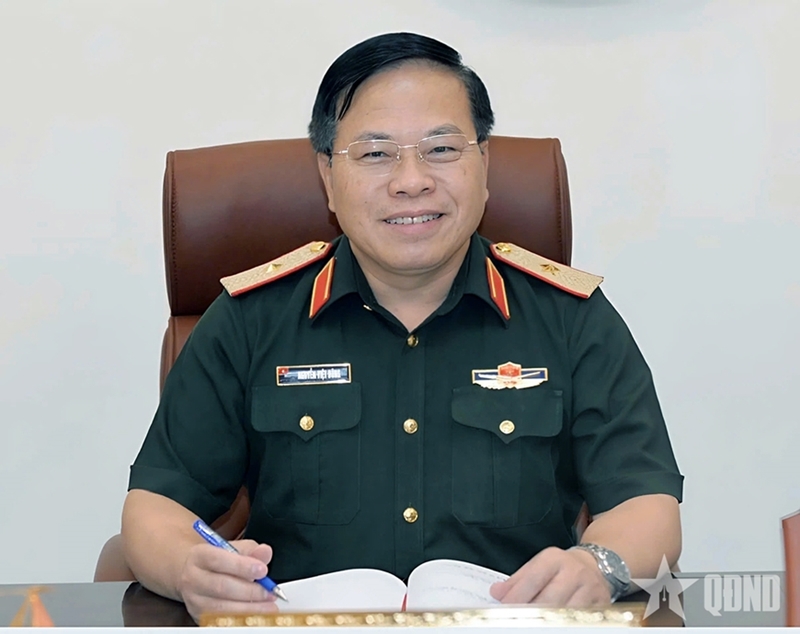
Major General Nguyen Viet Dung, Director of the Department of Legal Affairs under the Ministry of National Defense (photo taken in August 2025) |
Leadership and execution saw major shifts. From the defense ministry to grassroots units, legal education has been integrated into action plans alongside military, defense, and mass mobilization duties. Content increasingly addresses practical issues residents need to follow, moving beyond one-way document distribution.
Concurrently, the legal communicator network was reinforced. The Border Guard, Coast Guard, economic-defense units, and local forces maximized their roles in disadvantaged areas with limited legal access, tailoring approaches to local demographics.
Results are evident in behavioral shifts rather than just event counts or printed handouts. Residents now proactively protect borderlines and markers, comply with fishery regulations, prevent crime, and abandon outdated customs, reflecting the Project’s tangible effectiveness.
Addressing factors behind widespread innovative models, Major General Nguyen Viet Dung emphasized that grounding legal education in people's real circumstances remains essential.
Because local conditions vary, uniform content or methods cannot succeed everywhere. Legal communicators must address practical concerns, explaining what residents may and must do under the law, and where to seek guidance when facing difficulties.
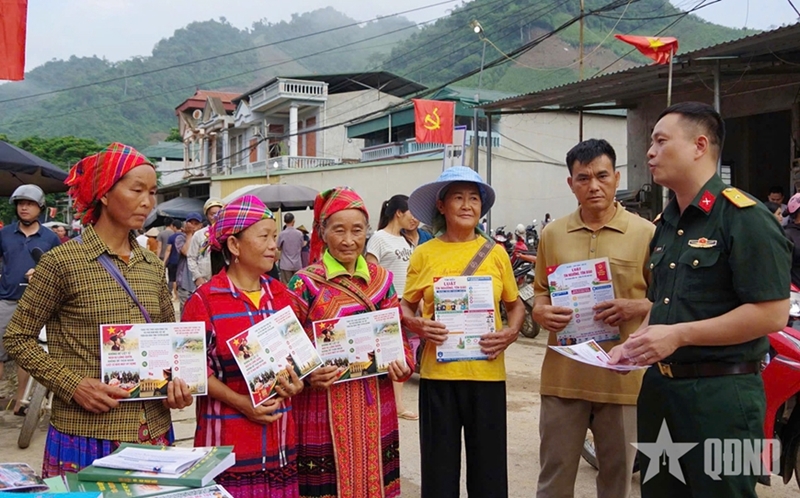
In ethnic minority communities, units utilize local dialects while engaging village elders, chiefs, and reputable figures. Along maritime corridors, dissemination highlights fishery rules, sovereignty defense, and violation prevention.
Initiatives including the “Border Guard Loudspeaker,” “Mock Trial,” “One Law a Week,” and community-level legal counseling have made legal knowledge accessible.
|
|
 |
|
Officers of the Tuyen Quang provincial Military Command disseminate legal knowledge among ethnic minority residents in Trung Son commune (photo taken in August 2026). |
Legal education must pair closely with mass mobilization and practical assistance. When troops help residents develop production, stabilize livelihoods, and understand their rights and duties, outreach becomes far more impactful.
Dissemination also requires exemplary conduct, as strict military discipline builds community trust and credibility.
On applying digital transformation and artificial intelligence (AI), Major General Nguyen Viet Dung noted digital tools offer rapid, visual, two-way interaction. Many units employ community Zalo groups, QR codes, short videos, and electronic materials to convey laws and answer questions.
Long term, he stressed creating a shared digital repository with updated regulations, situational Q&As, and localized materials, reducing preparation time for grassroots communicators while preventing misinterpretations.
Maximizing these tools requires established verification procedures, distinct responsibilities, and routine training.
|
|
 |
|
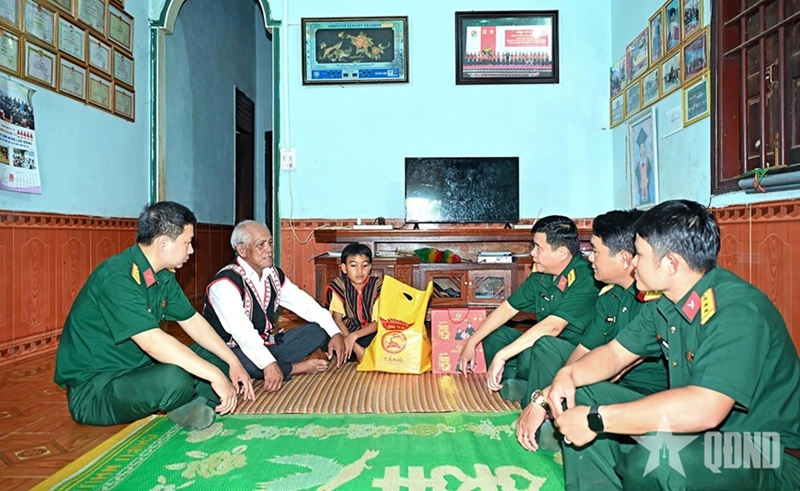
Officers of Economic-Defense Unit 74 (Army Corps 15) discuss legal dissemination activities for local residents with village elder Ro Mah Duen in Ia Dok commune, Gia Lai province (photo taken in September 2026). |
While AI assists in outlining, visual design, and simplifying terminology, it remains purely supportive. Legal data must be verified against current statutes beforehand, as technology cannot replace legal officers' verification duties.
Regarding hurdles to reaching 2027 targets, Major General Nguyen Viet Dung pointed to expansive implementation areas across border regions, islands, and remote localities with difficult transport and communications.
Public legal awareness remains uneven, while communicators juggle multiple responsibilities. Certain areas lack materials, gear, and funding, and situational teaching skills vary. Evaluations sometimes still prioritize activity volume over behavioral improvements.
Furthermore, implementing two-tier local administration and reorganizing administrative boundaries have altered jurisdictions and coordination hubs.
To meet Project goals, military agencies and units must review targets, identifying completed duties, remaining shortcomings, and responsible entities.
Inspections must focus on the grassroots level, assessing dissemination quality, practical application, and public compliance, while evaluating successful models before scaling them up.
Units should proactively review coordination regulations with local Party committees, authorities, and judicial bodies to maintain continuous outreach across remote villages.
Dissemination methods and content must adapt to practical needs, focusing on citizen rights, land, identification, military service, civil defense, and cybersecurity.
Finally, agencies must intensify training for legal communicators, publish concise Q&A handbooks, and strengthen coordination with judicial agencies, political-social groups, and community leaders.
Translated by Minh Anh