New homes, public welfare projects, labor support, and disaster relief have helped improve local people’s lives, strengthen military-civilian solidarity, and build a strong "people’s heart posture" at the grassroots level.
Doing what the people need
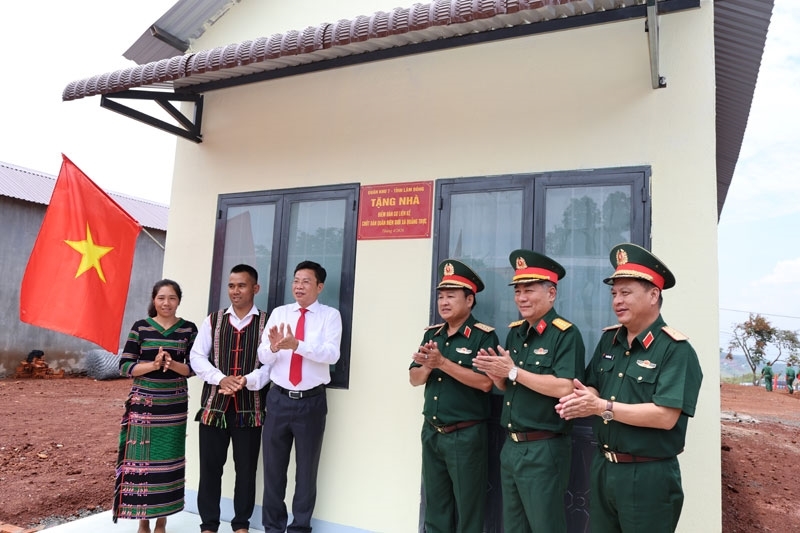
During this year’s rainy season, Ka Dem in Da Nghich residential quarter, Bao Loc ward, Lam Dong province, no longer worries about her deteriorating house. In 2025, the provincial armed forces provided VND 80 million to help her family build a new house, while the family contributed another VND 80 million. She expressed her deep gratitude for the soldiers’ support.
    |
 |
|
New house presented to ethnic minorities in Quang Truc commune, Lam Dong province |
Ka Dem’s family is among hundreds of ethnic households that the provincial armed forces have helped build or repair houses. According to Senior Colonel Nguyen Van Son, Political Commissar of the Lam Dong provincial Military Command, the model was launched by Military Region 7 in 2019. It aims to promote the armed forces’ role in mass mobilization, encourage ethnic and religious communities to follow the Party’s guidelines and the State’s laws and policies, improve their living standards, and contribute to socio-economic development and national defense and security consolidation.
The model has produced concrete results. Since 2019, provincial armed forces units have conducted more than 2,580 dissemination sessions, built and handed over 12 cultural and sports facilities, and constructed and presented 122 houses. Troops have contributed more than 315,500 labor days to repair rural roads, dredge canals, build bridges and clean-water facilities, and protect the environment. Millions of seedlings and livestock have also been provided, while hundreds of visits, medical examinations, distribution of free medicines, and gift-giving activities have been organized for policy beneficiaries, national contributors, poor households, and those facing hardship.
The approach varies according to local needs: Building houses where housing is lacking, roads and bridges where transportation is difficult, and providing breeds and production techniques where livelihoods are limited. These practical efforts have helped turn the model into a genuine part of community life.
Elevating mass mobilization work
After the merger, Lam Dong became the country’s largest province by natural area, with nearly 3.9 million people from 49 ethnic groups. Ethnic people account for nearly 18 percent of the population, while 24 religions are officially recognized. These characteristics place greater demands on mass mobilization and ethnic and religious affairs.
The provincial Party Committee and Military Command therefore regard the model not only as a regular political task but also as an important solution for implementing the two-tier local administration system and achieving Lam Dong’s double-digit growth target.
Since July 2025, the provincial armed forces have carried out numerous large-scale activities. Under the Quang Trung Campaign, they helped build and repair 42 houses damaged by natural disasters and mobilized thousands of officers and soldiers to assist people affected by floods and storms in stabilizing their lives. The 11th “Soldier’s Spring” Program mobilized more than VND 10.4 billion, including funding to build a 60-house residential area next to a border militia post in Quang Truc commune, together with a community center, soccer field, roads, and electricity and water systems. The project was completed in just two months.
The armed forces also supported families of children of war veterans exposed to toxic chemicals. From May 27 to July 15, 38 new houses and 46 repaired houses were completed and handed over. On June 12, the provincial Military Command launched a program to build 100 houses of military-civilian solidarity and great solidarity houses for troops and people facing housing difficulties, with completion scheduled for 2026.
A common feature of these activities is their focus on the grassroots level and on improving local people’s lives. Soldiers support communities not only through information dissemination sessions but also by building houses, roads, and public facilities, providing labor, and assisting people during difficulties and natural disasters.
The provincial armed forces also attach importance to the role of village patriarchs, village heads, reputable people, and religious dignitaries and officials as bridges between the authorities and local communities. Since 2019, more than 4,000 reputable people have received national defense and security education. Hundreds of officers and soldiers have been trained in ethnic and religious affairs, while many have learned K’Ho and M’Nong languages to better communicate with local communities.
According to Senior Colonel Nguyen Van Son, after more than six years, the model has become a bright spot in the provincial armed forces’ mass mobilization work, strengthening the close bond between the military and the people, increasing public trust in the Party, State, and military, and helping maintain political stability, public order, and social safety at the grassroots level.
Translated by Song Anh