By making scientific research a driving force of training quality, the Institute of Missile and Control Engineering under the Military Technical Academy is gradually affirming its leading role in training high-level technical personnel while conducting research and development of modern control technologies.
Training high-quality technical human resources
Senior Colonel, Dr. Cao Huu Tinh, Director of the Institute of Missile and Control Engineering, said that in the field of military engineering, training and scientific research are always closely connected. He explained that instructors must successfully carry out research tasks and master technologies before they can pass on modern, practical knowledge to cadets. From that approach, the institute has closely integrated training with scientific research, regarding it as a consistent development orientation. Research results are continuously updated into curricula, lectures, and laboratories to enhance training quality.
    |
 |
|
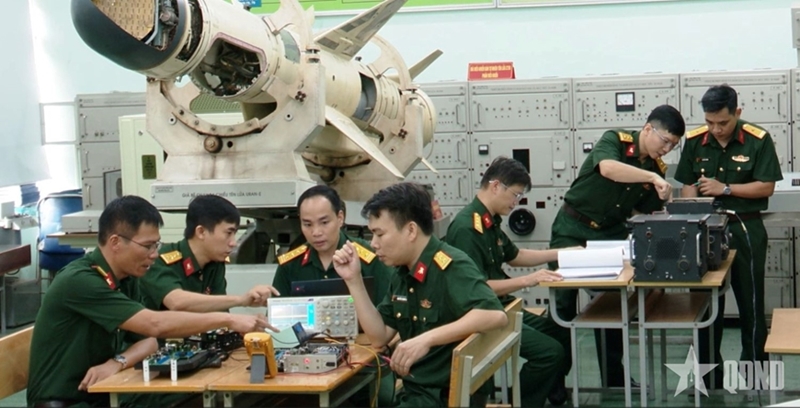
Officers and instructors of the Institute of Missile and Control Engineering under the Military Technical Academy conduct practical scientific research. (Photo: Thanh Tung) |
At present, the institute provides undergraduate and postgraduate training in control engineering, automation, missiles, electrical engineering, and biomedical electronics. It is in charge of 10 military engineering training programs in specialized fields, including air defense missiles, naval missiles, torpedoes, naval mines, naval guns, shipboard electrical equipment, biomedical electronics, and control and informatics in technical systems. Notably, several new training programs have been developed with a focus on modern technologies to meet the development requirements of the defense industry, including the design and manufacture of missile control systems and the training of surface-to-surface missile engineers. These are fields with high scientific and technological content, requiring learners to both firmly grasp theory and directly participate in research tasks.
In addition to undergraduate training, the institute also attaches importance to postgraduate education and the development of a team of leading instructors and experts. Colonel, Dr. Nguyen Ngoc Tuan, Head of the Department of Electrical Engineering, said that the institute prioritizes high-quality scientific human resources by enabling instructors to join major projects, publish in top international journals, and pursue specialized research directions. Many officers have become reputable experts in control and automation.
The institute also maintains research cooperation with major training institutions and actively participates in specialized scientific conferences, thereby continuously fostering high-quality technical human resources to serve the military and the defense industry.
Aiming to master core technologies
As one of Military Technical Academy’s key research units in control and automation, the Institute of Missile and Control Engineering develops its research directions from the practical requirements of the military, such as missile guidance and control, smart robots, biomedical electronics, production of technical supplies, and technical assurance for missile systems and naval guns. From these research tasks, many products have been effectively put into practice, including the WM-18VN multiple rocket launcher system, the TLDP-V625 semi-automatic artillery shell assembly system, replacement technical supplies, repair and upgrade solutions for missile systems and naval guns, and a combat team training simulation system for the S300-PMU1 missile system.
Senior Colonel, Dr. Cao Huu Tinh emphasized that the institute aims not only to create specific products, but more importantly to gradually master foundational and core technologies. This is the decisive factor in enhancing autonomous capacity in researching, designing, and manufacturing modern weapons and technical equipment. The institute has pursued several new research directions, such as modern missile guidance methods based on deep reinforcement learning; AI-powered target detection, recognition, and tracking algorithms for electro-optical seekers; and smart robot navigation in real-world environments. These results are scientifically significant and lay an important foundation for developing smart control systems, contributing to technological autonomy in the defense industry.
A typical testament to the effective integration of research and training is the project on designing a tracking controller using an improved proportional velocity controller and image processing algorithms for a ball-and-plate system, carried out by Colonel, Dr. Pham Xuan Thuy, Deputy Head of the Department of Automation and Computing Techniques, and his colleagues. The project won first prize in the Best Paper category at the seventh International Conference and Exhibition on Control and Automation (VCCA 2024).
The computer vision-based ball-and-plate control system has been completed and put into operation at the laboratory of the Department of Automation and Computing Techniques, serving as a practical model for both teaching and research. Colonel, Dr. Pham Xuan Thuy said that bringing research products into the classroom enables cadets to directly test algorithms and gain hands-on access to computer vision, artificial intelligence, and smart control in an experimental environment, contributing to realizing the motto of using research to serve training and vice versa.
To further enhance training quality and scientific research, the institute will continue to update its training programs to meet the scientific and technological development requirements. It will also expand cooperation with universities and research institutes inside and outside the military, organize scientific conferences, build specialized research groups, and foster a contingent of young scientists, thereby contributing to the development of a modern, self-reliant defense industry and the gradual mastery of strategic technologies.
Translated by Minh Anh