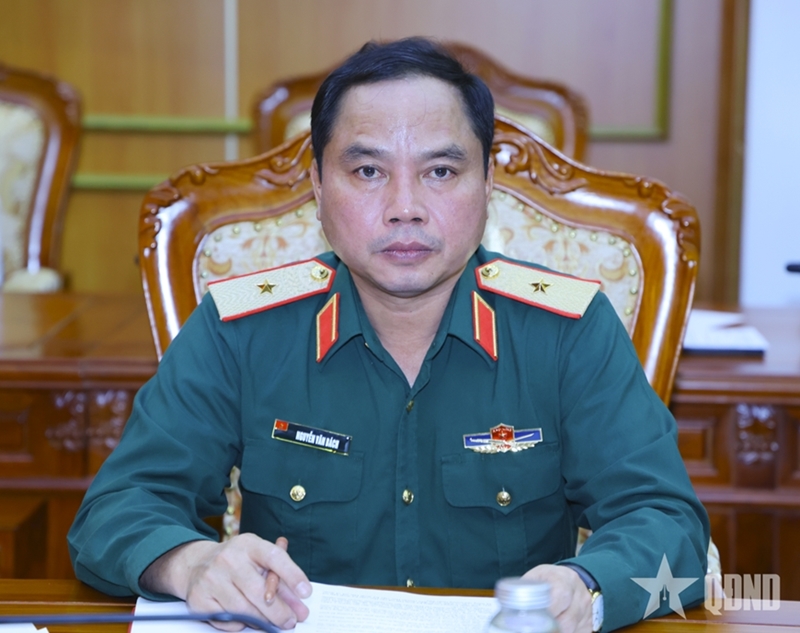
The third edition builds on the success of the first two, affirmed Rear Admiral Nguyen Van Bach. Accordingly, the expo this year has made gains in four areas: scale, appeal, range of exhibits and activities, and standing.
    |
 |
|
Rear Admiral Nguyen Van Bach. |
The expo will cover nearly 124,000 square meters, up nearly 24,000 square meters from 2024. Indoor exhibition space will reach 23,500 square meters, 1.3 times the previous edition’s area. As of November 12, 2026, 255 organizations and businesses from 37 countries have registered to take part, compared with 31 countries in 2024. Exhibitors have booked more than 8,400 square meters indoors, equivalent to 703 standard booths, 1.6 times the area booked last time and nearly 1.8 times the target.
Beside weapons and technical equipment in service and products developed and manufactured by Viet Nam’s defense industry, the expo will showcase defense-economic products and the cultural identities of the country’s three regions. For the first time, a defense experience zone will offer interactive activities in military medicine and commando skills, simulated shooting and virtual-reality operation of combat vehicles. The zone is intended to help the public and visitors better understand the military’s work and the defense industry’s progress.
Rear Admiral Nguyen Van Bach said Party, State, and Ministry of National Defense leaders continued to give the expo due attention and direction. Viet Nam Television will broadcast the opening ceremony live.
|
|
 |
|
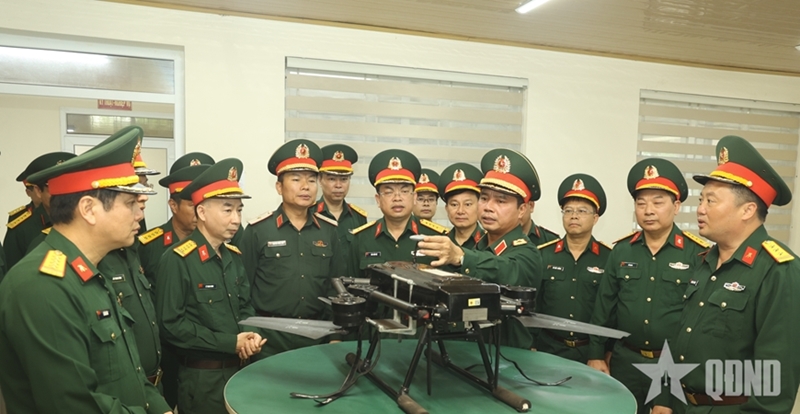
Leaders of the General Department of Defense Industry check preparations for the weapons and equipment display at the Viet Nam Defense Expo 2026. |
He said the figures and preparations reflected the expo’s growing appeal, reputation and standing. He hoped the event would bring partners together, build trust and promote defense cooperation for peace, friendship and mutual development.
Regarding achievements of Viet Nam’s defense industry in research, manufacturing and technology, Rear Admiral Nguyen Van Bach said the Vietnamese exhibits would span five main categories and show advances in performance, modernization, automation and technology integration.
The first category covers army weapons. An 8×8 armored personnel carrier and a light tank will make their debut at the expo. Units across the military worked together to research, design, and build them. Other exhibits include infantry fighting vehicles, armored vehicles, self-propelled artillery, thermobaric rocket artillery systems, new-generation infantry weapons, anti-tank and thermobaric munitions, and electro-optical equipment.
The second category covers naval vessels and underwater weapons. It includes multipurpose anti-submarine frigates, anti-ship missile boats, combat vessels, reconnaissance vessels, landing transport vessels, naval guns, coastal artillery, and unmanned surface and underwater vehicles.
|
|
 |
|
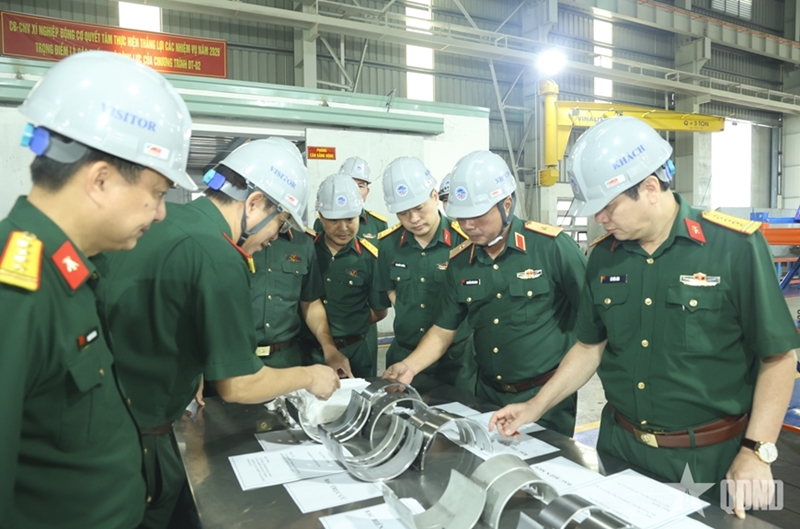
Factories under the General Department of Defense Industry put the finishing touches on products for the Viet Nam Defense Expo 2026. |
The third category is missiles and aerospace products. It includes several types of missiles, unmanned aerial vehicles (UAVs) for reconnaissance, transport and strike missions, and counter-UAV systems combining automatic weapons and jamming equipment for hard-kill and soft-kill responses.
Meanwhile, high-tech military equipment, including radars, electronic warfare and communications equipment, and command-and-control and training simulation systems are the fourth category.
The fifth category covers technical materials and supplies, including propellants, explosives, fuzes, pyrotechnic devices, industrial rubber, and electrical wires and cables.
Rear Admiral Nguyen Van Bach noted that the breadth of the exhibits reflected growing capabilities in research, design, manufacturing and systems integration. Those capabilities would help the industry become more technologically self-reliant and better meet the military’s equipment needs under changing conditions.
Those advances reflect a broader effort by the GDDI to build technological self-reliance.
According to Rear Admiral Nguyen Van Bach, the GDDI identifies science, technology, innovation and digital transformation as its top priorities because they were critical to developing and producing advanced weapons and technical equipment.
On that basis, the GDDI focuses on four areas. It is building the capacity to research, design and develop products independently. It is also working to master foundational and core technologies and specialty materials and to raise the share of domestic content. It is improving manufacturing processes and shortening the time from research and prototyping to serial production. The fourth priority is to strengthen systems integration so it can manufacture complete modern weapons systems. The GDDI is also developing highly skilled personnel, building on its strengths in dual-use technology and selectively expanding international cooperation.
Viet Nam’s defense industry has mastered nearly 400 foundational, core and strategic technologies. It has developed and manufactured a range of new, modern weapons of strategic significance that are now in military service. In the 2020–2025 term alone, the GDDI undertook more than 300 science and technology projects and assignments. Of those, 85 percent produced results suitable for practical use. Science and technology projects accounted for 80 percent of domestically manufactured defense products.
The rear admiral underscored the results showed the industry was on the right track and laid the groundwork for greater self-reliance and less dependence on outside technology. He said the GDDI’s approach was to master the technologies it acquired and applied, then use that expertise to research, design and develop products independently to meet practical needs.
Talking about the preparations for the expo, Rear Admiral Nguyen Van Bach emphasized that the GDDI, as the standing body of the Steering Committee and the Organizing Committee and the lead agency for the Content Subcommittee, has actively advised organizers and coordinated work across agencies and units. Despite a preparation period of about eight months, a heavy workload and demanding requirements, many tasks had been completed on or ahead of schedule.
Accordingly, organizers have approved the overall design, layout of functional areas, list of products and services to be displayed, and design of the Ministry of National Defense’s booth. The organizing committee and subcommittees had been reorganized, and plans for preliminary and full rehearsals and for running the expo were largely complete. Several tasks finished two to six months early. The size of the expo, the number of participating countries and ministerial-level delegations, and the resources mobilized had all exceeded targets.
Besides, the GDDI had finished refurbishing existing aircraft hangars and was installing additional exhibition areas, aiming to complete the infrastructure before November 17, 2026. Opening ceremony participants were training and rehearsing together. Organizers had carefully prepared plans for security, safety, fire prevention and response, traffic, logistics and military medical support. Smart access control and online registration systems were largely complete. A total of 49 military and civilian units and businesses had committed to supporting the expo.
After leaders of the Ministry of National Defense inspected the site on October 30, 2026, the GDDI continued reviewing individual tasks and following up on progress. It aims to finish preparations before November 30, 2026. Rear Admiral Nguyen Van Bach said meeting the deadline had to go hand in hand with quality, professionalism and safety so the expo would be conducted with due ceremony and deliver practical results. Beyond the event itself, the GDDI sees the expo as a way to build technology partnerships, develop joint production and reach more export customers.
According to the GDDI leader, the first two editions had helped Viet Nam showcase its defense industry, widen its network of partners and expand international cooperation.
In 2022, GDDI units signed four export contracts worth USD 25 million. In 2024, they signed 11 export contracts worth USD 278.3 million, a large share of the 16 contracts signed at the expo. Many partners subsequently requested products in which Viet Nam has strengths, including firearms, ammunition, propellants and explosives. Rear Admiral Nguyen Van Bach said that interest pointed to the growing reputation of Vietnamese defense products abroad.
He said the GDDI wanted product promotion and contracts to lead to substantive, long-term cooperation that would directly support a modern, self-reliant defense industry.
The GDDI is pursuing three priorities. It wants more joint research and technology transfer, especially in foundational and core technologies, new materials, automation, and digitization, while building the expertise to master the technologies it receives. It also seeks joint ventures and partnerships for investment and production so Viet Nam can play a greater role in global defense industry value chains. It aims to strengthen ties with longstanding partners, find new customers, reach more export markets, and build the reputation and brands of Vietnamese defense products.
The general department also plans to hold workshops on defense industry cooperation between Viet Nam and other countries alongside bilateral meetings. These will give researchers and businesses opportunities to exchange ideas and explore partnerships.
Concluding the interview, Rear Admiral Nguyen Van Bach said he hoped the expo would generate contracts and lasting partnerships that would strengthen research and production and help Viet Nam build a proactive, self-reliant, resilient, dual-use, and modern defense industry.
Translated by Minh Anh