Thanh, who is former Vietnamese Ambassador to India and senior lecturer at the Diplomatic Academy of Viet Nam, said that General Secretary and President To Lam’s message at the UNGA that restoring trust does not require countries to eliminate differences but to responsibly manage them was particularly significant amid growing polarization and divisions worldwide.
The message clearly stressed that differences should be addressed through dialogue, in strict accordance with international law and the U.N. Charter, rather than through force. Even in complex issues such as territorial disputes, the only way forward is to maintain control and respect international law, particularly the 1982 United Nations Convention on the Law of the Sea (UNCLOS), rather than resorting to force to resolve them.
    |
 |
|
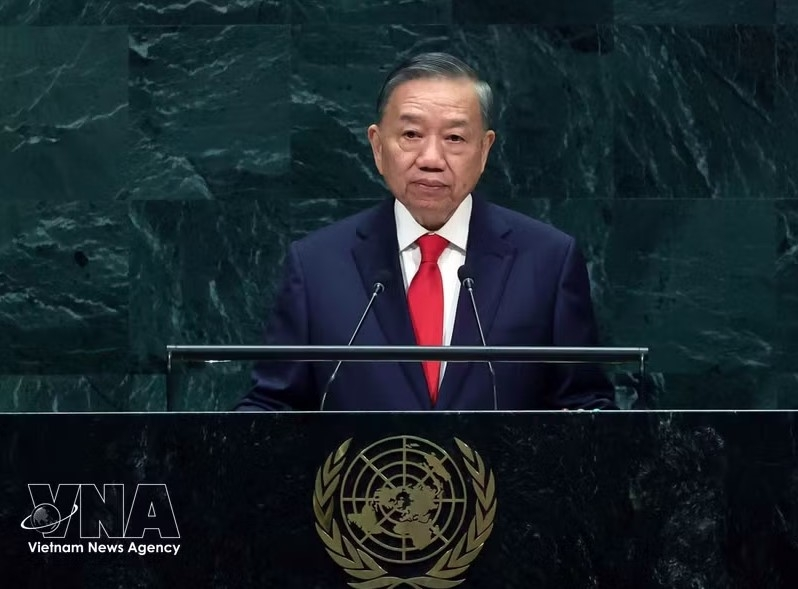
General Secretary of the Communist Party of Vietnam Central Committee and President To Lam delivers remarks at the 81st session of the United Nations General Assembly. |
This approach, Thanh said, reflected Viet Nam’s consistent policy of not choosing sides or depending on any particular party, but standing firmly for international law and the U.N. Charter, thereby safeguarding national independence and strategic autonomy.
Regarding Viet Nam’s shift from following existing rules to proactively contributing to the shaping of new global governance frameworks, the ambassador stated that the General Secretary and President’s UNGA address has put forward major orientations for the U.N., including the governance of technology, particularly artificial intelligence (AI), in a way that serves people, ensures inclusiveness and respects national sovereignty. Thanh viewed this as a clear reflection of Viet Nam’s evolving foreign-policy thinking and its increasingly proactive role in proposing initiatives and contributing to the formation of international rules, particularly in emerging fields.
He noted that this development was consistent with major Party orientations on elevating multilateral diplomacy and deepening international integration, as well as the 14th National Party Congress’s foreign policy directions. Viet Nam has increasingly demonstrated this role through initiatives and co-sponsored initiatives on global issues, including environmental protection, women’s and children’s rights and sustainable development.
Looking back nearly five decades since Viet Nam joined the U.N. in 1977, Thanh said the country’s multilateral diplomacy has matured significantly. From a country primarily receiving international assistance for post-war reconstruction, Viet Nam has become an active contributor of resources and experience to the international community. It has also played increasingly prominent roles in ASEAN, the Asia-Pacific Economic Cooperation (APEC) forum and the U.N., including serving as ASEAN Chair, hosting APEC summits and holding non-permanent membership of the U.N. Security Council.
He noted that Viet Nam’s participation in U.N. peacekeeping operations in Africa has further demonstrated its practical commitment to international peace and security.
On “head-of-state diplomacy,” the ambassador said direct engagement among national leaders offered distinctive advantages, including building high-level personal trust, strengthening commitments and helping resolve complex issues more effectively. High-level policy messages also have strong international reach and symbolic value.
He viewed General Secretary and President To Lam’s recent engagements at the U.N., in the U.S. and in Canada as important opportunities to reaffirm Viet Nam’s foreign-policy direction and highlight its transition from a rule follower to a contributor to international rule-making. Direct contacts with leaders, political circles and business communities in the U.S. and Canada, he said, could help open new frameworks for cooperation and mobilize high-quality external resources for national development.
In the new development period, Thanh stated, stronger bilateral and multilateral diplomacy would help the country combine its internal strengths with external resources to meet its socio-economic development goals.
Source: VNA