The meeting provided an opportunity for the two sides to brief each other on their respective socio-economic situations and foreign policies, comprehensively review bilateral relations and assess the outcomes of meetings of the Joint Committee’s subcommittees on political affairs, sustainable development, and good governance, rule of law and human rights.
The two sides noted with satisfaction that Viet Nam-E.U. relations have continued to develop positively, extensively and substantively, particularly since the elevation of bilateral ties to a comprehensive strategic partnership in January 2026.
    |
 |
|
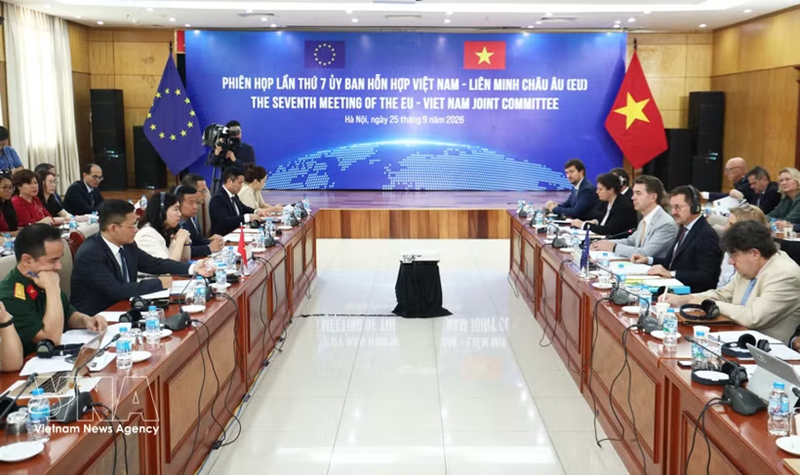
An overview of the 7th meeting of the Vietnam-EU Joint Committee |
Affirming the E.U. is one of Viet Nam’s leading important partners, Hang stressed that under the new framework, the Joint Committee and relevant subcommittees should continue to play their overall coordinating role and promote the effective implementation of major orientations, commitments and cooperation programs.
The E.U. side spoke highly of Viet Nam’s socio-economic achievements, international integration and growing role and stature in the region and at multilateral forums, affirming that Viet Nam is the union’s important priority partner in the Asia-Pacific region and expressing its wish to work with Viet Nam to put the comprehensive strategic partnership into substantive implementation.
The two sides agreed to increase delegation exchanges, expand cooperation in trade and investment, sustainable development, defense and security, and emerging areas, and work together to address outstanding issues and obstacles.
They agreed to fully and effectively implement the E.U.-Viet Nam Free Trade Agreement (EVFTA), facilitate trade and investment, and better tap the complementary strengths of the two economies. They also committed to strengthening connections among programs, resources and specific projects under the E.U.’s Global Gateway initiative and Just Energy Transition Partnership (JETP), particularly in green infrastructure, clean energy and sustainable value chains.
The Vietnamese official urged the E.U. to encourage its remaining member states to complete ratification of the E.U.-Viet Nam Investment Protection Agreement (EVIPA), recognize Viet Nam’s efforts to combat illegal, unreported and unregulated (IUU) fishing and facilitate the early lifting of the “yellow card” against Vietnamese seafood. She also called on the E.U. to consider removing Viet Nam from its list of non-cooperative jurisdictions for tax purposes and work with the country to identify and implement concrete investment projects.
The two sides identified science and technology, innovation and digital transformation as key areas of cooperation, agreeing to promote joint research, connect research institutions, universities and technology enterprises, develop high-quality human resources and make effective use of E.U. programs, including Horizon Europe.
They also agreed to deepen cooperation in green transition, the circular economy, climate change response, disaster prevention and sustainable development, while expanding collaboration in marine affairs, maritime security and safety, education, culture, tourism and youth exchanges.
On regional and international issues, the two sides agreed to enhance consultations and coordination at international forums, support multilateralism and the central role of the United Nations, and settle disputes by peaceful means in line with international law and the U.N. Charter.
Regarding the East Sea (aka South China Sea), they shared concern over recent complex developments and reaffirmed the importance of maintaining peace, stability, security, safety and freedom of navigation and overflight. They stressed that disputes should be settled by peaceful means in accordance with international law, particularly the 1982 U.N. Convention on the Law of the Sea (UNCLOS).
Source: VNA