The visit carried historic significance as it marked the first state visit to India by a Vietnamese Party General Secretary and State President. Taking place shortly after the CPV’s 14th National Congress and the consolidation of the country’s key leadership positions, the trip underscored Vietnam’s commitment to deepening its time-tested friendship, while opening up a new chapter of practical and future-oriented cooperation with India.
    |
 |
|
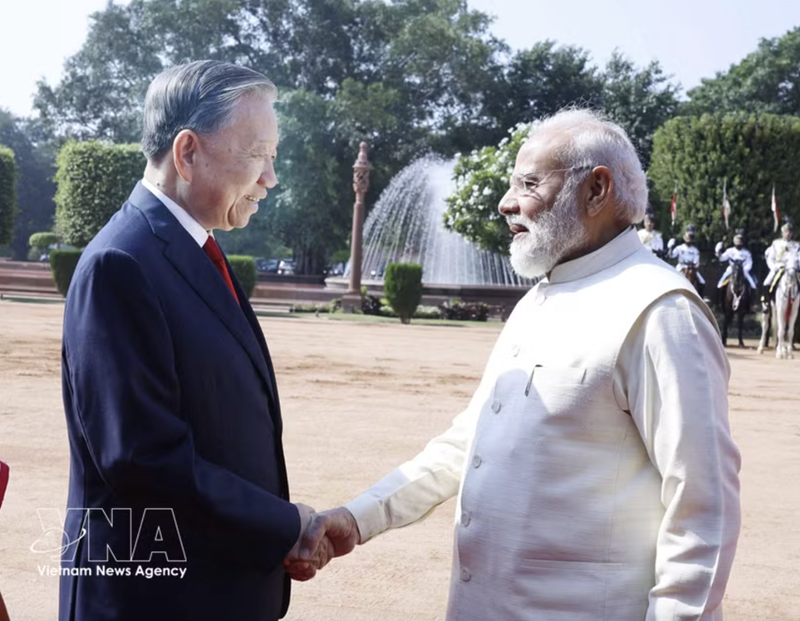
Indian Prime Minister Narendra Modi (right) welcomes General Secretary and State President To Lam in New Delhi. |
During meetings and engagements in New Delhi and Mumbai, leaders of the two countries reaffirmed that the strong foundation of bilateral relations is built on mutual trust, respect, understanding, a shared vision, and effective cooperation across multiple fields. Vietnam and India are both pursuing new development goals toward the centenary of their independence, with an emphasis on balancing economic growth and social progress.
India’s “Viksit Bharat 2047” vision aims to transform the country into a developed nation on the occasion of the 100th anniversary of its independence through a balanced approach combining economic growth, social progress, environmental sustainability, governance effectiveness and technological advancement. Vietnam, meanwhile, has set targets of becoming a developing country with modern industry and upper-middle income by 2030 and a high-income developed nation by 2045.
Against this backdrop, the two sides agreed to elevate their relationship to an “Enhanced Comprehensive Strategic Partnership” based on the spirit of “shared vision, strategic convergence and substantive cooperation.”
To concretize the Enhanced Comprehensive Strategic Partnership, the two leaders, during the talks, concurred strategic directions to further deepen cooperation in various aspects.
|
|
 |
|
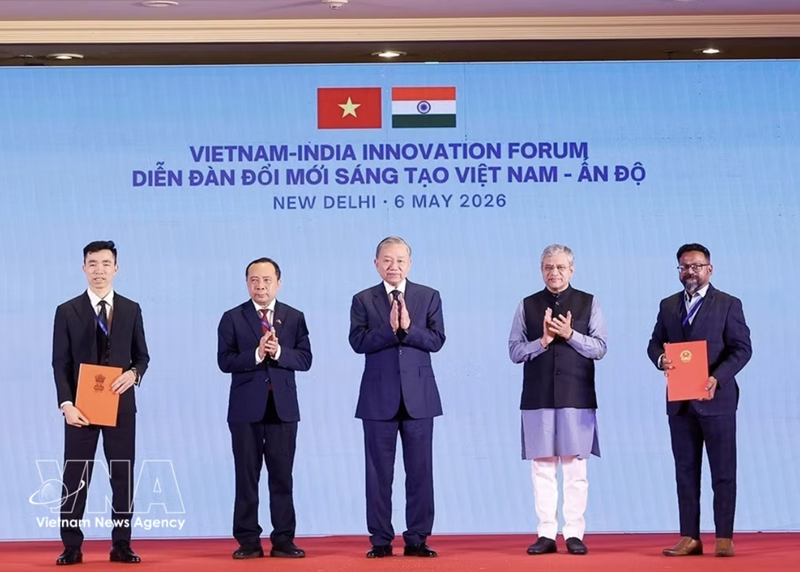
General Secretary and State President To Lam attends and delivers a speech at the Vietnam-India Innovation Forum in New Delhi on May 6. |
Speaking at the Indian Council of World Affairs, General Secretary and President To Lam expressed confidence that with strong political will, decisive government action and the dynamism and innovation of businesses in both countries, Vietnam–India relations will continue to deepen in a more practical and effective manner, and the connection between the two countries will be even more solid, bringing tangible benefits and success to the development of each country, and making a positive contribution to peace, stability, cooperation, and prosperity in the region and the world.
According to former Indian Ambassador to Vietnam Preeti Saran, the steady and positive development of bilateral ties over the past decade has been driven by strong political commitment and clear shared interests. According to her, both countries possess young and dynamic populations and share ambitions of becoming high-income economies by the centenary anniversaries of their respective independence milestones, creating broad opportunities for future collaboration.
Economic cooperation has emerged as one of the strongest pillars of the bilateral relationship. Building on robust trade growth over the past decade, the two sides agreed to work toward raising bilateral trade turnover to 25 billion USD by 2030 in a balanced and mutually beneficial manner.
During this visit, the two countries’ leaders pledged to facilitate greater market access for each other’s goods, strengthen supply chains in sectors of shared interest and accelerate the review of the ASEAN–India Trade in Goods Agreement while ensuring common benefits. They also agreed to expand two-way investment, particularly in high technology, manufacturing, transportation, logistics, renewable energy, smart agriculture, electric vehicles, healthcare, information technology and digital economy sectors.
Speaking at the Vietnam–India Business Forum, the top Vietnamese leader affirmed that the country is committed to safeguarding the legitimate rights and interests of investors, enhancing dialogue, and fostering a transparent and fair business environment. Vietnam, he stressed, aspires not only to be a destination for investment, but also a place where businesses can achieve long-term growth and build sustainable partnerships.
Science, technology, innovation and digital transformation emerged as particularly promising areas of cooperation during the visit. Both General Secretary and President To Lam and Indian Prime Minister Narendra Modi agreed to make these sectors new drivers of bilateral relations in the coming phase of development.
The Vietnam–India Innovation Forum, held on this occasion, highlighted the growing emphasis on technology partnerships and human resources development. Addressing the forum, General Secretary and President To Lam stressed that knowledge, data, technology and high-quality human resources should become the new foundations of strategic cooperation between the two countries.
He affirmed Vietnam's commitment to ensuring the legitimate rights and interests of investors, strengthening dialogue, and creating a transparent and healthy competitive business environment. Vietnam aspires to be not only a place where businesses come to invest, but also a place where businesses can develop sustainably and maintain long-term ties, he said.
Beyond economy and technology, defense and security cooperation continued to serve as a strategic pillar, while collaboration in education, tourism and people-to-people exchanges was also expanded. Air connectivity has become another notable success story. From having no direct flights in 2016, the two countries now operate nearly 100 flights per week, significantly boosting tourism, investment and cultural exchange.
During the visit, General Secretary and President To Lam witnessed the signing and exchange of numerous cooperation agreements in numerous areas, including science and technology, healthcare, cybersecurity, tourism, finance, auditing and local-level cooperation. He also called on ministries and agencies to swiftly implement the agreements to ensure concrete progress in bilateral relations.
|
|
 |
|
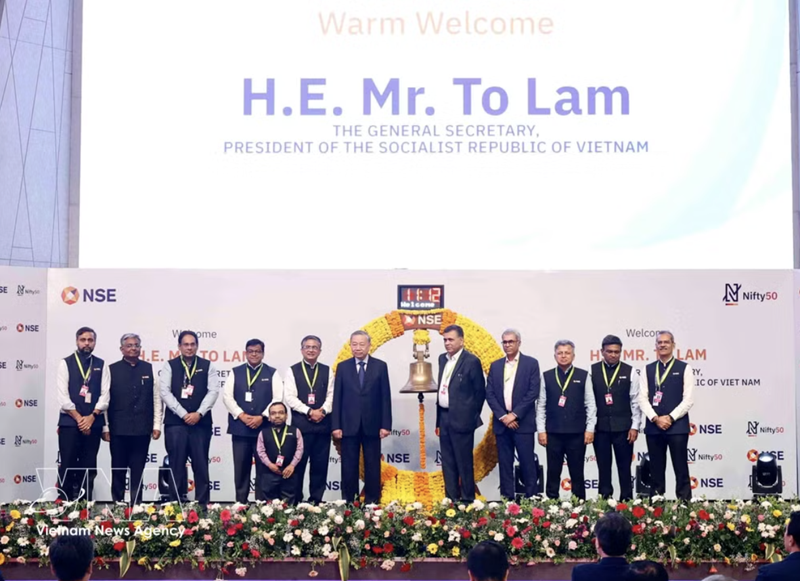
General Secretary and State President To Lam at India's National Stock Exchange in Mumbai on May 7 |
General Secretary and President To Lam and the delegation laid wreaths in tribute to Mahatma Gandhi Memorial at the late leader's memorial site and at the statue of President Ho Chi Minh in G20 Park in New Delhi, expressing their respect for the historical values and traditional friendship between the two nations. The Vietnamese leader then wrote in the memorial book, expressing his deep respect for Gandhi as a leader whose life and legacy remain a shining example for struggle movements for national independence across Asia and the world.
With a packed agenda in New Delhi and Mumbai, the state visit reaffirmed the determination to deepen political trust, strengthen strategic cooperation and build a forward-looking partnership. It also reflected Vietnam’s broader foreign policy of independence, self-reliance, multilateralization and diversification of external relations, and being a responsible member of the international community.
Source: VNA