In an interview granted to Vietnam News Agency correspondents in Beijing on the occasion of the steering committee’s 17th meeting in Hanoi, Binh said that the committee is the highest-level mechanism coordinating cooperation between the two governments. It plays an important role in implementing and concretizing common perceptions reached by the top leaders of the two Parties and countries.
Over the course of 16 previous sessions, the mechanism has proven effective as a central platform for coordinating bilateral collaboration across sectors while reviewing and urging ministries, sectors and localities of both sides to effectively implement cooperation agreements.
    |
 |
|
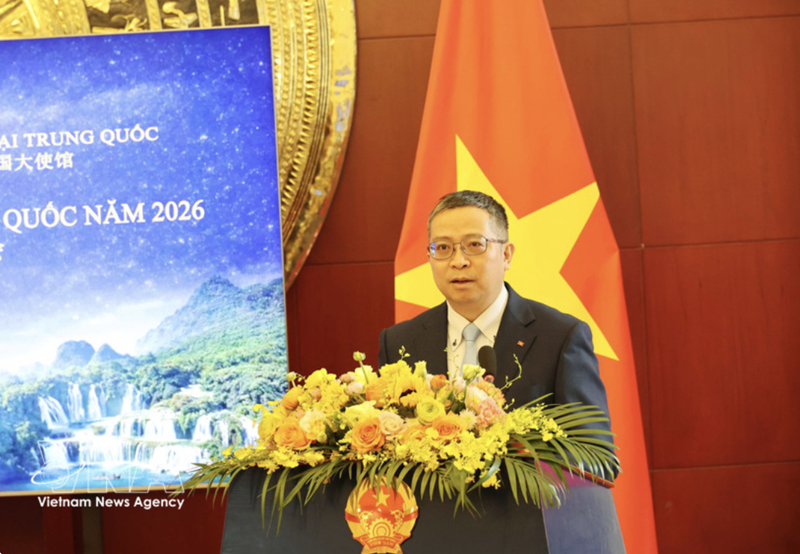
Vietnamese Ambassador to China Pham Thanh Binh |
The 17th meeting provides an opportunity for the two sides to comprehensively review progress in bilateral cooperation since the previous session and further implement high-level common perceptions.
As a practical step to implement the foreign policy outlined at the 14th Party Congress of the Communist Party of Vietnam, and boost bilateral relations towards the “six major orientations,” the meeting is expected to boost political, defense, security and judicial cooperation, people-to-people exchanges, local-level collaboration and coordination at multilateral forums. The two sides will also hold candid and constructive exchanges to address existing challenges in bilateral ties in a spirit of friendship and mutual respect, consistent with common perceptions reached by high-ranking leaders of both countries.
Regarding the first ministerial-level Strategic Dialogue among the foreign, defense and public security ministries of Vietnam and China - known as the “3+3 Dialogue,” the ambassador described the mechanism as an important form of inter-sectoral cooperation. Notably, this is the first 3+3 dialogue mechanism that each country has established with a foreign partner. The dialogue had previously been conducted at the deputy-ministerial level in 2024 alongside the 16th meeting of the Steering Committee, yielding positive outcomes. The decision to upgrade the mechanism to the ministerial level reflects the growing political trust between the two sides and highlights the importance both attach to strengthening strategic exchanges in key sectors.
For two countries sharing a long land border such as Vietnam and China, an inter-agency cooperation mechanism plays an important role in border management, crime prevention and control, and addressing non-traditional security challenges, Binh stated.
Regarding bilateral ties, the ambassador expressed confidence that the potential and scope for cooperation remain substantial, providing a solid basis for translating the common perceptions of the high-level leaders into concrete outcomes, thereby contributing to the development of the Comprehensive Strategic Cooperative Partnership and the building of a Vietnam–China community with a shared future which carries strategic significance.
In terms of strategic connectivity, the two sides will accelerate infrastructure linkages, prioritizing railway and expressway connections as well as border gate infrastructure. Key projects include standard-gauge railway routes linking Lao Cai - Hanoi - Hai Phong, Lang Son - Hanoi and Mong Cai - Ha Long - Hai Phong.
Economically, the two countries aim to make better use of free trade agreements such as the ASEAN-China Free Trade Area 3.0 and the Regional Comprehensive Economic Partnership (RCEP), improve the business environment and enhance institutional and standard connectivity to facilitate balanced and sustainable trade growth.
Vietnam also encourages Chinese enterprises to expand investment in priority sectors including high-tech manufacturing, strategic infrastructure, the digital and green economies, renewable energy and smart urban development, he added.
Source: VNA