Welcoming the diplomats, the General Secretary and State President highlighted the significance of 2026, a year that marks the 96th foundation anniversary of the Communist Party of Viet Nam’s, the 81st anniversary of the country’s establishment, and four decades of Doi Moi (Renewal).
    |
 |
|
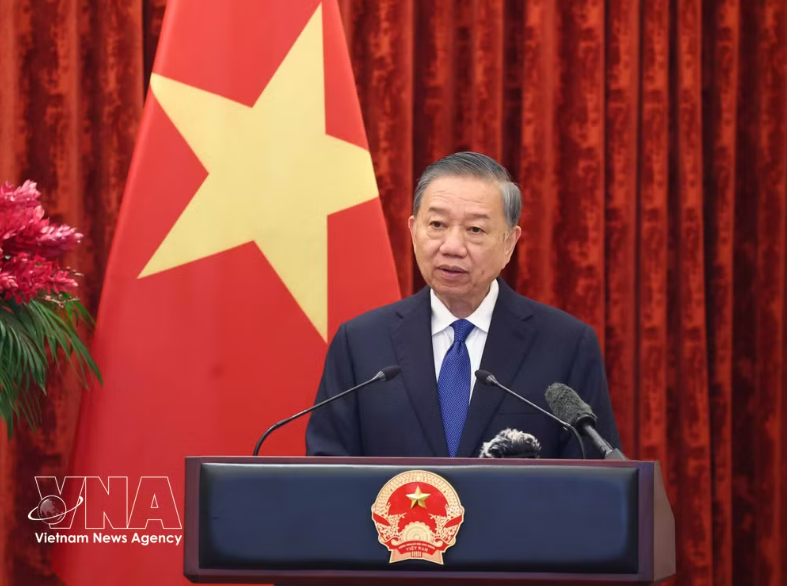
General Secretary and State President To Lam addresses the meeting. (Photo: VNA) |
Viet Nam has undergone a profound transformation, moving beyond the devastation of decades of war and hardship to become a peaceful, unified, independent and self-reliant country. Its economy has become increasingly dynamic, international integration has deepened, and the country has gained a growing presence in global production and supply chains, he said.
The Vietnamese leader also paid tribute to the international friends whose solidarity and assistance helped Viet Nam during its struggles for national independence and reunification and in its subsequent efforts to build and develop the country. He said the Vietnamese people continued to hold their support in high regard.
Looking ahead, 2026 marks the beginning of a new development era for Viet Nam, with two centenary milestones shaping its long-term ambitions. The country aims to become a developing nation with modern industry by 2030, when the CPV marks its 100th anniversary, and a developed, high-income country by 2045, the centenary of its founding.
To advance toward these goals, Viet Nam will seek to sustain annual economic growth of at least 10% during 2026-2030, creating a strong foundation for a subsequent period of accelerated development, General Secretary and President To Lam said.
The country’s development approach is built around self-reliance, resilience, innovation, humanism, sustainability and international integration. People remain at the center of development, with a focus on ensuring that they share in its benefits. Knowledge and education are treated as leading national priorities, while advanced science and technology, innovation, digital and green transitions, and connected strategic infrastructure are expected to drive economic restructuring and growth in the new era.
|
|
 |
|
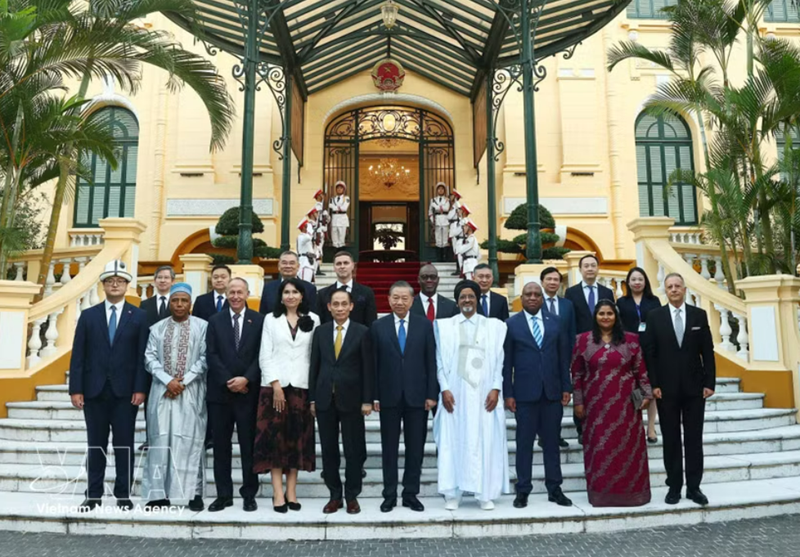
General Secretary and State President To Lam and the foreign ambassadors at the meeting (Photo: VNA) |
The Party and State leader reaffirmed Viet Nam’s commitment to maintaining friendly, practical, effective and mutually beneficial relations with countries and international partners, grounded in shared development goals. He said this approach would remain central to the country’s foreign relations in the years ahead.
Viet Nam will continue to pursue an independent foreign policy focused on peace, self-reliance and resilience, while diversifying and multilateralizing its external relations. The country seeks to remain a friend and reliable partner of all nations, he added.
After acknowledging the development achievements of the ambassadors’ respective countries, General Secretary and President To Lam expressed Viet Nam’s desire to build on longstanding friendships and historical ties, expanding multifaceted cooperation through both bilateral and multilateral channels. Such relations should be founded on equality, mutual benefit, shared responsibility and common development.
The Vietnamese leader encouraged the ambassadors to help advance cooperation in several areas, with the aim of making bilateral ties more substantive and effective.
He said stronger political trust and a solid political foundation were essential to ensuring stable, sustainable relations. Shared values, converging interests and a long-term development vision should be reinforced through more frequent exchanges at all levels, including between the two Parties, states, governments and national assemblies, as well as through local, business and people-to-people channels.
Cooperation should also be regularly reviewed and adjusted to reflect changing circumstances, generating practical benefits for both sides and enabling deeper participation in regional and global production and supply chains.
Viet Nam is interested in expanding cooperation with the countries in a broad range of fields, including trade, investment and economic development; advanced technological applications, semiconductors, artificial intelligence and new materials; digital transformation; sustainable agriculture; environmental protection; energy and renewable energy; the marine economy and maritime transport; strategic infrastructure and logistics; education and training; human resource development; and cultural and people-to-people exchanges.
General Secretary and President To Lam also highlighted the importance of closer coordination in multilateral affairs, calling for collective efforts to build a more interconnected world and address shared regional and global challenges. Such cooperation would contribute to maintaining peace and stability and advancing sustainable development across regions, he said.
The Vietnamese leader expressed confidence that the ambassadors would draw on their experience and diplomatic standing to help translate these cooperation priorities into concrete outcomes.
He assured the envoys that the Vietnamese Government and relevant agencies would provide favorable conditions and the necessary support for them to successfully carry out their diplomatic duties in Viet Nam.
Translated by Song Anh