Throughout the visit, the two countries’ parliaments continued to play an important role in refining the legal framework, facilitating bilateral cooperation and promoting the effective implementation of already signed cooperation agreements, helping deepen the bilateral relationship in a substantive and practical manner.
Lessons from a development journey
Seoul has long impressed visitors with its iconic landmarks, which have helped shape the city’s distinctive character. Lotte World Tower rises into the sky like a giant stroke of a pen; N Seoul Tower stands prominently atop Namsan mountain as a landmark in the heart of the metropolis; while Dongdaemun Design Plaza, a prominent cultural complex, is known for its sweeping curves reminiscent of a flowing stream.
On the central streets, visitors from many countries bustle about, while shopping districts remain lively from day to night. Yet amid a Seoul that seems to be constantly in motion, traces of the past remain carefully preserved. Gyeongbokgung Palace stands majestically in the heart of the capital; Gwanghwamun Square bears witness to Seoul’s history; while old neighborhoods and traditional cultural practices continue to coexist naturally with contemporary life.
    |
 |
|
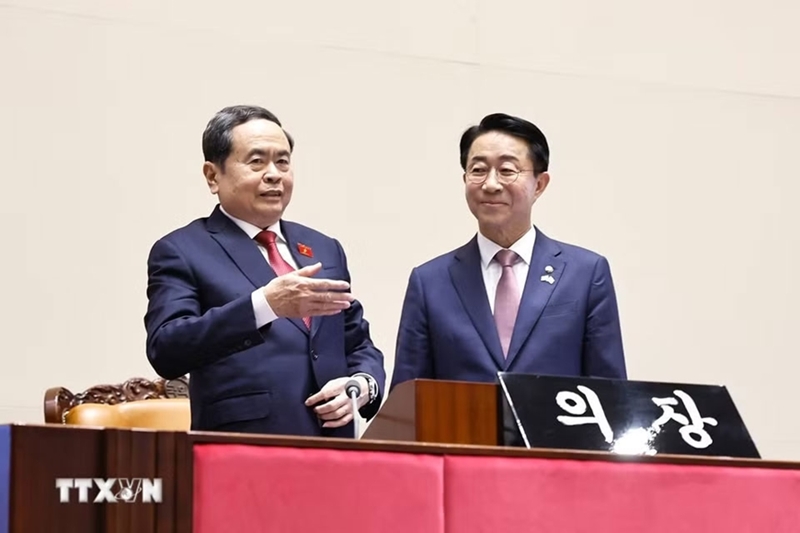
National Assembly Chairman Tran Thanh Man and Speaker of the National Assembly of the RoK Cho Jeong Sik visit a meeting room of the RoK National Assembly. Photo: VNA |
Behind the skyscrapers, modern roads and global brands lies a strength accumulated over decades: industry, technology, human resources, management capacity and an innovation ecosystem built steadily over time, driving breakthroughs in the course of the “Miracle on the Han River.” Samsung, LG, Hyundai, Daewoo, Lotte and SK are among the names that have expanded beyond the RoK’s borders to become globally recognized brands.
Behind this rise lies not only the strength of individual businesses, but also a consistent development strategy and sustained investment in science, technology, education, human resources and production capabilities. These are precisely the lessons Viet Nam attaches particular importance to as it embarks on a new stage of development.
In particular, through N.A. President Tran Thanh Man’s meetings and exchanges in RoK, it can be seen clearly that Viet Nam-RoK relations today are opening up a broader, more substantive and promising space for cooperation, commensurate with the framework of a Comprehensive Strategic Partnership.
Turning commitments into action
RoK Prime Minister Han Seong Sook supported the proposals put forward by N.A. President Tran Thanh Man during their meeting, affirming that RoK would promote cooperation with Viet Nam in high-tech industries and artificial intelligence. The Prime Minister also highly valued the close cooperation between the two countries’ legislatures in recent years and expressed confidence that parliamentary cooperation would continue to advance. He further voiced the hope that Viet Nam would continue creating favorable conditions for Korean businesses to operate and make long-term investments in the country.
At their talks, the Vietnamese N.A. President and Speaker of the N.A. of the RoK Cho Jeong Sik held extensive discussions on how the two legislatures could provide legislative support, facilitate bilateral cooperation and promote the implementation of cooperation agreements signed between the two parliaments. The discussions underscored an increasingly clear requirement: Parliamentary diplomacy should not merely expand relations and strengthen mutual trust, but also help create concrete conditions for high-level commitments to be translated into substantive outcomes.
This was further demonstrated at the N.A. President’s meeting with Korean friends, which brought together more than 70 representatives of Korean scholars, intellectuals, associations, people’s organizations, businesses and non-governmental organizations operating in Viet Nam.
The discussions focused not only on achievements already made, but also on concerns and aspirations to continue contributing to the development of bilateral relations, particularly in areas where Viet Nam has significant needs and substantial room for growth: artificial intelligence, semiconductors, data, green data centers, digital transformation, strategic technologies and the commercialization of research results.
Looking at the meetings in the RoK, it is clear that opportunities for Viet Nam-RoK cooperation today are no longer confined to traditional fields. A new space for cooperation is emerging from the complementary strengths of the two economies. The RoK has technology, capital, management expertise, production capabilities and deep participation in global value chains. Viet Nam offers an open market, an abundant workforce, a favorable geo-economic position and increasingly deep integration into the region and the world.
When these strengths are connected, the scope for cooperation will extend beyond trade and investment to science, technology, innovation, digital transformation, green transition, supporting industries and the development of strategic supply plans. Such cooperation will help Viet Nam and the RoK strengthen their domestic capabilities, enhance their positions and make greater contributions to regional and global development.
Immediately after the visit, N.A. President Tran Thanh Man said he would work with relevant National Assembly agencies to consider and address proposals and recommendations from the Korean side.
From the parliamentary chamber to reality, and from commitments to action, this is the practical value that parliamentary diplomacy is helping bring to Viet Nam-RoK relations. And when the handshakes in Seoul are followed by concrete actions in Ha Noi, new momentum for cooperation will be transformed into tangible results, bringing practical benefits to the peoples of both countries and further deepening the Viet Nam-RoK Comprehensive Strategic Partnership in a substantive, effective and mutually beneficial manner.
Translated by Quynh Oanh