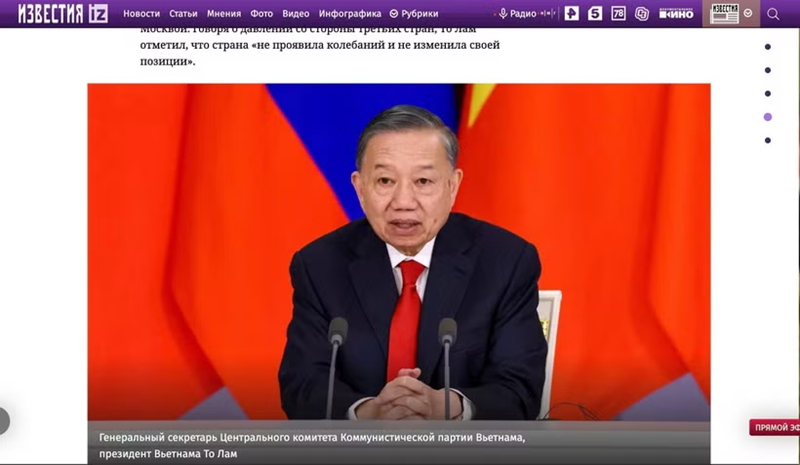
A lengthy article published by Izvestia (iz.ru) said the visit would “go down in history” as it was the first time since 1991 that a Vietnamese leader concurrently holding the positions of General Secretary of the CPV Central Committee and President had visited Russia.
    |
 |
|
A screenshot of an Izvestia (iz.ru) story on the state visit to Russia by General Secretary of the CPV Central Committee and President To Lam |
Izvestia noted that as Viet Nam enters a new era with ambitious goals for modernization and technological development, the visit demonstrated its continued importance attached to relations with Russia. During talks at the Kremlin on September 9, Russian President Vladimir Putin and General Secretary and President To Lam stressed the importance of maintaining stable and long-term bilateral relations.
The visit came shortly after the 14th National Party Congress and the election of Viet Nam's 16th National Assembly, with Viet Nam setting new development orientations, focusing on modernization, digital transformation, science and technology, the space industry and energy. The country aims to become a developing country with modern industry and upper-middle income by 2030 and a high-income country by 2045.
High-level dialogue between Russia and Viet Nam has remained strong in recent years. In May 2025, the top Vietnamese leader visited Russia to attend celebrations marking the 80th anniversary of Victory Day and the military parade in Red Square. However, Izvestia said the latest visit stood out for its broad agenda, covering politics, science and technology.
In Moscow, General Secretary and President To Lam held talks and meetings with senior Russian leaders, attended the Viet Nam-Russia Science and Technology Forum and received the Lev Tolstoy International Peace Prize.
Highlighting the talks between General Secretary and President To Lam and President Putin, Izvestia stressed their friendly atmosphere and positive messages. Putin called the Vietnamese leader as a “dear comrade” and recalled the history of deep bilateral relations, while the Vietnamese leader affirmed his friendship with the Russian President and people.
These political messages were reflected in a joint statement on further strengthening the Comprehensive Strategic Partnership in the new period. The two sides also set a target of raising bilateral trade to USD 15 billion by 2030.
The discussions covered energy, science and technology, health care and other fields. The Vietnamese and Russian leaders joined online a ceremony inaugurating a new infectious disease laboratory in Hanoi. AnN.A. Popova, head of Russia’s Federal Service for Surveillance on Consumer Rights Protection and Human Wellbeing (Rospotrebnadzor), said the project would strengthen Viet Nam’s capacity to research and prevent infectious diseases.
Tourism was also highlighted as an area with potential. General Secretary and President To Lam invited Putin to visit Viet Nam and attend the APEC Economic Leaders’ Week, scheduled to take place in Phu Quoc in November 2027.
On foreign policy, Izvestia described Moscow as an important stop on the top Vietnamese leader’s European tour. Following Russia, he travelled to France to attend the International Space Summit and hold talks with French President Emmanuel Macron.
The newspaper said combining the Russia and France visits in the same overseas trip reflected Viet Nam’s continued pursuit of a foreign policy of independence, self-reliance, and multilateralization and diversification of external relations. Political scientist TatyaN.A. Kosacheva said maintaining ties with multiple partners would help Viet Nam expand cooperation and increase its options in the development process.
Meanwhile, kommersant.ru ran an article saying the visit opened additional opportunities for bilateral cooperation in new areas.
The newspaper noted that Viet Nam’s new era places modernization, technological innovation and greater economic self-reliance among its priorities, with science and technology, innovation and digital transformation identified as key drivers of growth.
To achieve these goals, Viet Nam needs greater access to markets, investment, technology and international experience. This also creates opportunities for Russia to expand cooperation with Viet Nam beyond traditional areas, particularly in science and technology and sectors where Russia has strengths.
Kommersant concluded that the visit not only strengthened Viet Nam-Russia political ties but also opened new avenues for cooperation aligned with Viet Nam’s development priorities, highlighting the growing role of high-level diplomacy in promoting bilateral cooperation and mobilizing resources for development.
Source: VNA