In an interview with Viet Nam News Agency correspondents in Paris on the occasion of General Secretary of the Communist Party of Viet Nam Central Committee and President To Lam’s official visit to France, Pouillieute said that while Southeast Asia and the European Union (E.U.) have many partners, few countries share the historical bonds, closeness, mutual understanding and respect like Viet Nam and France. He described this as a major advantage at a time when the world is facing unprecedented instability and numerous conflicts.
    |
 |
|
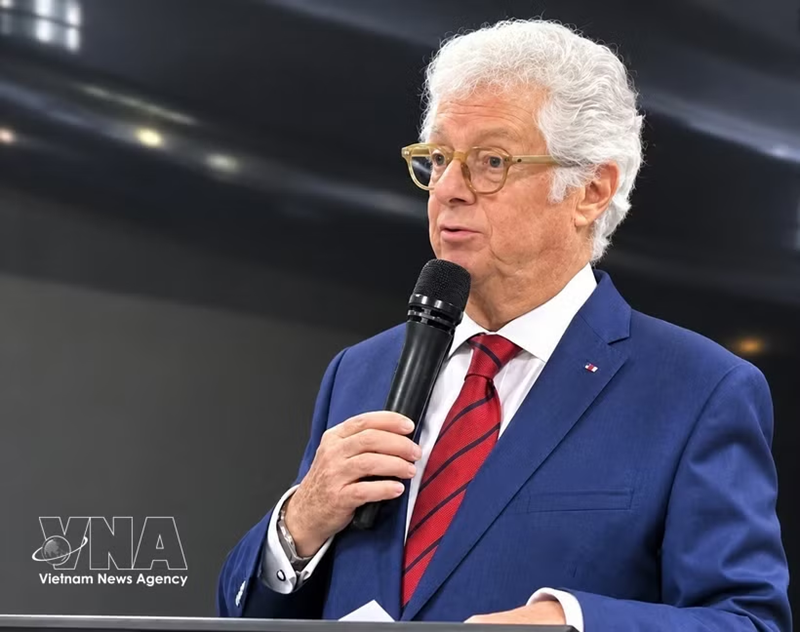
Antoine Pouillieute, who served as French Ambassador to Viet Nam from 2001 to 2004 |
He noted that regional integration processes such as ASEAN and the E.U. continue to develop, which he viewed as a positive trend. However, such processes should not result in the formation of opposing blocs, but instead contribute to common progress through political dialogue, economic growth and stronger social cohesion.
Each country has its own goals, strengths and challenges, he said, but all parties have a responsibility to seek harmony rather than increase tensions in international relations. Realizing this vision requires leaders capable of promoting a shared outlook, making the top Vietnamese leader’s visit to France particularly significant.
Regarding the implementation of the Viet Nam-France Comprehensive Strategic Partnership, Pouillieute said the priority is not to set more ambitious goals, as the two countries already have ambitious cooperation across many areas, but to ensure the partnership better meets current needs while proactively preparing for future challenges.
He suggested shifting the approach from “cooperation” to “partnership,” with greater emphasis on expanding and deepening links in manufacturing investment, technology application and human resources development through stronger exchanges among scientists, universities and businesses.
In the longer term, greater attention should be paid to social cohesion, which could either drive or constrain economic development, particularly amid less favorable demographic prospects. Viet Nam and France could also share experience in territorial organization reform and social protection.
Climate change response and green transition are another promising area. According to the former ambassador, commitments made by both countries in these fields have created an avenue for practical, necessary and urgent cooperation.
Looking ahead, he highlighted two key foundations for stronger and more sustainable bilateral ties: trust and identity. He stressed that trust has never been lacking in Viet Nam-France relations, even when differences arise. Disagreements are normal between countries and individuals alike, he said, and what matters is candid dialogue to overcome them together.
The second factor is a clear awareness of each country’s identity. Both Viet Nam and France have been shaped by history, possess strong identities and seek to preserve them. By understanding who they are, the two countries can better play their respective roles in the regional frameworks to which they belong – Viet Nam in ASEAN and France in the E.U.
The Viet Nam-France Comprehensive Strategic Partnership should therefore continue to be nurtured on the foundations of mutual trust, respect for each country’s identity and a shared responsibility to promote dialogue between Southeast Asia and Europe. These foundations will enable bilateral ties to develop in a substantive, sustainable and forward-looking manner, he added.
Source: VNA