A series of Russian news agencies and television channels on April 7 widely reported on the decision, which they said reflects an important shift in Vietnam’s governance model toward greater consolidation of leadership and improved policy execution capacity.
    |
 |
|
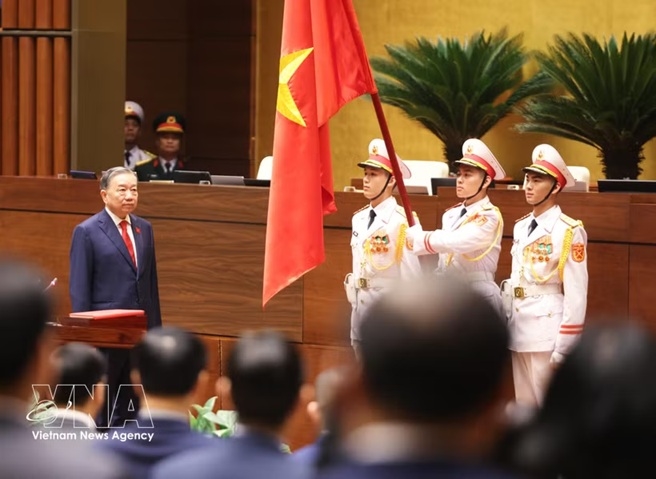
State President To Lam takes the oath of office |
The TASS news agency reported that the Vietnamese N.A. had elected the country’s top leadership, with Party General Secretary To Lam becoming State President, and Le Minh Hung, Head of the Party Central Committee's Organization Commission, elected as Prime Minister.
According to TASS, Party General Secretary To Lam has made several visits to Russia. His most recent trip in May 2025, at the invitation of Russian President Vladimir Putin, reaffirmed the long-standing friendship and desire to further strengthen political trust between the two countries. In 2021, Party General Secretary To Lam was awarded the Order of Friendship of Russia for his important contributions to bilateral cooperation. He is also an honorary professor at the Russian Presidential Academy of National Economy and Public Administration (RANEPA).
Meanwhile, the daily newspaper Kommersant reported that the Vietnamese N.A. unanimously approved General Secretary To Lam as State President for a five-year term. The publication noted that the consolidation of the roles of Party General Secretary and State President marks a major change in building a more “real-power” state apparatus under the Party’s unified and comprehensive leadership.
It also highlighted To Lam’s career trajectory and noted that since assuming the position of General Secretary of the Communist Party of Vietnam (CPV) in August 2024, he has launched extensive administrative reforms, including reducing the number of provincial-level administrative units by half and abolishing one layer of local administration. These reforms were described as revolutionary policies to streamline the political system and improve State governance efficiency.
Kommersant further emphasized Vietnam’s large-scale economic reform agenda aimed at enhancing national competitiveness. It noted that General Secretary Lam has repeatedly identified science, technology, innovation and digital transformation as top national priorities, with the private sector increasingly recognized as an important driver of the national economy.
General Secretary Lam has repeatedly emphasized the need to build a legal framework that serves businesses rather than hinders development. Regarding state foreign policy, he has stated that proactive foreign affairs and international integration are “key and regular” tasks. One of the most ambitious goals in the era of the nation’s rise is to achieve an average GDP growth of at least 10% per year during the 2026–2030 period, becoming an upper-middle-income country by the end of this decade, and attain developed country status by 2045.
The reports noted that Vietnam already has strong foundations to pursue these goals. Foreign direct investment (FDI) remains a key driver of sustained growth, while anti-corruption efforts have strengthened public trust in the Party and the State, and created a more transparent and predictable environment for both domestic and foreign investors.
However, they cautioned that achieving double-digit GDP growth this year will remain challenging due to external pressures, including the US’s tariff policies and conflicts in the Middle East, which are disrupting global supply chains and exports. Alongside rising energy prices, these are having a significant impact across Southeast Asia, including Vietnam.
The same day, Gazeta.ru reported that in his speech, the new President of Vietnam outlined goals of ensuring stability, accelerating economic growth, and improving living standards for the people. He also pledged a new development model based on science, technology, innovation, and digital transformation, while strengthening the country’s self-reliance in national defense.
Gazeta.ru also commented that the consolidation of the two top leadership positions will help ensure the Party’s guidelines and resolutions are implemented more consistently, rapidly and effectively across the entire political system, thereby improving policy execution efficiency and facilitating development goals.
Source: VNA