President Aliyev’s second official visit to Viet Nam, following his first in 2014, aims to usher Viet Nam-Azerbaijan relations into a new phase of development commensurate with their strategic partnership framework.
    |
 |
|
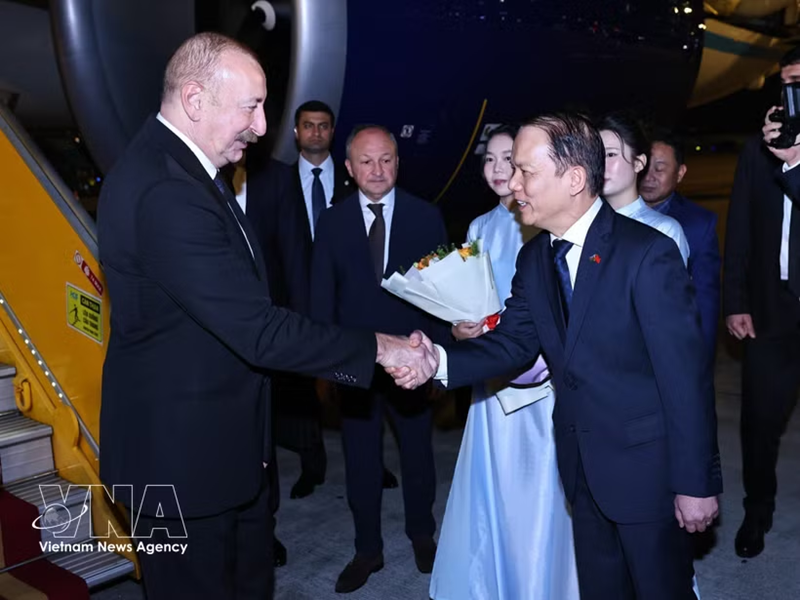
Minister of Justice Hoang Thanh Tung welcomes President of Azerbaijan Ilham Aliyev (left) at Noi Bai International Airport in Ha Noi on November 19 evening. |
At Noi Bai International Airport, the delegation was welcomed by Minister of Justice Hoang Thanh Tung, Deputy Minister of Foreign Affairs Le Thi Thu Hang and Vietnamese Ambassador to Russia and Azerbaijan Dang Minh Khoi.
Accompanying the Azerbaijani President are his spouse Mehriban Aliyeva; Head of the Presidential Administration Samir Nuriyev, Minister of Foreign Affairs Jeyhun Bayramov, Minister of Defense Zakir Hasanov, Assistant to the President Hikmat Hajiyev, Minister of Energy Parviz Shahbazov, Minister of Emergency Situations Kamaladdin Heydarov, Minister of Economy Mikayil Jabbarov, and Azerbaijani Ambassador to Viet Nam Shovgi Mehdizade.
Ambassador Khoi told the Viet Nam News Agency that the visit would open a phase of translating the two countries’ strategic vision into concrete action, turning potential areas of cooperation into practical opportunities for the benefit of both peoples and contributing positively to peace, stability and development in their respective regions and worldwide.
Viet Nam and Azerbaijan share a long traditional friendship built by generations of leaders and people. Azerbaijan has consistently given support and sincere affection to Viet Nam, while Viet Nam always values friendship and cooperation with Azerbaijan.
The May 2025 state visit by General Secretary of the Communist Party of Viet Nam Central Committee To Lam to Azerbaijan and the formal upgrade of ties to a Strategic Partnership ushered in a new chapter, with all-around cooperation clearly advancing since then.
Against that backdrop, President Aliyev’s visit carries particular significance. It offers high-ranking leaders a chance to reinforce political trust, review the full range of relationship-building directions and set concrete steps to realize the Strategic Partnership, adding new momentum across politics, diplomacy, economy, trade, investment, energy, education, science-technology, and people-to-people exchanges.
Source: VNA