In an interview granted to the Viet Nam News Agency ahead of National Assembly President Tran Thanh Man’s official visit to the RoK from September 6 to 9, Park said parliamentary exchanges are particularly significant as the two legislatures represent their respective peoples.
He noted that parliamentary diplomacy complements high-level and government diplomacy while providing a channel to discuss issues directly affecting people’s lives, including education, employment, business, immigration and cultural exchanges.
    |
 |
|
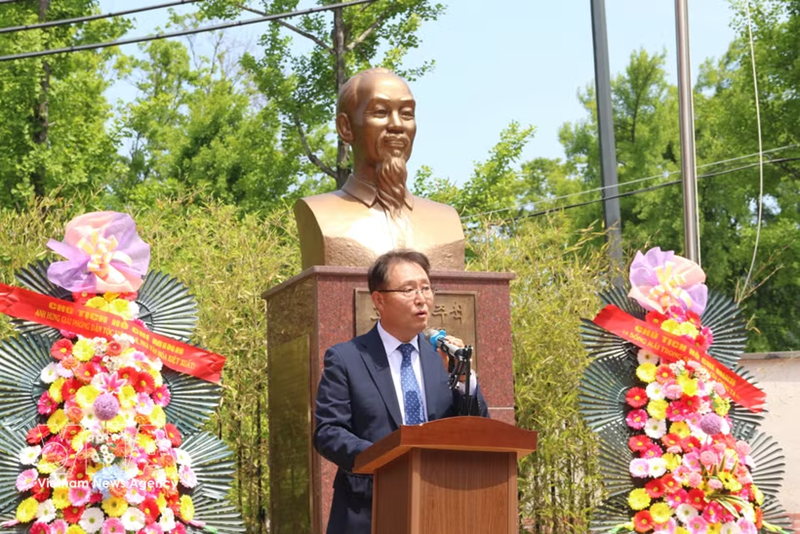
Professor Park Yeon Kwan, Head of the Department of Vietnamese at Hankuk University of Foreign Studies |
Parliamentary exchanges between Viet Nam and the RoK are not merely interactions between lawmakers, but also an important channel of people-to-people diplomacy that connects the two peoples and enhances bilateral ties, the scholar said.
About 190,000 Koreans are currently living in Viet Nam while some 340,000 Vietnamese are residing in the RoK. In 2025, about 4.33 million Koreans visited Viet Nam and around 630,000 Vietnamese travelled to the RoK, highlighting the scale of people-to-people exchanges.
Against the backdrop of the Viet Nam–RoK Comprehensive Strategic Partnership, Park underlined the importance of education, particularly language training, in ensuring the sustainable development of bilateral relations.
He cited the rapid expansion of Korean-language education in Viet Nam as evidence. In 2025, 48 universities in Viet Nam offered Korean language and/or Korean studies programs, with 27,222 students enrolled. Including non-major learners, more than 50,000 people were studying Korean. If colleges and vocational education schools are included, the number of institutions offering Korean-related programs totaled some 60.
This development shows that bilateral ties are expanding beyond government and business cooperation into education, employment and opportunities for young people, he said.
Meanwhile, Vietnamese-language graduates in the RoK have diverse career prospects. Graduates of the Department of Vietnamese at Hankuk University of Foreign Studies work at major corporations such as Samsung, Hyundai and POSCO, as well as in diplomacy, law, accounting and journalism.
Park said language education should, therefore, go beyond foreign-language proficiency to equip students with knowledge of the history, culture, economy and society of both countries. Such graduates can serve as crucial bridges between Viet Nam and the RoK.
The scholar also highlighted the potential for deeper cooperation between universities and research institutions of the two countries. Hankuk University of Foreign Studies has maintained long-standing exchanges and academic cooperation with major Vietnamese universities such as Viet Nam National University, Hanoi; Viet Nam National University, Ho Chi Minh City; Hanoi National University of Education and Ho Chi Minh City University of Education.
Future cooperation should move beyond student and lecturer exchanges towards joint research and training programs, including in emerging fields such as artificial intelligence, digital technology, semiconductors, biotechnology, healthcare, the environment and energy.
He said universities and research institutions should work together to train human resources and conduct research for the future, adding that Hankuk University of Foreign Studies, with its extensive network of Vietnamese partners, can play an important bridging role.
Recalling that he began studying Vietnamese in 1988, when Viet Nam and the RoK had yet to establish diplomatic relations, Park encouraged young learners to view Vietnamese as more than a foreign language and deepen their understanding of Viet Nam’s history, culture, economy and society as they will play a direct role in shaping bilateral relations in the future.
Source: VNA