In an interview with the Vietnam News Agency's correspondent in Buenos Aires, Rodriguez noted that Vietnam’s target of around 8% economic growth in 2025 is highly ambitious, particularly amid global uncertainties ranging from prolonged armed conflicts to trade tensions and strategic competition among major powers.
    |
 |
|
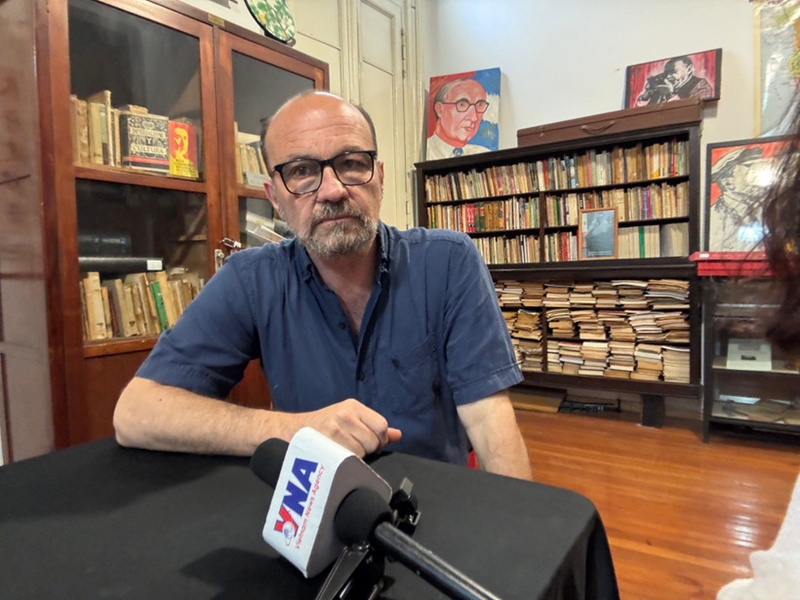
Marcelo Rodriguez, head of the Commission for Foreign Affairs of the Communist Party of Argentina Central Committee |
However, he highlighted Vietnam’s ability to mobilize endogenous drivers as a defining strength, reflected in deep reforms to the organization and operation of its political system.
According to Rodriguez, who also serves as Director of the Center for Marxist Studies (CEFMA) under the Communist Party of Argentina, reforms to streamline organizational structures, re-organize administrative units and address overlaps among Party and State agencies have laid an important foundation for more effective national governance. These reforms, he said, carry long-term strategic significance and will continue to yield results in the years ahead.
He praised Vietnam’s foreign policy of independence, self-reliance, multilateralization and diversification of international relations, noting that it has enabled the country to strengthen its internal capacity for development across economic, social and industrial pillars while remaining flexible in responding to global fluctuations and firmly upholding its principles, identity and strategic priorities.
Political and social stability, he stressed, remains a decisive factor underpinning Vietnam’s consistent development trajectory, an achievement not shared by many countries.
Regarding Vietnam’s goal of achieving double-digit growth of over 10% in 2026, Rodriguez described it as challenging yet realistic. Based on Vietnam’s performance in 2025, during which most development targets were met, he said the prospects for high growth in the coming period are achievable, despite expected impacts from the global political, economic and trade environment.
He noted that Vietnam is entering a new development phase as it prepares to review the implementation of the 13th National Party Congress Resolution and formulate the next five-year socio-economic development strategy, with the aim of becoming an upper-middle-income country. If Vietnam continues to consolidate a growth model centered on modern industry, science and technology, digital transformation, artificial intelligence and high-quality human resources, he said the country’s development potential remains substantial.
He also underscored the importance of cooperation between the Communist Party of Vietnam and the Communist Party of Argentina. Over the past year, the CEFMA has initiated in-depth research into Vietnam’s revolutionary experience and Party-building practices, viewing them as highly relevant to the theoretical and practical work of the Communist Party of Argentina.
Rodriguez said that, driven by deep respect for Vietnam’s national heroes and the historic role of the Communist Party of Vietnam, the CEFMA has coordinated with the Vietnamese Embassy in Argentina to organize a thematic seminar and publish a special volume compiling papers on Argentina - Vietnam relations, along with contributions from a commemorative event honoring President Ho Chi Minh. This marked one of the first systematic cooperation initiatives between the two sides in theoretical research.
Building on these outcomes, Rodriguez said the two Parties are formulating plans to expand exchanges, dialogues and joint research activities in 2026, thereby further strengthening the friendship and cooperation between the two Parties for the benefit of the two countries' people and the global progressive left movement.
Source: VNA