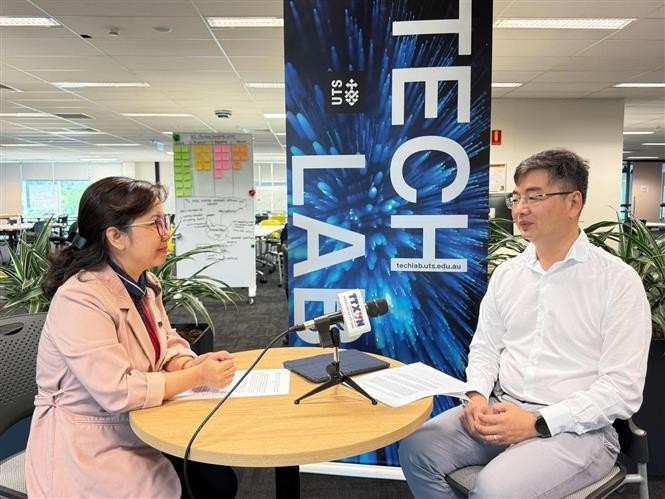
In an interview with the Vietnam News Agency's correspondents in Australia, Professor Nghiem Duc Long, Director of the Center for Environmental and Water Research at the University of Technology Sydney (UTS), welcomed the Party and Government’s sustained attention and increasingly diversified approaches to mobilizing overseas Vietnamese contributions to national development.
    |
 |
|
Professor Nghiem Duc Long (right), Director of the Center for Environmental and Water Research at the University of Technology Sydney (UTS) |
As Chairman of the Vietnamese Association of Scholars and Experts in Australia (VASEA), Professor Long said VASEA members have recently been enabled to contribute in areas aligned with their expertise through multiple channels, including host-country institutions and direct exchanges with Vietnamese agencies. Through the Australian Water Partnership under Australia’s Department of Foreign Affairs and Trade, he has provided technical input to help refine Vietnam’s draft Law on Water Resources. He has also been invited to serve on advisory groups of the Ministry of Science and Technology, contributing to research and innovation orientations, including programs under the National Foundation for Science and Technology Development (NAFOSTED).
He noted that issues opened for OV input in recent years are largely major, long-term matters closely tied to Vietnam’s development needs, areas where overseas Vietnamese, particularly experts and intellectuals, can offer substantial international experience.
According to Professor Long, OVs tend to focus their contributions on technical policy design, implementation mechanisms, international benchmarking and practical lessons, rather than broad principles. When consultations are clearly targeted, well scoped and linked to professional expertise, OV participation is typically active and substantive, he said.
VASEA members, he added, are ready to share lessons from Australia through government-funded programs for small and medium-sized enterprises, such as Innovation Connections and the Cooperative Research Centers (CRC) Program, a key framework fostering collaboration among businesses, universities and research institutions.
Australia is home to more than 300,000 Vietnamese, making it one of the country’s larger migrant communities given Australia’s population of about 26 million. The community has made positive contributions across politics, economy, education, science and technology, culture and arts.
In the OV community in Australia, especially among intellectuals and experts, support for Vietnam’s policies and development orientations is reflected in closely following developments, offering professional feedback and engaging in cooperation in science and technology, education, innovation, economy and sustainable development. Notably, VASEA has rolled out initiatives aligned with Vietnam’s policies, including VietNEST and the Australia Alumni Business Forum.
Professor Long said clearer, more consistent communication of long-term development orientations tends to foster stronger consensus and more active OV participation, particularly where concrete value can be added from international experience. When policies are implemented clearly, overseas Vietnamese respond with practical, sustained and constructive actions, strengthening links with Vietnam’s development process.
He added that many OV intellectuals seek to be heard, trusted and engaged in line with their expertise, ensuring contributions are meaningful and durable. There is also demand for clearer, more stable and transparent channels to facilitate policy advice, research cooperation, training, and support for domestic enterprises and localities.
Looking ahead, VASEA members expect OV participation mechanisms to remain flexible, respect professional expertise and simplify procedures, ensuring contributions are goal-oriented and responsive to real needs. Engagement should also prioritize continuity and long-term cooperation to build trust-based, sustainable partnerships.
Representing VASEA, Professor Long said he and the association’s members aim to continue serving as a bridge linking the international knowledge and experience of Vietnamese experts in Australia with domestic development needs, particularly in science and technology, innovation, education, healthcare and sustainable development, through technical policy advice, research collaboration, human resources training, and support for enterprises and localities in adopting proven international models and solutions.
Source: VNA