Addressing the ceremony, Tran Anh Tuan, President of the association, stressed that the Vietnamese people will always remember the valuable spiritual support extended by the Nepalese people, through progressive solidarity organizations, during Vietnam’s struggle for national liberation and reunification.
    |
 |
|
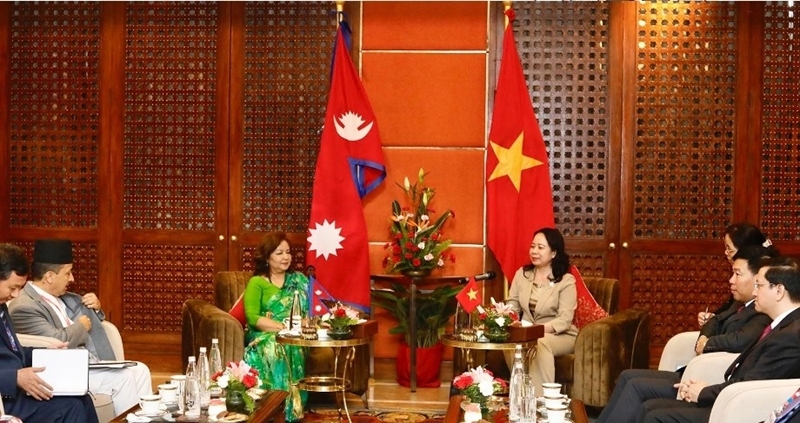
Nepal, Vietnam mark 50 years of relations with high-level visit by Vice President Vo Thi Anh Xuan (Photo: myrepublica.nagariknetwork.com) |
Rabindra Adhikari, coordinator of the Nepal Peace and Solidarity Council (NPSC), stated that Vietnam has long been a symbol of resilience, industrious spirit and noble sacrifice. Its remarkable achievements made in transformation and development over a short period of time have served as a powerful source of inspiration for many countries, including Nepal, he said.
Entering the 21st century amid increasingly complex challenges, the need to strengthen cooperation between the two countries has never been more urgent. The world is facing a range of issues such as climate change, political instability and economic uncertainty. In this context, Nepal and Vietnam can play a positive role in promoting sustainable development, advancing scientific and technological progress, and reinforcing the principles of peace and diplomacy, he suggested.
Adhikari stressed that to further enhance people-to-people exchanges and cultural connectivity, the opening of direct flights between the two countries, as well as the establishment of diplomatic representative offices, would serve as important and potentially transformative foundations.
At the seminar, scholars and researchers from the Vietnam Academy of Social Sciences, together with experts from Nepal, discussed and contributed ideas centered on three main pillars for the nations’ future cooperation, namely political trust and people-to-people diplomacy; economic and trade cooperation; and cultural, tourism and spiritual connectivity.
Participants also agreed that while bilateral friendship and cooperation have developed positively over the past five decades, potential for joint work, particularly in agriculture, industry, trade, tourism, services and people-to-people exchanges, remains underexploited.
They called for enhanced information-sharing on each country’s situation and cooperation opportunities in key sectors; the organization of international conferences, seminars and dialogues on bilateral relations; increased all-level delegation exchanges; strengthened education cooperation through student, intern and postgraduate exchange programs; and the organization of economic, trade, tourism and services exhibitions in both countries.
Source: VNA