The latest data released by the National Statistics Office (NSO) under the Ministry of Finance show that GDP grew by 8.18% in the period, including 8.39% growth in the second quarter.
Shantanu Chakraborty, ADB Country Director for Vietnam, described the figures as highly encouraging, saying they reflect the economy's resilience in the face of global headwinds. He noted that the results exceeded the bank's earlier forecasts.
    |
 |
|
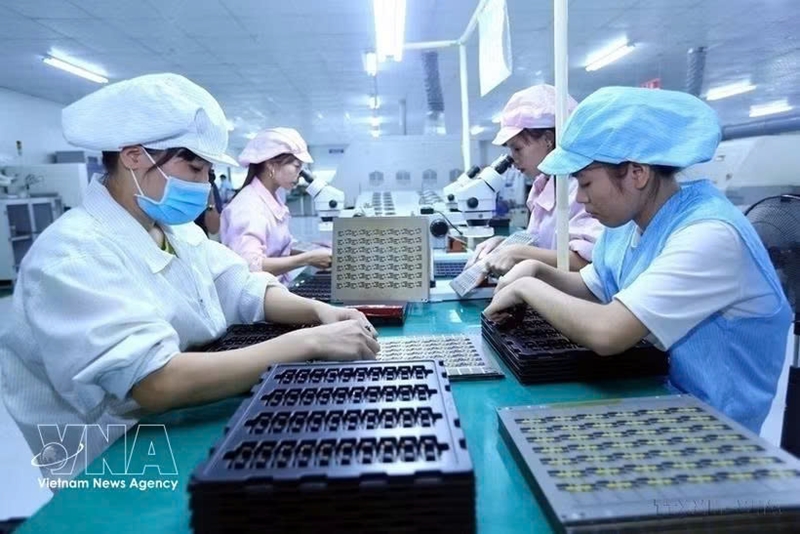
Workers assembles electronic components on the production line at the Bao Sen Co., Ltd. in Bac Ninh province. |
Echoing that view, Bui Minh Giap, ADB's principal economist for Vietnam, said the country's growth has been broad-based, supported by strong performance in industry, construction, services, exports, foreign direct investment (FDI), public investment and a recovery in domestic demand.
Despite the strong headline figures, however, the expert cautioned that external uncertainties and domestic macroeconomic pressures remain significant.
Giap pointed out that with total foreign trade around 170% of GDP, Vietnam is a highly open economy. As a result, fluctuations in global trade, tariff policies and weakening demand in key export markets have a substantial impact on growth through trade, logistics, investment flows, and business reactions.
He also highlighted that imports have been rising faster than exports, resulting in a sizeable trade deficit during the first half of the year. Although the deficit is not entirely a negative indicator as it reflects expanding production activities, with enterprises ramping up imports of machinery, equipment, raw materials, and components to meet manufacturing needs. However, he emphasized the downside of this trend, noting that it highlights the domestic economy’s heavy reliance on imported inputs.
Inflationary pressures, he added, also warrant close monitoring. With both core inflation and the consumer price index (CPI) exceeding 4% in the first half of the year, room for monetary policy maneuvering during the remaining months has tightened, demanding continued flexibility and caution in monetary governance.
Against this backdrop, Giap said the key challenge is no longer how to achieve rapid growth, but how to sustain high-quality, long-term growth while maintaining macroeconomic stability.
Chakraborty agreed, noting that while achieving strong growth in a single year is encouraging, maintaining both the pace and quality of growth over many years will be essential if Vietnam is to achieve its goal of becoming a high-income country by 2045.
To realize that ambition, he said, the economy must move decisively away from a model reliant on capital, low-cost labor and the FDI sector towards one driven by productivity, skills, innovation and a stronger domestic private sector.
The ADB Country Director underlined the need to enhance the capacity of Vietnamese private enterprises to absorb the benefits of foreign investment and participate more deeply in value chains.
Giap added that strong GDP growth must ultimately translate into higher incomes for the population while enabling domestic businesses – particularly small- and medium-sized enterprises (SMEs), which account for more than 95% of firms operating in Vietnam – to integrate into global supply chains.
He also welcomed the Politburo’s Resolution No.10-NQ/TW on the development of the foreign-invested economic sector, noting that its emphasis on linking domestic enterprises with global value chains demonstrates Vietnam's determination to make the domestic private sector a key driver of economic growth.
Regarding foreign investment, Giap said the country’s priority should no longer be attracting greater volumes of FDI, but rather securing higher-quality investment and increasing the share of value added retained within the domestic economy.
He described the inclusion of this objective in Resolution No. 10-NQ/TW as a well-founded policy direction.
Looking ahead, the ADB economist said Vietnam's economic outlook remains highly positive. The bank's Asian Development Outlook (ADO), released in July, continues to project the country as the fastest-growing economy in Southeast Asia.
Source: VNA