Opening the symposium, Prof. Liu Liping, President of the Asian Fisheries Society, said Vietnam has made remarkable progress in aquaculture, particularly through the application of high technologies in offshore farming, helping drive growth in both production and exports.
He noted that Asia remains the global centre of aquaculture, with strong potential for innovation and growth.
    |
 |
|
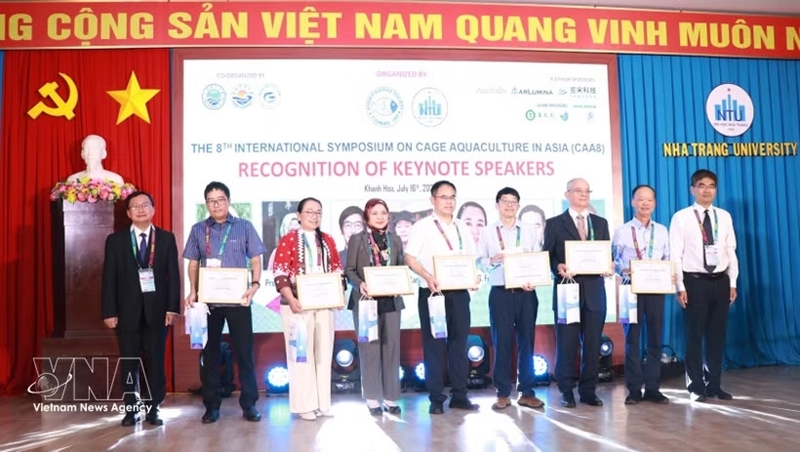
The organizers present certificates of appreciation to speakers who deliver presentations at the symposium. |
According to Liu, the Asian Fisheries Society is committed to three key goals: strengthening collaboration between scientists and farmers, promoting the sustainable use and conservation of of aquatic resources, and expanding partnerships with fisheries organizations across the region.
Quach Hoai Nam, Rector of Nha Trang University (NTU), said the symposium provides a platform for experts to exchange knowledge, seek ways to address challenges and explore opportunities in the fields of technological innovation, breeding, nutrition, processing, environmental management, climate change adaptation and social welfare, helping shape an innovative, adaptable and more sustainable future for the aquaculture sector while fostering stronger international cooperation.
Discussions cover the entire aquaculture value chain, from broodstock and seed production, nutrition, animal health and biosecurity to cage design, environmental monitoring, and efficient resource use.
An NTU representative presented a report on marine cage aquaculture in Vietnam's south-central region, highlighting the development potential of high-value species while identifying challenges related to environmental protection, disease control, seed quality, feed, climate change and technology adoption.
Speakers introduced a range of solutions, including HDPE cages, automated feeding systems, Internet of Things (IoT)-based environmental monitoring, artificial intelligence (AI) applications and integrated multi-trophic aquaculture to improve productivity and sustainability. They also looked into issues related to aquatic animal welfare, economic efficiency, community livelihoods, gender, and governance with a view to promoting cage aquaculture in an efficient, safe, and sustainable manner.
Running from July 15 to 18, CAA8 also features networking activities involving universities, research institutes, professional associations and businesses, alongside technical meetings and cooperation signing ceremonies aimed at strengthening international collaboration in aquaculture.
Source: VNA