According to the National Statistics Office under the Ministry of Finance, GDP expanded by 8.39% in the second quarter, up from 8.14% a year earlier. Growth for the first six months reached 8.18%, exceeding the 7.63% recorded in the same period of 2025.
    |
 |
|
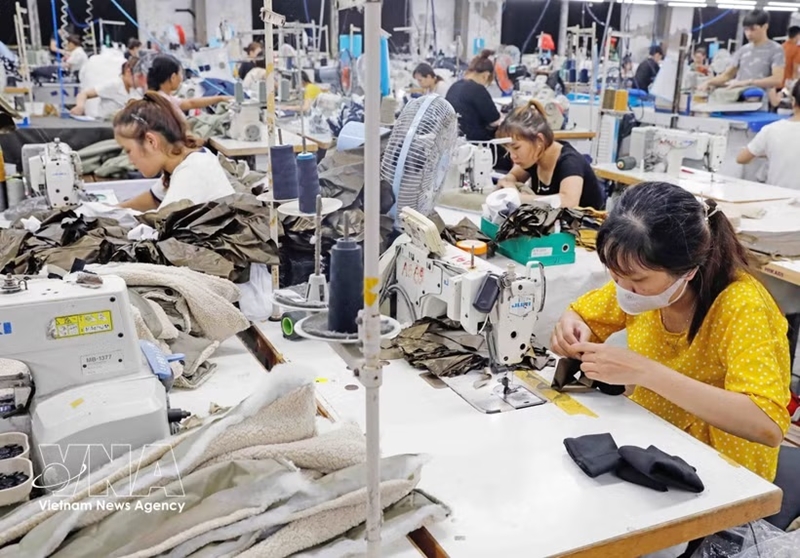
Manufacturing garments for export at Hung Yen Jute and Garment Joint Stock Company |
The performance reflected broad-based contributions from both the supply and demand sides of the economy.
On the supply side, all three major economic sectors recorded balanced growth.
Agriculture, forestry and fisheries remained a key pillar, sustaining steady expansion through structural reforms, wider application of advanced technologies, improved planting-area code management, stronger disease control in livestock and enhanced forest protection.
Industry and construction continued to serve as the main growth engine. Processing and manufacturing led the expansion, rising 10.56% in the second quarter and 10.23% in the first half, supported by a strong recovery in export orders for electronics, computers, metals and automobiles. Electricity and gas production grew 12.19%, ensuring stable energy supplies, while construction rose 10.28% and mining increased 7.59%, driven by higher crude oil and natural gas output.
The services sector also recorded positive growth despite higher input costs.
On the demand side, final consumption rose 7.02% in the second quarter and 8.15% in the first six months. Household spending increased 9.94% in the second quarter and 9.48% in the first half, reflecting stronger domestic demand supported by seasonal spending and the recovery of tourism, accommodation and entertainment services.
Consumption patterns also shifted towards higher-quality and more sustainable products, with spending on environmentally friendly goods and experience-based services such as tourism and leisure increasing.
Asset accumulation remained a major growth driver, surging 20.4% in the second quarter and 15.2% in the first half, reflecting stronger public investment disbursement and a recovery in production. Inventories also rose sharply as businesses increased imports of raw materials and components for future production.
Merchandise trade expanded 27.1% year-on-year in the first six months. Exports increased 21%, while imports climbed 33.4%, driven by higher purchases of fuel, electronic components and production materials, as well as investment in data centers and AI infrastructure. The resulting trade deficit may weigh on the external sector's net contribution to GDP growth.
The statistics office said traditional growth drivers – investment, manufacturing, exports, and consumption - continued to underpin the economy. Faster public investment disbursement, particularly for major infrastructure projects, boosted construction activity while encouraging private investment. Manufacturing and exports remained resilient despite a slow global recovery, and stronger household consumption helped support domestic demand and economic stability.
At the same time, new growth drivers such as science and technology, innovation and the digital economy are gaining momentum and gradually expanding into high-tech industries and services. However, they remain supportive rather than leading drivers of growth, with their full potential dependent on continued institutional reforms, human resource development and a stronger innovation ecosystem.
Source: VNA