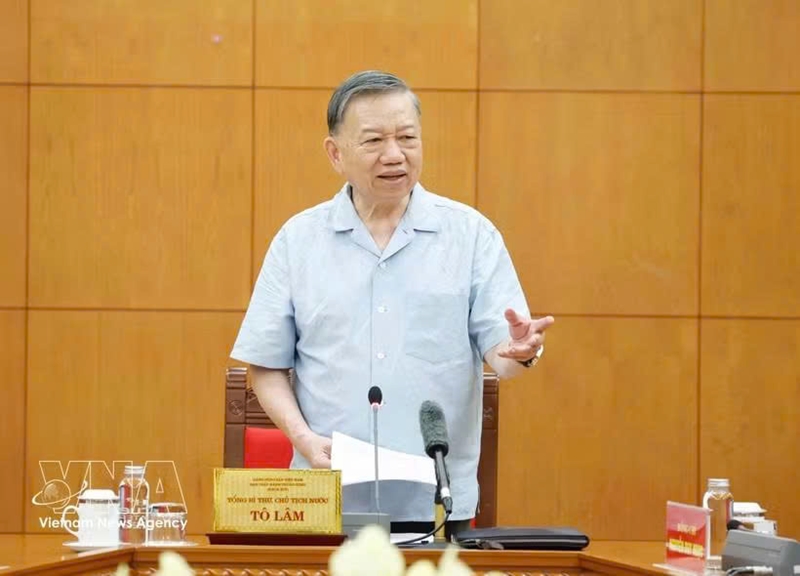
Chairing a working session with relevant agencies on developing the national maritime industry in Hanoi on July 14, the top leader said Vietnam must maintain core capabilities in vessel design, building, repair, conversion and technical maintenance to ensure resilience against supply-chain disruptions, market volatility and emergencies.
    |
 |
|
Party General Secretary and State President To Lam speaks at the working session with relevant agencies on developing the national maritime industry in Hanoi on July 14. |
The shipbuilding industry should be developed based on an integrated ecosystem approach, in tandem with the development of the merchant fleet, inland waterway vessels, ports, logistics, supporting industries and lifecycle services, instead of fragmented development by individual factories, localities or product lines, he said, noting that policies should foster chain links, stable markets, rational division and overall efficiency.
According to the General Secretary and President, the State should play a facilitating role by providing strategic direction, improving institutions, organizing markets and ensuring essential industrial capabilities, rather than reverting to subsidies or taking over the role of businesses. Enterprises, in turn, should lead investment, production, innovation and competition, while taking full responsibility for their performance.
The roles of the State and businesses must be clearly defined, with each economic sector leveraging its strengths, transparent competition ensured, and policies not used to mask weak governance, General Secretary and President Lam said.
He underscored that maritime industry development must be selective and based on actual demand, national competitive advantages and long-term efficiency. Investment decisions should prioritize technology mastery or transfer, management capacity, market prospects and the value retained within the country. The country should refrain from scattered and overlapping investment, and never sacrifice quality, safety or environmental standards for short-term growth, he stressed.
The top leader also emphasized that international cooperation, foreign investment attraction and development of dual-use defense industry must serve the goal of enhancing Vietnam’s strategic autonomy.
For the immediate tasks ahead, he called for efforts to unlock markets, fully tap existing capacity, and remove bottlenecks hindering development.
He instructed the Government's Party Committee to direct the Government to promptly build a national program on maritime and marine engineering industry development through 2035, with a vision to 2050. He noted that the program must define clear objectives, priorities, implementation roadmaps, resources and mechanisms, while aligning with strategies for shipping, inland waterways, ports, logistics, marine energy, and defense and security.
He also ordered a comprehensive review, assessment and classification of the industry's capabilities to clearly identify which capabilities should be preserved, upgraded, integrated, transformed or phased out, while pinpointing strategically important enterprises, assets, technologies, data and technical personnel for appropriate policy responses. The assessment must serve as the basis for policymaking, resource allocation and performance evaluation, he noted.
Attention must be paid to studying and refining financial, credit, guarantee and insurance mechanisms tailored to the shipbuilding industry's unique characteristics, including large-scale contracts, long project cycles and high risks, he said, noting that support mechanisms must be conditional, targeted and linked to confirmed orders, enterprises' capabilities, viable financing plans and transparent governance.
|
|
 |
|
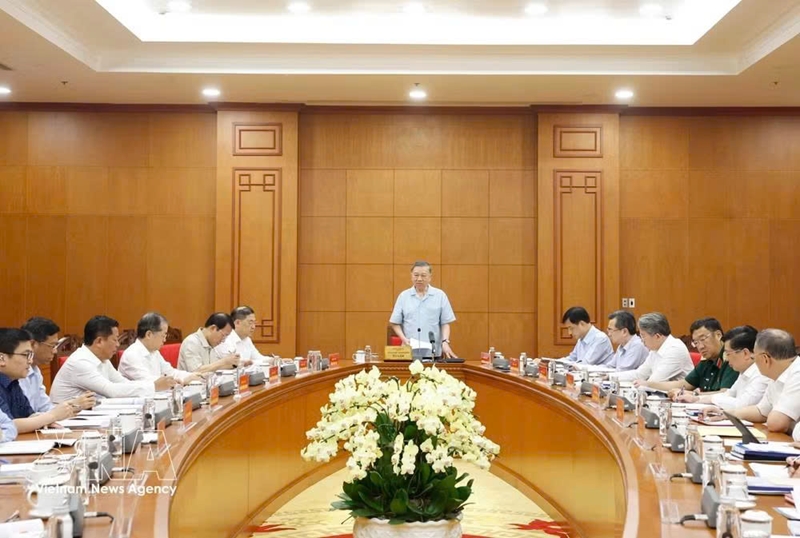
An overview of the working session |
He further urged the reorganization of the domestic market by linking demand for merchant vessels, inland watercraft, public-service ships, offshore services and defense–security vessels with domestic industrial capacity under the principles of competition, quality and efficiency. In the near term, ship repair, retrofitting, green upgrading, maintenance and lifecycle services should be prioritized to maximize existing capacity, generate stable revenue and retain skilled workers.
The leader stressed that legal issues and legacy problems must be resolved in accordance with the law while protecting the legitimate rights and interests of the State, creditors, employees and other stakeholders. He also warned against mechanical solutions that could result in the loss of strategic industrial assets, technologies, data, customer networks and highly skilled workforce.
Looking further ahead, he said Vietnam must move beyond maintaining production capacity to building a modern, green, digital and internationally competitive maritime industrial ecosystem with strong self-reliance. This includes developing supporting industries, ship design, science and technology, standards, data systems and high-quality human resources, while promoting new models of FDI attraction, joint ventures, supplier development and exports.
He also called for the development of dual-use defense and security industries in shipbuilding and marine engineering, alongside the establishment of several specialized maritime and inland waterway industrial clusters based on regional strengths and integrated into a national production network.
The Party and State leader affirmed that Vietnam will develop its maritime industry through an ecosystem-based approach, focused investment and disciplined implementation, ensuring the proper roles of the State, enterprises and international cooperation. The ultimate goal is to build a maritime industry that strengthens Vietnam’s capacity to harness the sea, master its water transport system and enhance the country's position in the new era, he stressed.
Source: VNA