The move is to maximize economic and social benefits once the lines become operational - a departure from previous practices.
According to the plan, construction of Metro Line No.2 (Ben Thanh - Tham Luong) is scheduled to begin on January 15, 2026. Immediately after finalizing the groundbreaking timeline, the municipal People’s Committee instructed relevant agencies to roll out TOD projects along the route.
    |
 |
|
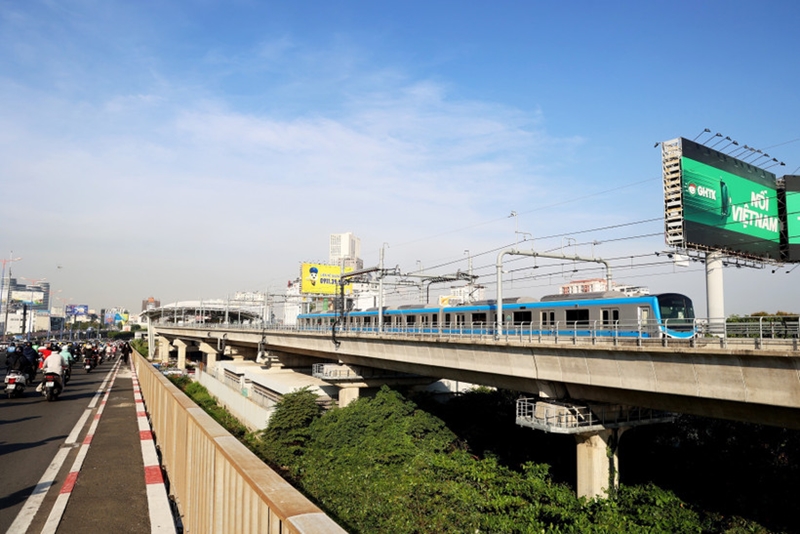
Ho Chi Minh City's Metro Line No.1 (Ben Thanh - Suoi Tien) |
Departments and agencies have been tasked with urgently reviewing zoning plans, preparing planning outlines and cost estimates, and allocating funding for TOD planning along Metro Line No.2.
Under the roadmap, all stages - from consultant selection and plan formulation to appraisal and approval of TOD zoning plans - will be carried out between January and August 2026. This demonstrates the city’s determination to minimize delays between infrastructure investment and the exploitation of land-based value added.
A major advantage of TOD projects along Metro Line No.2 is that many land plots have already been identified and can be implemented quickly without major site-clearance obstacles.
Financial mechanism remained a major roadblock in the past, which, however, is now being gradually removed following the National Assembly’s adoption of the amended Resolution 98, allowing Ho Chi Minh City to retain 100% of revenue generated from land development in TOD areas and reinvest it directly into related transport infrastructure projects.
Ben Gray, Head of Capital Markets at Knight Frank Vietnam, described the new mechanism as a positive step forward.
The policy enables the city to reinvest directly in expanding and upgrading public transport, creating a circular ecosystem that builds investor confidence in transport-linked real estate projects while reducing reliance on the state budget, he said.
Phan Cong Bang, head of the Ho Chi Minh City Management Authority for Urban Railways (MAUR), noted that simplified procedures, stronger decentralization and greater autonomy for the city and enterprises have created fresh momentum, attracting growing investor interest in metro and TOD projects.
With mechanisms now in place, the parallel implementation of metro lines and TOD is considered both feasible and promising. This approach is expected to serve as a foundation for expanding the model to future metro lines, supporting the city’s goal of completing six urban railway lines within the next five years.
Source: VNA