This was their second meeting this year, reflecting joint commitment to promoting development cooperation.
At the meeting, Tuan outlined Viet Nam's goals of becoming a developing country with modern industry and upper-middle income by 2030, and a developed, high-income nation by 2045.
To achieve these targets, the country's investment demand in 2026-2030 is projected to be more than 2.2 times that of the 2021-2025 period, he said.
    |
 |
|
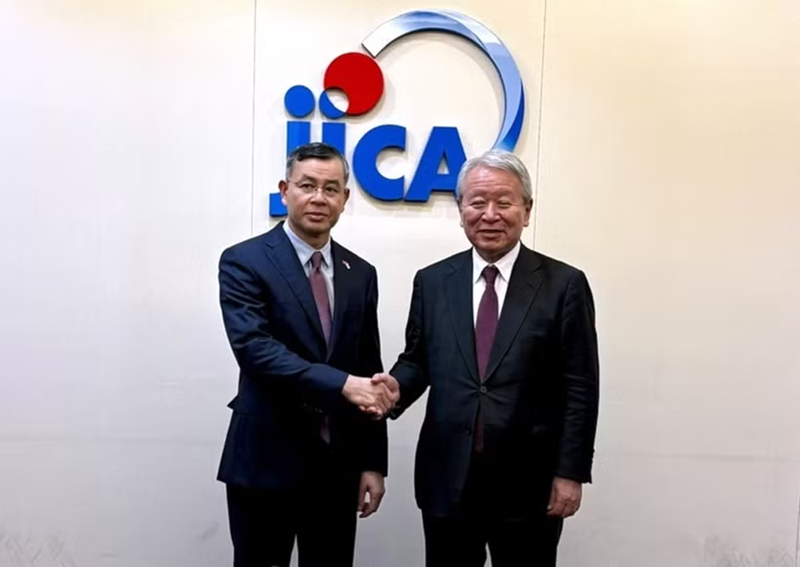
Finance Minister Ngo Van Tuan (left) and Tanaka Akihiko, President of the Japan International Cooperation Agency (JICA) |
The official therefore called on the Japanese Government, through JICA, to continue providing funding for Viet Nam's essential infrastructure projects.
He also briefed the Japanese side on progress in streamlining the administrative apparatus and strengthening decentralization and delegation of authority, alongside greater accountability among agencies and localities.
Reviewing cooperation since Tanaka's visit to Viet Nam in June, both sides noted positive progress in official development assistance (ODA), particularly through a trilateral task force involving the Vietnamese Ministry of Finance, the Japanese Embassy and JICA in Viet Nam. The mechanism has helped address obstacles facing Japanese-funded ODA projects, including Ho Chi Minh City's Metro Line No.1 and projects supplying equipment through Japanese grant aid.
Progress was also recorded in negotiating and signing loans and grants for new programs and projects. Three key ODA documents – an exchange of notes for the Viet Nam-Japan University project, a loan agreement for the O Mon III Combined Cycle Power Plant Construction Project (I), and an agreement facilitating Japanese grant-aid projects – were signed and exchanged in the presence of Party General Secretary and President To Lam and Japanese Prime Minister Takaichi Sanae on the evening of November 9.
Looking ahead, both sides agreed to make full use of existing dialogue and coordination mechanisms to resolve outstanding issues in projects funded by Japanese ODA loans and grants. They also pledged to accelerate the O Mon III and Viet Nam-Japan University projects and discuss a budget-support loan for artificial intelligence (AI) development.
Tuan called on JICA to work closely with the ministry to harmonize procedures and shorten project preparation times, improving the mobilization, management and use of ODA funds to meet Viet Nam's development needs.
Tanaka affirmed that strengthening cooperation with Viet Nam was a priority agreed upon by the two countries' senior leaders. He praised the trilateral task force's role in resolving project implementation difficulties and called for continued coordination to speed up disbursement, payments to contractors and implementation of projects with committed funding.
He said Japan wished to expand cooperation with Viet Nam in infrastructure development, human resource training, AI, science and technology. With Japan's strengths in AI and semiconductor technology and the participation of leading global companies, he expressed confidence that closer cooperation would help both sides leverage their respective advantages.
Both officials expressed confidence that Viet Nam-Japan development cooperation would continue to deepen in a substantive and effective manner, remaining an important pillar of the Comprehensive Strategic Partnership between the two countries in the new development era.
Source: VNA