At the meeting, Thang thanked the IMF delegation for its serious, constructive and responsible work, with frank discussions, objective assessments and practical policy recommendations during the consultation.
He expressed his hope that the delegation would fully consider the information, explanations and policy views provided by Vietnamese Government agencies to ensure that the 2026 Article IV report offers a comprehensive, objective and balanced assessment of the country’s macro-economic situation, specific circumstances, achievements, challenges and policy directions.
    |
 |
|
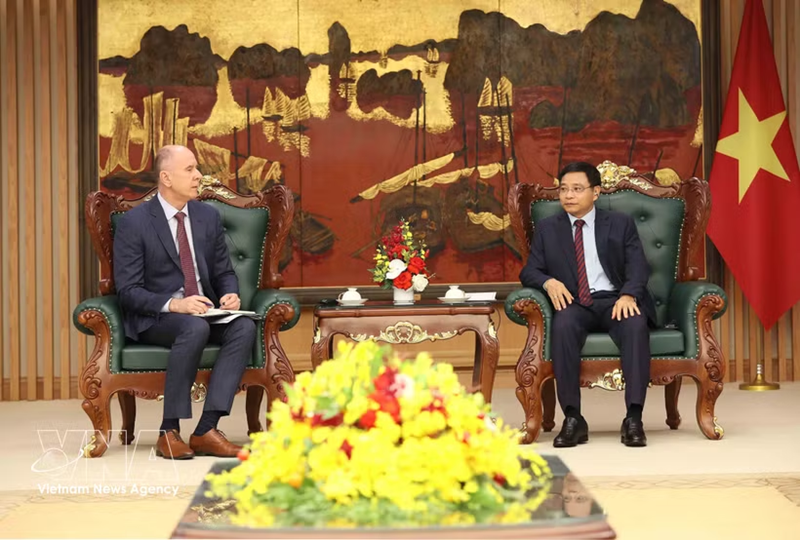
Deputy Prime Minister Nguyen Van Thang meets with Martin Sommer, head of the IMF’s Article IV consultation mission team to Viet Nam, in Ha Noi on November 13, 2026. |
Sommer welcomed the Vietnamese Government’s efforts to maintain macro-economic stability while taking decisive measures to accelerate growth. He described Viet Nam as one of the world’s fast-growing economies, with positive growth prospects.
He also praised the Government’s pro-active approach to structural reforms, particularly social welfare policies. These measures were moving in the right direction and would help strengthen the foundations for long-term growth, he said, encouraging Viet Nam to continue pursuing them.
Sommer noted that inflation risks in Viet Nam remain under control, but several factors could add to price pressures. He therefore called for cautious monetary policy management and readiness to respond promptly if inflationary pressures increased.
He said 2027 will be an important year as Viet Nam implements its growth plans, requiring continued vigilance and flexibility in policy management. The IMF stands ready to provide policy advice and maintain close coordination with the Ministry of Finance and the State Bank of Viet Nam, he added.
Thang said the Government, ministries, sectors and localities were working to achieve key targets, including economic growth alongside inflation control – two challenging objectives.
Under the National Assembly’s resolution on the 2027 socio-economic development plan, adopted on November 7, Viet Nam aims for GDP growth of at least 10%, per capita GDP of around USD 6,100, inflation of about 4.5%, and total social investment equivalent to 36-38% of GDP.
Achieving these targets will require strong reforms, higher productivity and more efficient resource allocation, he said. However, Viet Nam will not sacrifice macro-economic stability or the safety of its financial and banking systems for short-term, unsustainable growth.
Regarding external risks, Thang acknowledged the IMF’s concerns that geopolitical tensions, particularly in the Middle East, could trigger energy shocks, raise imported inflation and affect inflation expectations.
He said the Government is taking coordinated measures, including managing fuel prices under a market-based mechanism with State regulation, using price stabilization tools and tax and fee policies, and providing targeted fiscal support. It was also working to ensure energy security, diversify supply sources and promote energy efficiency.
Thang also highlighted the need for comprehensive structural reforms, effective public investment and sound management of fiscal and public debt risks to improve medium-term growth prospects.
Viet Nam is determined to shift from extensive to intensive growth, with productivity, efficiency and competitiveness serving as the foundations for long-term growth.
Economic growth must also go hand in hand with improvements in people’s living standards, he stressed.
Source: VNA