The event was part of the second Thang Long - Hanoi Festival 2026, themed “Hanoi – A Heritage Flow.”
Addressing the event, Le Thi Anh Mai, Deputy Director of the Hanoi Department of Culture, Sports and Tourism, said that as part of the second Thang Long - Hanoi Festival, the department, in coordination with the Hanoi Museum, is organizing a series of art programs, exhibitions and discussions to introduce, promote and bring into greater play the value of intangible cultural heritage.
    |
 |
|
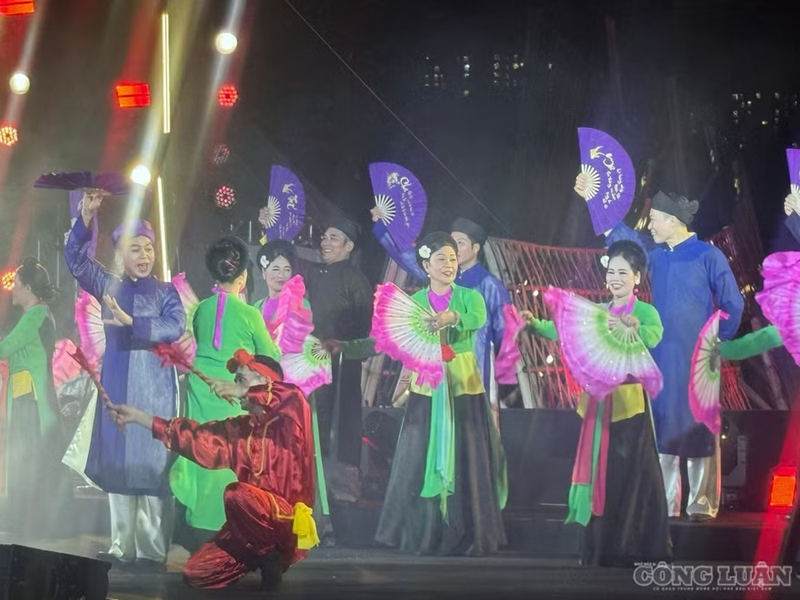
Artists and performers showcase traditional art in the "Music and Heritage" program at the Hanoi Museum. |
The activities, including “Music and Heritage”, “Connecting Heritage – Creating the Future” and “Heritage Stream.” provide spaces for community groups to practice, perform and share cultural values passed down through generations.
The key message the organizers want to convey to the public and international friends is that heritage is not a collection of artefacts or values frozen in the past, but a living flow that continues to evolve, adapt and be enriched by each generation, Mai said.
The organizers hope to develop new approaches to make intangible cultural heritage more accessible to the public, particularly young people, she added.
The “Music and Heritage” program featured two main activities, namely an artistic parade around the museum grounds from 5:10 pm and an evening performance at 8 pm on the main stage in front of the museum.
The program draw the participation of six representative traditional arts clubs from Hanoi, showcasing three forms of traditional performing arts – Cheo (traditional Vietnamese opera), Tuong (classical Vietnamese drama) and Ca tru (also known as Hat A Dao) singing.
The clubs are directly involved in preserving and passing on traditional arts within their communities. Through the work of artisans and artists, cultural values have been transmitted across generations and are gradually being brought back into contemporary life through approaches suited to today's audiences.
By combining performances, hands-on experiences and interaction with artists, the program not only introduced traditional arts but also gave audiences an opportunity to learn first-hand about how heritage has evolved, been practiced and passed down through generations. The approach aims to bring traditional art forms closer to everyday life, particularly for younger audiences.
According to the Hanoi Museum, the “Music and Heritage” program contributes to enhancing the museum's role as a space connecting heritage with the community, thereby raising public awareness and encouraging greater participation in the preservation and promotion of Thang Long - Hanoi's intangible cultural heritage.
Bringing artisans, artists and community-based heritage clubs into an open space for performances and interaction also creates further opportunities for traditional art forms to remain part of contemporary cultural life, while helping promote the cultural identity of Thang Long - Hanoi to a wider audience.
Source: VNA