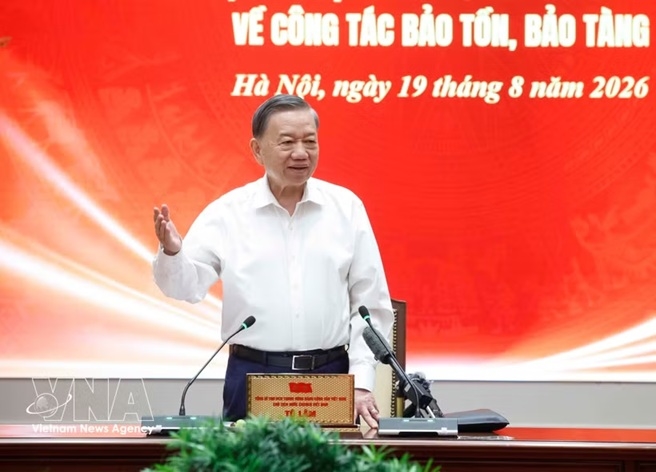
At a working session with the Ministry of Culture, Sports and Tourism (MoCST) in Hanoi on August 19, General Secretary and President Lam called for a serious reassessment of the capacity and structure of the preservation and museum system, swift action on shortcomings and long-delayed projects, and a gradual enrichment of national collections.
    |
 |
|
Party General Secretary and President To Lam speaks at the event. |
The MoCST, he said, must complete a preliminary review to identify urgent issues and prepare a comprehensive report clearly outlining priority areas and solutions for each group of problems. The review should cover the condition of heritage sites, deterioration of existing bodies and investment priorities, avoiding prolonged piecemeal repairs in which repeated investments ultimately fail to fix fundamental problems.
The top leader called for the settlement of gaps in the preservation of Viet Nam’s history from independence to the present, particularly the history of reconstruction, development and social transformation. He stressed the need to build the capacity to identify and create future heritage as soon as such values begin to emerge.
He said historical and cultural data and heritage must be seen as a core component of the national cultural infrastructure, and called for a unified, interconnected, verifiable and sustainable national digital cultural data repository, along with special and breakthrough mechanisms to advance data and artificial intelligence (AI) in protecting heritage and transforming cultural values into economic value. The long-term digital preservation challenge must be tackled immediately, he noted.
According to the General Secretary and President, AI will play an increasingly important role in searching for, compiling, interpreting and disseminating knowledge. This is a matter of knowledge sovereignty and the right to tell the nation’s own story, rather than merely a digital transformation project for the cultural sector.
The MoCST was urged to renew how museum performance is evaluated, with measurable indicators covering visitor numbers and profiles, whether young people visit and return, the impact of educational activities, research contributions, data use and the social benefits generated from state investment.
The Ministry of Education and Training must coordinate to make museums regular learning spaces, as history and culture conveyed solely through textbooks are less likely to foster a deep connection than seeing authentic artifacts, experiencing real spaces and engaging with real stories, he said.
The MoCST reported that Viet Nam now has more than 40,000 heritage sites and nearly 70,000 inventoried intangible cultural heritage elements. A total of 20,060 relics and antiquities have been registered under the Law on Cultural Heritage. The country has 177 museums housing more than 4 million documents and artifacts, including many rare and valuable collections, while 1,881 artisans have been awarded People’s Artisan or Meritorious Artisan titles.
Source: VNA