The recognition is not only an affirmation of its cultural value, but also a strong impetus to transform the risk of falling into oblivion into opportunities for sustainable development.
    |
 |
|
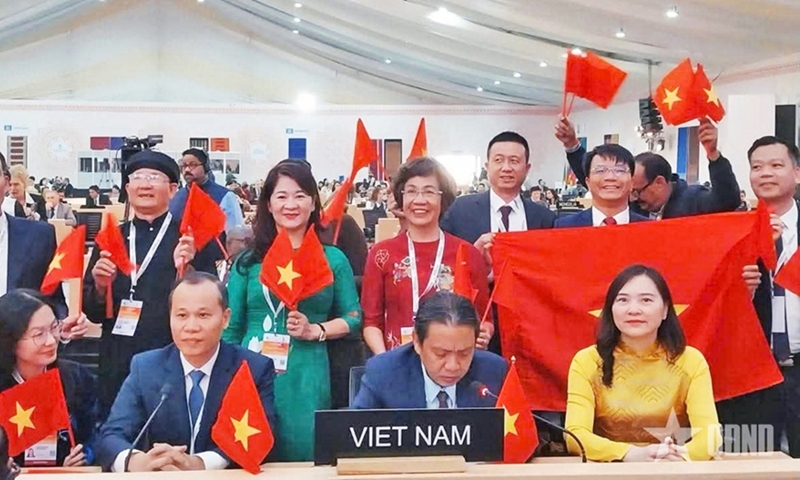
The Vietnamese delegation at the twentieth session of the Inter-governmental Committee for the Safeguarding of the Intangible Cultural Heritage in New Delhi, India |
Beyond their appealing subject matter, Dong Ho paintings are widely regarded by art scholars as genuine works of art. They are distinguished by unique color harmonies, characteristic line and block printing techniques, and a rustic yet refined aesthetic that resonates with the sensibility of Vietnamese folk verses and poetry.
|
|
 |
|
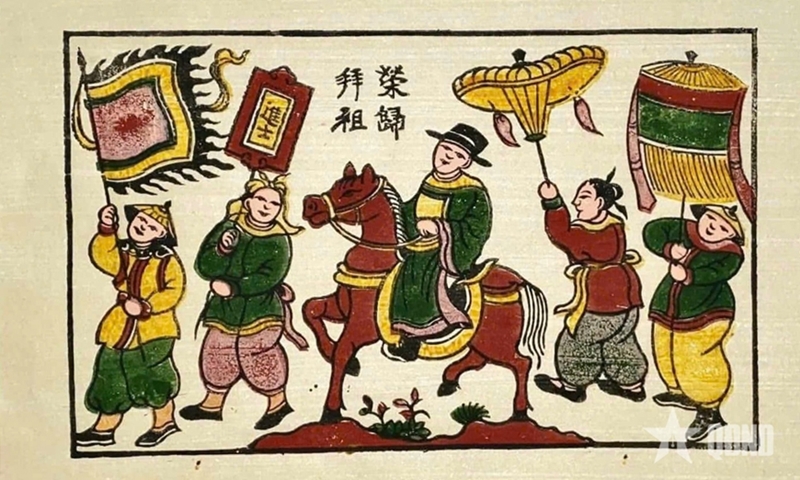
Dong Ho painting, titled “Vinh quy bai to” (Returning home in glory to pay homage to ancestors) |
Dong Ho paintings belong to the genre of folk fine arts, with distinct features in themes, printing techniques, colors, and graphic composition. The subjects are diverse, ranging from worship paintings and congratulatory paintings to historical scenes, narrative stories, depictions of daily life, and landscapes. These works are closely associated with traditional customs, particularly the practice of displaying paintings during the Lunar New Year, the Mid-Autumn Festival, ancestor worship. As such, the Dong Ho painting craft vividly reflects the cultural life and social customs of the community and has been transmitted from generation to generation.
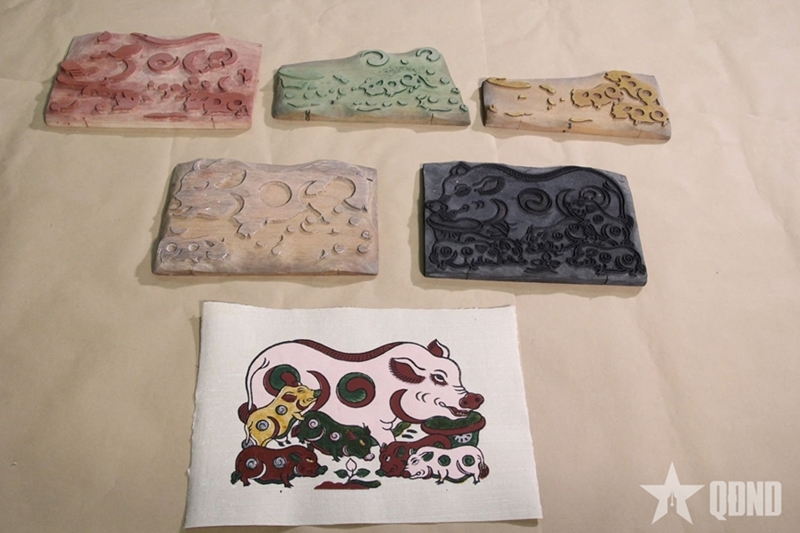
The knowledge and skills involved in the craft, such as designing motifs, selecting materials, carving woodblocks for line and color printing, making do paper coated with diep flakes, and printing the paintings are passed down directly through hands-on practice within families and clans, from experienced artisans to apprentices. Certain stages, especially motif creation and woodblock carving, are highly demanding and require both talent and long-term training; only a limited number of individuals are able to master these techniques.
|
|
 |
|
Dong Ho woodblocks, regarded as family heirlooms and vital means of livelihood, passed down from generation to generation |
The Dong Ho painting craft is deeply embedded in the historical, cultural, and social life of Dong Ho village, closely associated with the village’s name and with Dinh Tranh, the communal house dedicated to the village’s tutelary deity. The paintings produced through this craft carry profound cultural value, reflecting everyday life, beliefs, and moral values of Vietnamese communities in the Red River Delta.
The bearers of this heritage are Vietnamese residents of the former Dong Ho village (now Dong Khe residential area, Thuan Thanh ward, Bac Ninh province). Prior to the 1950s, the village was home to 17 clans engaged in the painting craft, with around 180 households, approximately 80 percent of which participated in producing Dong Ho paintings. Over time, however, the number of practitioners has declined sharply. Today, only three families, comprising about 30 individuals across four generations, are still capable of fully practicing the craft, notably the families of artisans Nguyen Dang Che, Nguyen Huu Hoa, and Nguyen Huu Qua.
UNESCO’s inscription comes at the time when the Dong Ho painting craft is facing serious challenges, including a shortage of successor artisans, a shrinking market, and strong pressures on the craft village space caused by urbanization. For this reason, the recognition serves not only as encouragement but also as a warning, highlighting the urgent need for coordinated and sustainable safeguarding measures.
|
|
 |
|
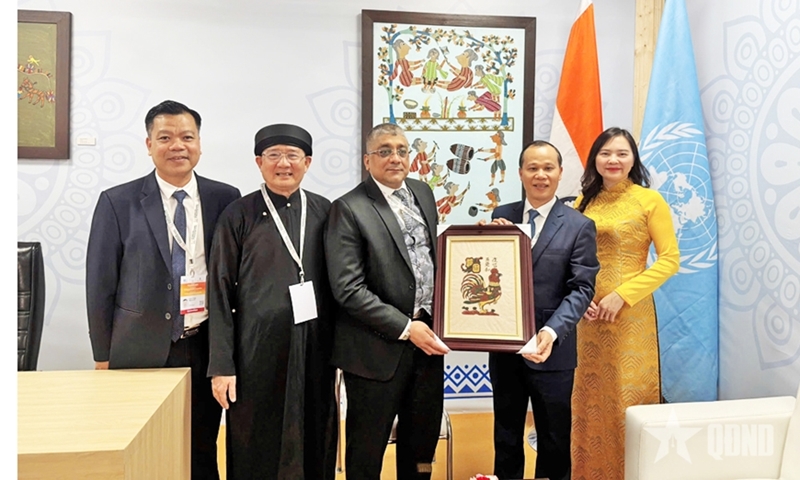
Standing Vice Chairman of the Bac Ninh Provincial People’s Committee Mai Son and the province’s delegation present a Dong Ho painting to international delegates at the 20th session. |
Attending the 20th session of the Intergovernmental Committee for the Safeguarding of the Intangible Cultural Heritage under the 2003 Convention, held in New Delhi, India, members of the Vietnamese delegation viewed the inscription as an important opportunity to revive and develop the Dong Ho painting craft. According to Hoang Dao Cuong, Deputy Minister of Culture, Sports and Tourism and Head of the Vietnamese delegation, the decision reflects the international community’s high appreciation of the unique values, historical depth, and profound humanistic significance of a folk painting tradition that has been intertwined with Vietnamese cultural life for centuries.
Mai Son, Standing Vice Chairman of the Bac Ninh Provincial People’s Committee, noted that when the committee considered the nomination, the heritage-bearing community and many local residents closely followed the proceedings and were delighted by the official inscription. He emphasized that the recognition affirms the outstanding global value of the Dong Ho painting craft not only in artistic terms, but also in its folk knowledge, cultural identity, and humanistic messages.
Immediately after the inscription, Bac Ninh province launched an Urgent Safeguarding Action Program for the Dong Ho folk painting craft in accordance with international commitments. Key measures include strengthening the community of artisans, organizing training and transmission classes to nurture successor generations, and ensuring the long-term continuity of the craft.
The province also focuses on preserving the practice space by restoring traditional craft households, developing exhibition and creative spaces, improving the craft village environment, and linking preservation efforts with cultural tourism. In addition, specialized agencies are tasked with inventorying, digitizing, and preserving the system of woodblocks and related materials to form a data bank serving research, education, and creative activities.
|
|
 |
|
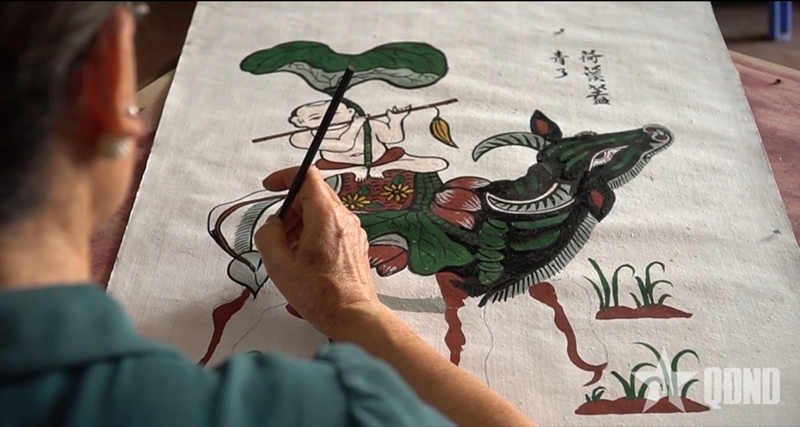
The inscription of the Dong Ho folk painting craft on UNESCO’s List of Intangible Cultural Heritage in Need of Urgent Safeguarding opens up numerous opportunities for the craft village to recover and develop. |
Alongside these efforts, Bac Ninh seeks to enhance international cooperation, promote communication, diversify experiential products, and connect markets to create sustainable livelihoods for practitioners. All activities are implemented under the principle that the community is the central actor, while state agencies play a supporting role, ensuring that the Dong Ho folk painting craft is preserved in line with its authentic values and oriented toward sustainable development.
Translated by Tran Hoai