This is Vietnam’s 17th intangible cultural heritage element recognized by the United Nations Educational, Scientific and Cultural Organization (UNESCO).
    |
 |
|
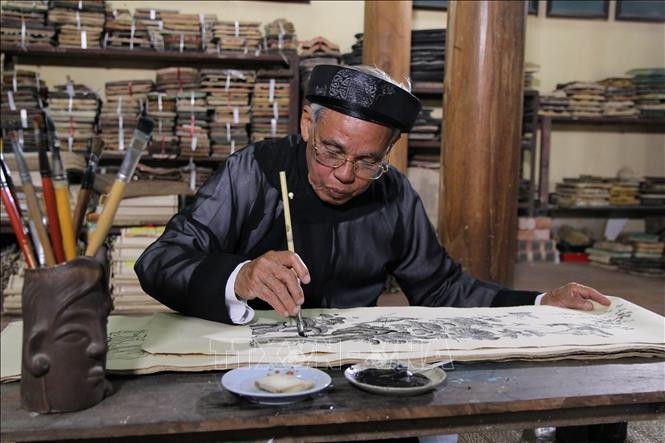
Artisan Nguyen Dang Che, one of the few individuals still practicing this ancient craft in Thuan Thanh ward, Bac Ninh province |
The committee found that the craft meets all criteria for urgent safeguarding. Dong Ho folk paintings are closely tied to major traditional festivals, including the Lunar New Year and the Mid-Autumn Festival, as well as ancestral and deity worship. However, only a handful of families in Bac Ninh province still practice the craft, passing skills down informally within households. The number of skilled artisans has fallen sharply due to limited economic prospects and declining demand for traditional woodblock prints during festivals, leaving too few practitioners to sustain transmission.
Vietnam’s safeguarding plan includes training classes, systematic inventorying, design development, market diversification, improved access to raw materials, and the provision of protective equipment for artisans. UNESCO assessed these measures as feasible, sustainable and inclusive, with the practicing community playing a central role. The nomination file also demonstrated the active involvement of local families in preparing documents and maintaining updated heritage inventories.
UNESCO encouraged Vietnam to integrate the craft into both formal and informal education to foster understanding among younger generations and strengthen long-term preservation efforts.
The craft originated some 500 years ago in Dong Khe street, Thuan Thanh district, Bac Ninh province, where communities developed a distinctive style of woodblock printing. Themes span worship paintings, blessings, historical narratives, daily life and landscapes, traditionally displayed during New Year celebrations and in ancestral altars. Every stage of production, from sketching the design to carving woodblocks, preparing colors and printing, is carried out by hand.
Designs are drawn using brushes and Chinese ink on do (poonah) paper before being carved into wooden blocks. Colors are produced from natural materials such as indigo for green, seashell powder for white, and ash from bamboo leaves or rice straw for black. Prints are made by pressing each colored woodblock sequentially onto paper coated with diep flakes, with red applied first and black lines added last.
The Department of Cultural Heritage said UNESCO’s recognition affirms the craft’s artistic and historical value and provides fresh momentum for safeguarding a tradition at risk of disappearing. It is expected to raise public awareness, encourage youth engagement and mobilize support from local authorities and cultural organizations. The inscription also enhances Vietnam’s cultural visibility internationally and reinforces pride in the country’s heritage diversity, the department stated.
Vietnam currently has 37 heritage elements recognized on UNESCO’s various lists, including world cultural and natural heritage sites, intangible cultural heritage elements, and documentary heritage entries. Bac Ninh province alone is home to several notable UNESCO-inscribed elements, including Quan ho (love duet singing), Ca tru (ceremonial singing), Mother Goddess worship and Huu Chap tug-of-war tradition, underscoring its role as a major center of Vietnamese cultural identity.
Source: VNA