The meeting formed part of the Party leader's state visit to Laos, attendance at Laos' 50th National Day celebration, and participation in a high-level meeting between the the CPV and the Lao People's Revolutionary Party (LPRP).
    |
 |
|
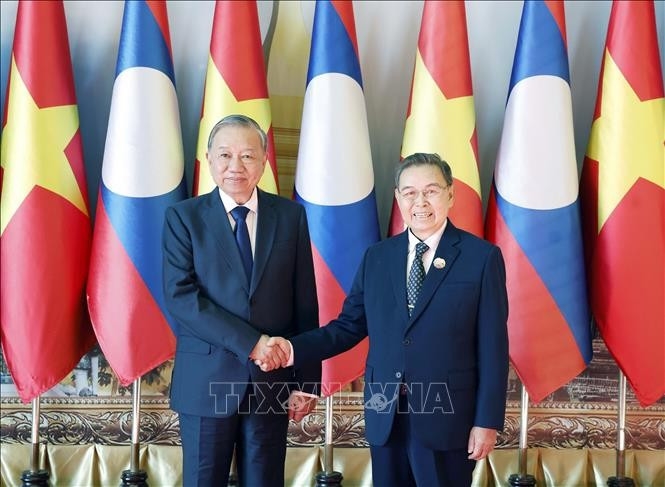
General Secretary of the Communist Party of Vietnam Central Committee To Lam (left) and Lao National Assembly Chairman Saysomphone Phomvihane at their meeting in Vientiane on December 1 |
General Secretary Lam briefed Chairman Phomvihane on the successful outcomes of his talks with LPRP General Secretary and President of Laos Thongloun Sisoulith. The two sides agreed to elevate Vietnam - Laos relations to the level of “great friendship, special solidarity, comprehensive cooperation and strategic cohesion.”
Both host and guest expressed their delight at the close and effective cooperation between the two N.A.s. The countries are effectively implementing the cooperation agreement between their legislatures, with joint work between their parliamentary committees and agencies carried out through flexible forms, both bilaterally and at regional and international inter-parliamentary forums.
Chairman Phomvihane affirmed that the Lao N.A. would work closely with its Vietnamese counterpart in effectively supervising the implementation of high-level agreements and cooperation accords, particularly key economic projects, thereby helping deepen the great friendship, special solidarity and comprehensive cooperation between the two countries.
The two leaders welcomed the increasingly substantive and effective development of cooperation in politics, security and defense, science and technology, education and training, people-to-people exchanges and locality-to-locality partnerships. Parliamentary collaboration has also grown robustly.
During the meeting, General Secretary Lam suggested several measures to strengthen ties between the two N.A.s, including continued exchanges and sharing of experience in areas of shared concern, especially in institutional building, legal system development, supreme oversight and decision-making on significant national matters.
He underscored the need to improve institutions and policies to facilitate the realization of high-level agreements between the two Politburos and cooperation pacts between the two Governments. The two legislatures should also work closely in overseeing the implementation of bilateral agreements; enhance supervision of investment cooperation projects; and propose solutions to institutional and procedural obstacles, creating a favorable legal environment for businesses and localities of both countries to cooperate sustainably and for mutual benefit.
The Vietnamese leader said both sides should continue close coordination and mutual support at regional and international parliamentary forums; strengthen consultations and align positions on regional and global issues in line with each country’s interests and priorities, and harmonized with ASEAN’s common stance, thereby contributing to maintaining a peaceful and stable environment for development.
The legislative bodies should also play a stronger role in spreading cooperation achievements in politics, defense and security to economy and other fields. They should establish cooperation mechanisms to work alongside governments, local administrations and sectors of both countries in addressing current challenges in bilateral cooperation, laying the foundation for further strengthening relations in the new period.
The Party chief thanked the top legislator for his attention and support for the Vietnamese community living, studying and working in Laos. He also called on Laos to continue creating favorable conditions for Vietnamese businesses and citizens investing and working in the country, contributing to Laos’ socio-economic development and bilateral relationship.
Immediately following their meeting, the two leaders launched an e-book on 50 years of relations between the Lao and Vietnamese N.A.s (1975-2025).
The publication represents the collective effort of N.A. leaders, agencies, officials and researchers of both countries, summarizing the time-tested traditional friendship and cooperation from the years of their struggles for national independence to the current period of national protection and development. It also highlights the longstanding cooperative ties between the two N.A.s.
Source: VNA