Today, the integration of modern technology with traditional craftsmanship is helping the centuries-old village preserve its heritage while adapting to rapid changes in manufacturing.
Bat Trang has moved beyond its traditional reliance on coal-fired kilns, where firing quality depended heavily on a craftsman's experience. Today, many workshops use gas and electric kilns equipped with automated temperature control systems, allowing for more precise firing, fewer defects, lower fuel consumption, and reduced emissions.
    |
 |
|
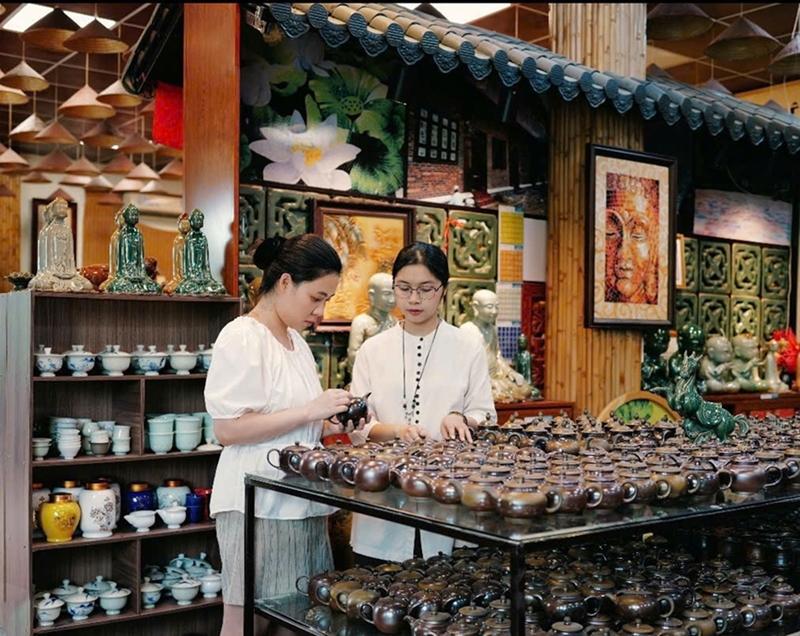
The product exhibition space at Bat Trang Pottery Village in Hanoi attracts visitors. |
Technology has also been applied to the production process, including clay preparation, raw material grinding, glaze filtration, mold making, and drying. Some businesses have established research laboratories, while others have adopted artificial intelligence and automated kiln management systems to monitor temperature, firing time, and each stage of the firing process with greater accuracy. At the same time, digital tools for product design, inventory management, order tracking, and online sales have become an important part of daily operations, helping local producers expand into broader markets through websites, social media, and e-commerce platforms.
Vu Dinh Manh, Chairman of the Board of Directors of Bat Trang Ceramic Space Joint Stock Company, said science and technology have enabled businesses to improve productivity, maintain consistent quality, reduce costs, and meet large orders. However, he emphasized that while automation can support production, it cannot replace the experience, craftsmanship, and creativity that give handmade ceramics their distinctive value.
Although technology has made large-scale production more efficient, many stages of ceramic making still depend on skilled artisans. Shaping clay, carving patterns, hand-painting decorations, glazing, and finishing all require precision, artistic judgment, and years of experience. Each ceramic piece therefore reflects not only its practical function but also the creativity and personal touch of its maker.
Visitors are drawn to Bat Trang not only to purchase ceramics but also to experience pottery making firsthand, learn about traditional production techniques, and explore the village's cultural heritage. As a result, many workshops have adopted a hybrid production model in which machines handle labor-intensive tasks such as material processing, mold making, drying, and firing, while artisans remain responsible for the creative stages that define the uniqueness of each product.
The transformation taking place in Bat Trang reflects the implementation of Resolution No.57-NQ/TW on science and technology development, innovation, and digital transformation. For the village, technology is not only a tool for improving productivity and economic value but also a means of preserving cultural identity, improving working conditions, and creating new opportunities for creativity.
According to Vu Dinh Manh, businesses should continue upgrading equipment and production processes while working with research institutes, universities, and experts to address challenges related to raw materials, glaze formulations, firing techniques, and product design. At the same time, Bat Trang should pursue two complementary development paths of using automation for mass-produced household and export products while preserving traditional handcrafting techniques for artistic and one-of-a-kind ceramics.
Sustainable development will also require continued investment in clean, energy-efficient technologies and greater support for small producers in accessing financing, equipment, and digital skills. Equally important is training the next generation of artisans to master traditional techniques while embracing digital technologies, understanding market trends, and building strong brands.
Today, technology allows Bat Trang ceramics to be produced more efficiently and reach wider markets. Yet the enduring strength of the village still lies in the hands of its artisans, whose creativity, dedication, and pride continue to shape every piece. By using technology to enhance rather than replace traditional craftsmanship, Bat Trang is strengthening its ability to preserve the spirit of its pottery for generations to come.
Translated by Tran Hoai