The program will be implemented nationwide, with priority given to especially disadvantaged coastal and island communes, ethnic minority and mountainous areas, and communes building new-style rural areas and advanced new-style rural models.
    |
 |
|
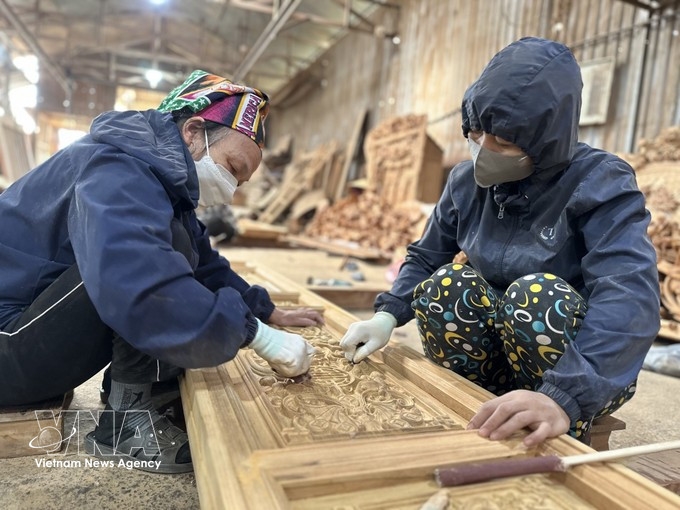
At a woodworking facility in the former Vinh Phuc province (now Phu Tho) |
The aim is to comprehensively reform and enhance the quality and effectiveness of the training, contributing to labor and economic restructuring, job creation, increased incomes, and narrowing the gap in the proportion of trained workers between rural and urban areas.
The program focuses on training high-quality human resources to serve advanced and modern agricultural production, while supporting the transition of part of the rural workforce into industry and services, in line with agricultural and rural industrialization and modernization, as well as international integration. It is also set to link rural human resource training with the development of modern, prosperous, culturally distinctive and sustainable new-style rural areas, associated with urbanization and climate change adaptation. The training offered must be substantive, in-depth, effective and sustainable.
By 2030, the program targets providing vocational training, retraining and skills upgrading for approximately 1.5 million rural workers annually. The employment rate after training is expected to exceed 85%.
To strengthen conditions for vocational training, the program will develop and upgrade training curricula, textbooks and learning materials in line with labor market demands and emerging occupations shaped by the Fourth Industrial Revolution.
It will also prioritize training courses in industrial, service and agricultural sectors, as well as rural trades aligned with regional socio-economic development needs.
Other priorities are the digitization of training programs, databases and manuals, as well as the pilot establishment of remote training stations in disadvantaged and ethnic minority areas.
Source: VNA