Opening on February 23, the five-day event has attracted about 3,000 education leaders from 70 countries and territories, serving as a major platform for dialogue and collaboration in international higher education across the Asia-Pacific.
    |
 |
|
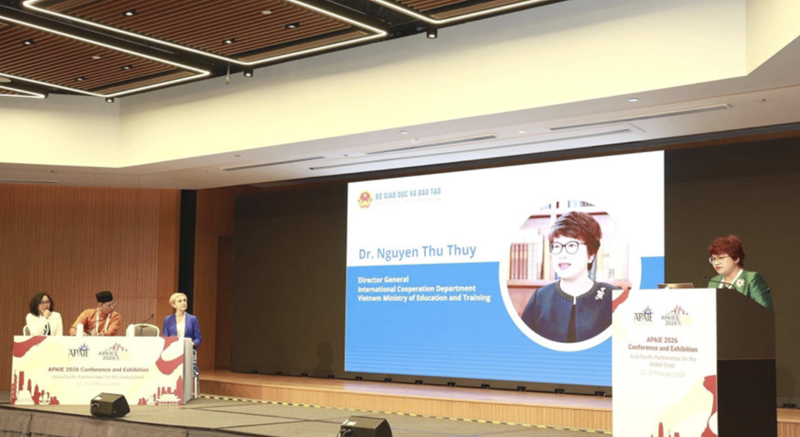
Nguyen Thu Thuy, Director of the Department of International Cooperation under the Ministry of Education and Training, delivers a speech during the discussion at APAIE. |
APAIE President Venky Shankararaman commended the Vietnamese delegation, noting that it marks the largest-ever participation by Vietnamese institutions at the forum. He said many Asia-Pacific countries, particularly in Southeast Asia, are keen to expand cooperation with Vietnamese universities.
Shankararaman revealed that he has proposed to the APAIE Secretariat the organization of capacity-building workshops on internationalization in Vietnam, similar to recent events in New Delhi, India, and earlier in Indonesia. The initiative aims to support training for university lecturers and administrators in global engagement. Having taught many Vietnamese students, he described them as intelligent, friendly and hardworking, leaving strong impressions on international peers.
Speaking at the event, Thuy said APAIE 2026 holds strategic significance as Vietnam’s higher education system has matured and is ready to expand regional and global cooperation.
She stressed that the Vietnamese delegation will prioritize strengthening connectivity, broadening partnerships and deepening traditional ties, thus creating more opportunities for students, lecturers and researchers, particularly within the Asia-Pacific.
Vietnam currently has around 2.2 million students studying domestically and some 200,000 pupils and students enrolled at major universities abroad. Participation by the MoET, along with the 17 universities, is expected to enhance the country’s image and help partners better understand the potential of Vietnamese education.
According to Thuy, APAIE 2026 offers Vietnam an opportunity to attract major global partners to explore investment and cooperation prospects. Beyond sending students overseas, Vietnam is positioning itself as an emerging regional hub for international education and training, she said.
Vietnam is implementing more than 500 joint training programs at various levels with reputable foreign institutions. The MoET is prioritizing the expansion of such programs in high-tech and core technology fields aligned with national development priorities, including artificial intelligence, semiconductor technology, green energy, biotechnology and high-speed rail.
The ministry is also facilitating credit transfer, mutual recognition of qualifications and greater cross-border labor mobility to align with international standards, she added.
Highlighting the geographical proximity and cultural similarities between Vietnam and Hong Kong, Thuy said these factors provide favorable conditions for expanding student exchanges, joint research and vocational training. Vietnam hopes to attract more lecturers, scientists and experts from global universities, including those in Hong Kong, she added.
|
|
 |
|
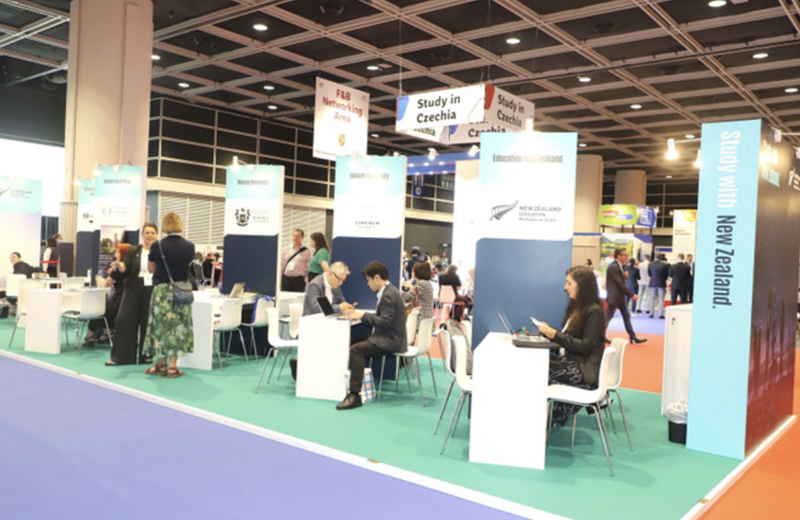
New Zealand's exhibition area at the event |
On the sidelines of the event, Thuy met with Hong Kong’s Secretary for Education Choi Yuk-lin to discuss measures to promote bilateral cooperation in higher education. Her presentation on Vietnam’s international education policies drew significant attention from participants.
Representatives of Vietnamese universities expressed high expectations for the forum in an interview with the Vietnam News Agency. Rector of Van Lang University Tran Thi My Dieu said APAIE gathers prestigious institutions and research partners worldwide, offering opportunities to advance internationalization strategies through substantive joint projects.
Pham Tran Vu, Vice President of the Ho Chi Minh City University of Technology under Vietnam National University-HCM City, said the university aims to further expand its global network and attract more foreign students to Vietnam through full-degree programs, semester exchanges and short-term cultural and language initiatives.
Source: VNA