The delegation, led by Eric Mathet, Operational Lead, the IAEA’s Nuclear Infrastructure Development Section, evaluated the current status of Vietnam’s national nuclear infrastructure according to the assessment criteria outlined by the IAEA for Stage 2 – assessing the readiness of a country to invite bids or negotiate contracts for the construction of its first nuclear power plant. Based on this, they identified areas requiring further action and provided recommendations for the Vietnamese Government and relevant agencies to develop an action plan to address limitations and gaps in the coming time.
    |
 |
|
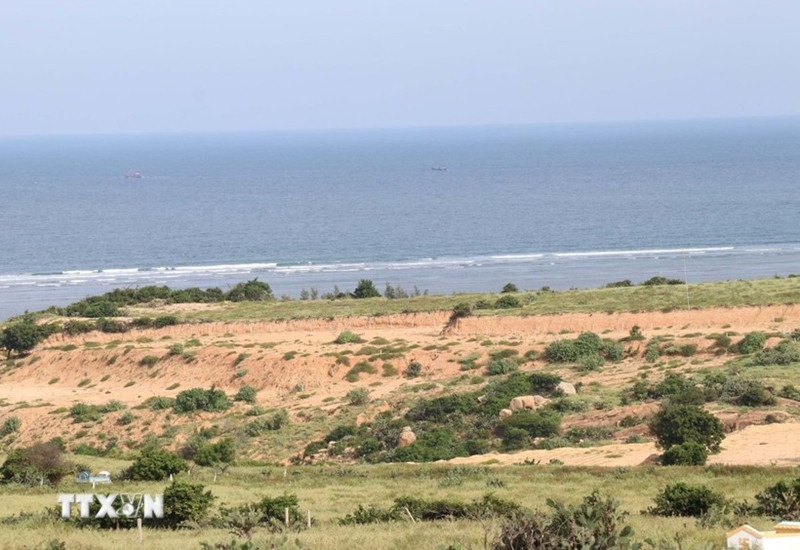
The chosen location for the construction of the Ninh Thuan 1 Nuclear Power Plant is Phuoc Dinh commune. |
Over nearly two weeks in Vietnam, experts held direct discussions with representatives from the Ministry of Science and Technology, Ministry of Industry and Trade, Ministry of Foreign Affairs, Ministry of Agriculture and Environment, Ministry of Education and Training, Ministry of Finance, Ministry of Public Security, Vietnam Electricity (EVN), Vietnam National Industry - Energy Group (Petrovietnam), and the People's Committee of Khanh Hoa province to review, assess, and conduct an objective and comprehensive evaluation of all 19 aspects of the nuclear power infrastructure.
At the closing session of the INIR mission’s working visit, they concluded that Vietnam has made significant progress in restarting and accelerating the implementation of the Ninh Thuan Nuclear Power Plant Project, as well as in developing the necessary infrastructure. Many solutions and decisions have been approved at all levels, including by the National Assembly, the Prime Minister, relevant ministries, and agencies. In 2025, Vietnam enacted the revised Law on Atomic Energy and adopted specific mechanisms to facilitate the implementation of the nuclear power project.
The draft preliminary report provided 38 recommendations and 13 proposals, emphasizing areas where further action is needed to benefit Vietnam. These include strengthening the legal and regulatory framework for the nuclear power program, implementing plans to enhance human resources capacity, completing preparations for the bidding and construction stages, reinforcing the national strategy on the nuclear fuel cycle and radioactive waste management, and updating the coordination mechanisms among all stakeholders involved.
The experts also recognized two good practices from Vietnam that could serve as valuable lessons for countries developing nuclear power.
First, the adoption of Resolution 189/2025/QH15 by the National Assembly demonstrates a strong political commitment to the nuclear power program. It also establishes specific mechanisms to simplify investment procedures, expedite land clearance, expand the ability to mobilize capital and select contractors, and enhance coordination among ministries, agencies, and local authorities. The IAEA considers this practice a key factor in ensuring the timely progress and sustainability of the program.
Second, Vietnam has effectively made the most of existing environmental monitoring experience and networks to support the preparation of the nuclear power project. This practice is recommended by the IAEA as it helps improve the quality of environmental assessments, increases transparency, and reduces the time required to prepare the project.
These two practices show that Vietnam is approaching its nuclear power program in a systematic way, aligned with international standards, and demonstrating a commitment to responsible and effective implementation.
It is expected that in the first quarter of 2026, IAEA and Vietnam will collaborate to finalize the INIR report draft, and in Q2 of 2026, IAEA will send the official report to the Vietnamese government after completing the necessary procedures.
Source: VNA